
About the Archive
This archive is devoted to preserving the history, details, and legacy of the Phantasm film Cudas.
A silent record of machines that slipped between myth and metal, leaving their mark on the Phantasm world.
What remains here are the traces, truths, and shadows they left behind.
For more than 30 years, this archive has preserved the history, craftsmanship, and cultural legacy of the Phantasm film Cudas. What began as a small collection of production notes and behind-the-scenes photographs has grown into the most comprehensive record of these iconic machines ever assembled.
This archive documents every known screen-used Cuda, including their construction details, filming modifications, restoration efforts, and verified provenance. It also catalogs rare production materials, interviews, technical breakdowns, and fan-submitted discoveries that help piece together the evolving story of the cars throughout the franchise.
Beyond simple documentation, the archive exists to protect the mythos surrounding the Phantasm Cudas — ensuring future fans, researchers, and collectors have a reliable, authoritative source of truth. Every entry is curated with accuracy, respect for the films, and a commitment to preserving the legacy of Don Coscarelli's world for generations to come.
To preserve the story of the Phantasm Cudas for future fans, researchers, and film-car historians.
This is not a franchise site.
It is a long-term enthusiast project curated by Don Almeido, whose work has been referenced in magazines, documentaries, and online publications. The archive exists to honor the craftsmanship, creativity, and cinematic legacy behind one of horror's most recognizable muscle cars.
PhantasmCudas.com is an independent, fan-curated archival project and is not affiliated with Don Coscarelli, Phantasm.com, or the official Phantasm franchise. This site is non-commercial and exists solely for historical documentation and enthusiast research.
All film references, titles, and imagery belong to their respective copyright holders. This archive is presented for educational and historical purposes only.
The Story Behind the Archive
The story of PhantasmCudas.com began long before the website, the research, or the restored car sitting in my garage today. It started in the summer of 1979, when I was thirteen years old and saw Phantasm for the first time. The moment that black '71 Cuda rolled across the screen, something clicked. That car wasn't just a movie prop — it was a spark. A calling. A mystery wrapped in sheet metal and horror-film atmosphere.
From that day forward, I was hooked.
The Cuda became my grail. I spent years digging through magazines, tracking down rumors, talking to Mopar insiders, and chasing every lead about the original film car. I wrote articles, documented sightings, interviewed people who were there, and pieced together the fragmented history of a vehicle that had already slipped into legend. The deeper I went, the more I realized that the hunt wasn't just about finding a car — it was about preserving a piece of cinematic and automotive history that had never been properly archived.
That obsession eventually led me to the car I own today — a tribute born from decades of passion, research, and respect for the original. It's not the film car, but it carries the spirit of the one that inspired me at thirteen. And that spirit is what this site is built to protect.
PhantasmCudas.com exists to preserve the legacy of the Phantasm Cudas, to document the history that was never officially recorded, and to share the story that began with a kid in a movie theater who fell in love with a black '71 Cuda roaring through a world of nightmares.
This archive is the result of that lifelong journey.
Whether you're a Mopar fan, a Phantasm fan, or a film-car historian, this archive is here to share the history, celebrate the details, and keep the legend alive.

A Cinematic Documentary Feature
The Curator's Cuda
1971 Plymouth 'Cuda · TX9 Triple Black · 426 Hemi
"Every car has a story. Some are forgotten. Some are found. And some — against every odd — become something more than metal and time."
Prologue

Born in the Muscle Era
Thursday, April 8, 1971 · Hamtramck, Michigan
The assembly line at Hamtramck never slept. On a Thursday morning in early April, 1971, a 'Cuda rolled off the line wearing Formal Black from roof to rocker — body code TX9, the darkest shade Plymouth offered that year. No chrome roof paint. No contrasting stripe. Just black on black on black.
It was a V-code car — the 440 Six Barrel, three two-barrel carburetors breathing through a Sport Hood with hood pins. Torqueflite automatic. Super Track Pak. Woodgrain console. Vinyl buckets in black. The order sheet read like a checklist for something built to intimidate.
"From double to triple. The original motor was lost — the Hemi was the next best thing."
— Don Almeido, Curator
Factory Build Record
Scene — The Fender Tag
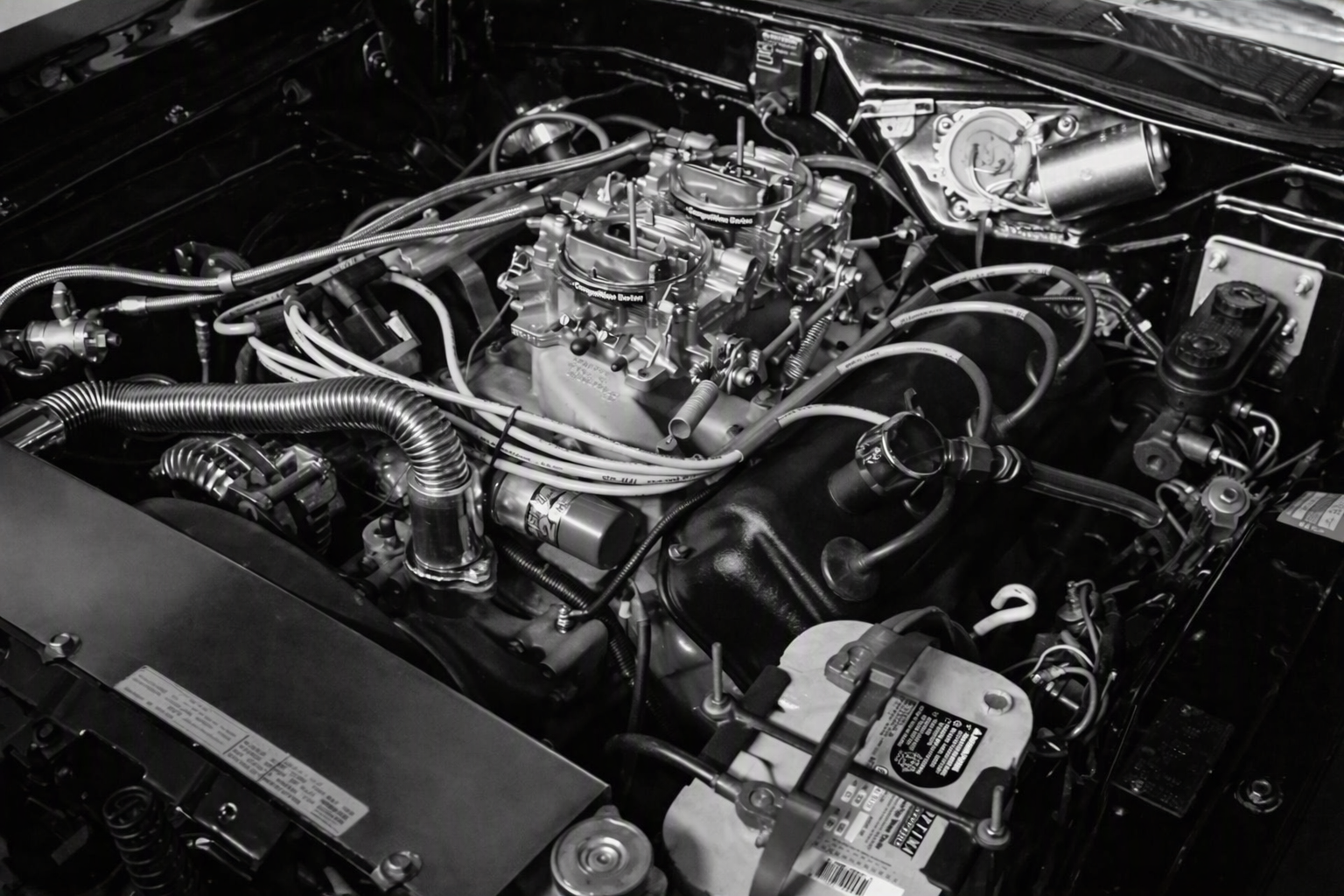
The engine bay — where the 426 Hemi now lives. The original 440 Six Barrel is gone, but the story it left behind is stamped in metal.
Somewhere on this car, stamped into a small metal plate riveted to the firewall, is the complete birth record. Every option. Every code. Every decision made on the factory floor before this machine ever touched asphalt.
Galen Govier decoded it. The report confirmed what the Curator had suspected — this was a genuine V-code TX9 double black car. Not a clone. Not a tribute. The real thing, wearing its original identity beneath decades of road and time.
The original motor was gone by the time it arrived. But a 426 Hemi — the engine Plymouth should have put in every 'Cuda — found its way home under that Shaker Hood. Double black became triple black. The transformation was complete.
"It left Hamtramck as a double black 440. It would become something else entirely — a triple black Hemi 'Cuda with a story no factory order sheet could have predicted."
Act I
The Lost Years
"Every great car has an origin. This one began at the oldest Chrysler dealership in America — and it was built for one thing only."
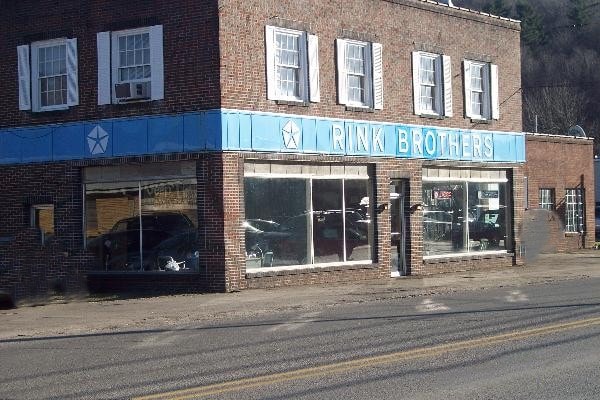
Rink Brothers Chrysler — Honored as the Oldest Original Chrysler Dealer in the U.S.A. — Pennsylvania
Pennsylvania — 1971
The original owner walked into Rink Brothers Chrysler with a singular purpose. He wasn't buying a show car. He wasn't buying a cruiser. He was buying a weapon for the drag strip — and he ordered it accordingly.
The TX9 double black 'Cuda left the factory with every option that mattered for going fast and nothing that didn't. Super Track Pack. A34 performance axle. TorqueFlite A727 automatic — the transmission drag racers trusted for its brutal, consistent shifts off the line.
He went further. The rear of the car was tubbed — the wheel wells cut and reshaped to accommodate wider rubber. A roll cage went in. This wasn't a street machine that occasionally saw the track. This was a purpose-built quarter-mile car that occasionally saw the street.
"The town remembers the Black Beast rolling down those streets. Black, loud, and built for one thing."
Race Build — As Ordered
Scene — The Silence After 1977
Nineteen thousand miles. That number tells the whole story. A car built for the quarter mile lives its life in increments of 1,320 feet. This one ran those increments for years — and then, sometime after 1977, it went quiet.
No documented photos have ever resurfaced from this era. No title transfers on record. No classified ads. No car show entries. The Black Beast simply vanished from the historical record — the way cars do when their owners stop talking about them.
But the town remembers. The people who were there remember a black 'Cuda rolling through those Pennsylvania streets — black, loud, and built for one thing. That memory is the only evidence that survived the silence.
Verona, Missouri — 1977 to 1997
"Somewhere in the Ozarks, on 160 acres of Missouri farmland, the greatest Mopar collection in America was quietly growing. The Black Beast was about to find its sanctuary."
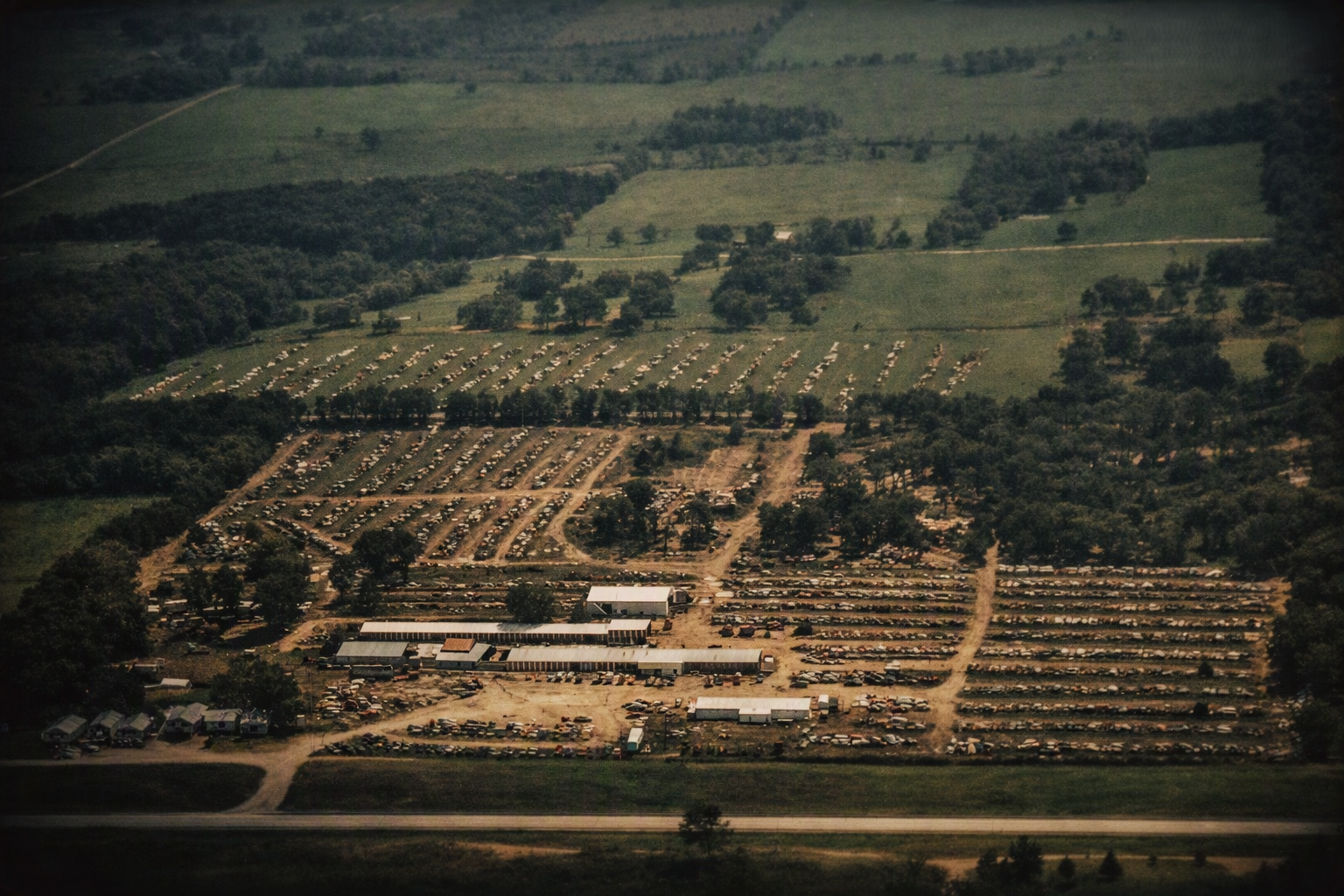
R&R Salvage — Verona, Missouri. 160 acres. The largest Mopar yard in the country. Ron & Kathy Slobe, proprietors.
Ron Slobe started collecting Mopars at age 16. By the time the Black Beast arrived from Pennsylvania, he had built something extraordinary — 160 acres of Mopar iron in the rolling hills of southwest Missouri, the largest yard of its kind in the country.
Ron had people all over the country hunting Mopars for him through the '70s and '80s. When a black TX9 'Cuda with a roll cage and a drag racing history came available, it was exactly the kind of car he was looking for. He had a particular love for black Mopars — and this one was as black as they came.
The 'Cuda was placed in the exclusive covered barn — the private section of the yard where Ron kept the crown jewels. Hemis. 440 Six Packs. The cars he wasn't selling. His goal before he passed was to have a fully restored 440-6 and Hemi Mopar of every make and model Chrysler ever produced. The Black Beast had earned its place among them.
"Standing amidst 120 acres of Mopars gives you that kid in a candy store feeling."
— Musclecar Review, September 1993
R&R Salvage — The Record
Scene — The Covered Barn
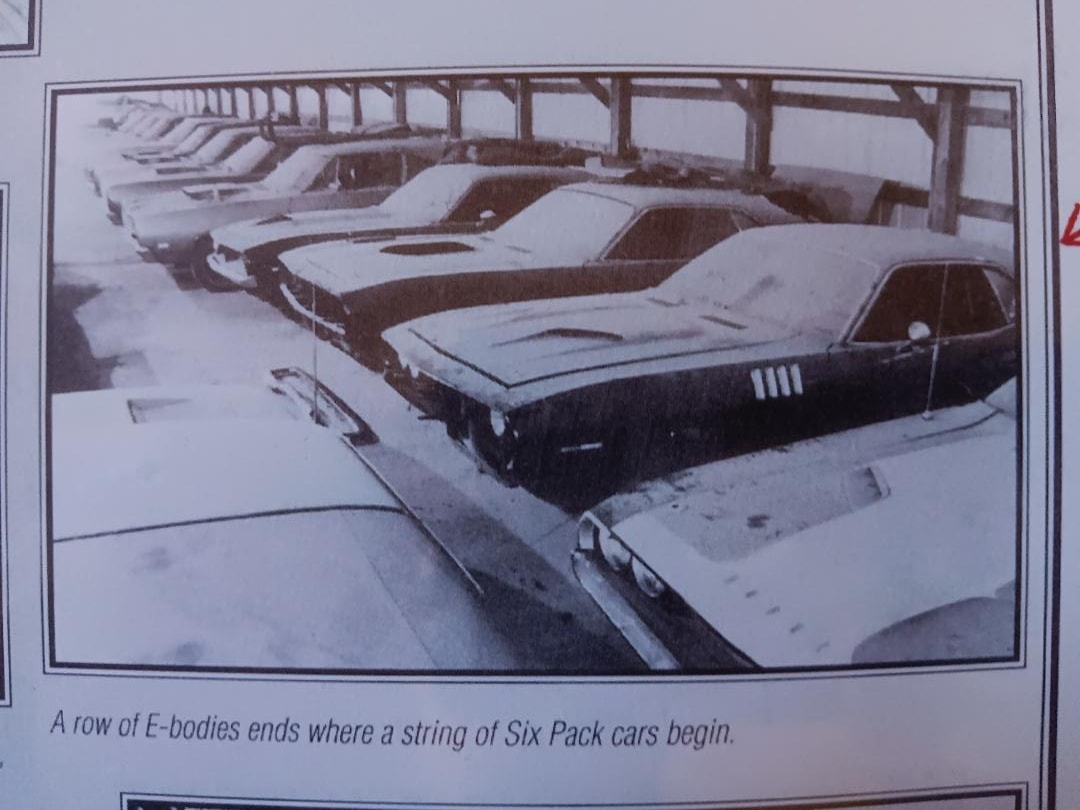
The Black Beast in the covered barn — row of E-bodies, roll cage still in place. Look closely.
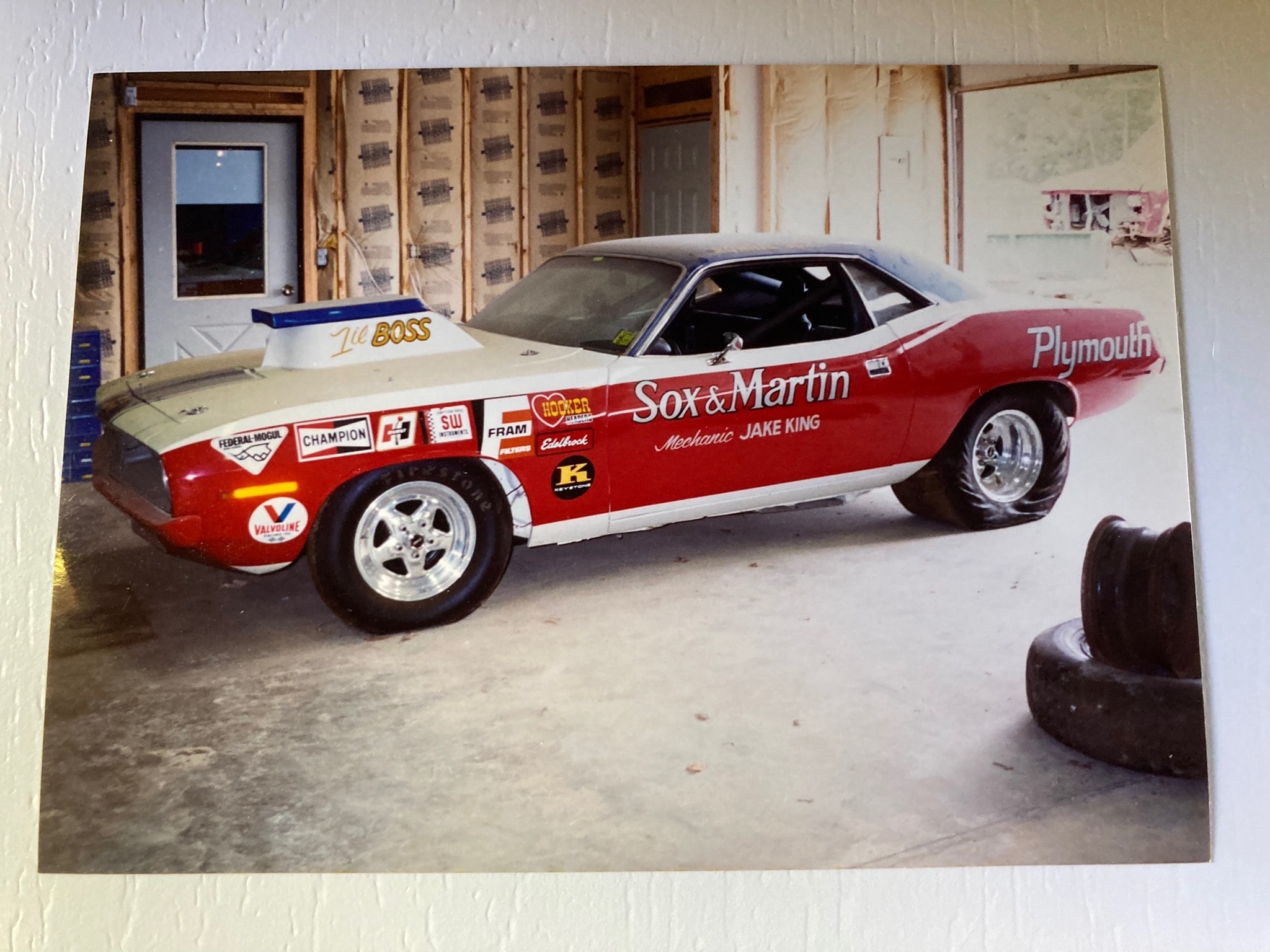
Ron's restored Sox & Martin 'Cuda — "Lil Boss" — one of the legendary drag racing Cudas in his private collection.
The covered barn was not open to the public. It was Ron's private museum — the cars he had pulled from the field and kept for himself. A row of E-bodies. Six Pack cars lined up end to end. And somewhere in that row, a black TX9 'Cuda with a roll cage and 19,000 original miles, sitting in the dark, waiting.
It sat there for twenty years. From 1977 to 1997. The drag racing era was over. The Pennsylvania streets were a memory. But the car was preserved — better than it would have been anywhere else. Ron Slobe didn't let Mopars die. He saved them.
From the Archive — Performance Magazine, May/June 1993
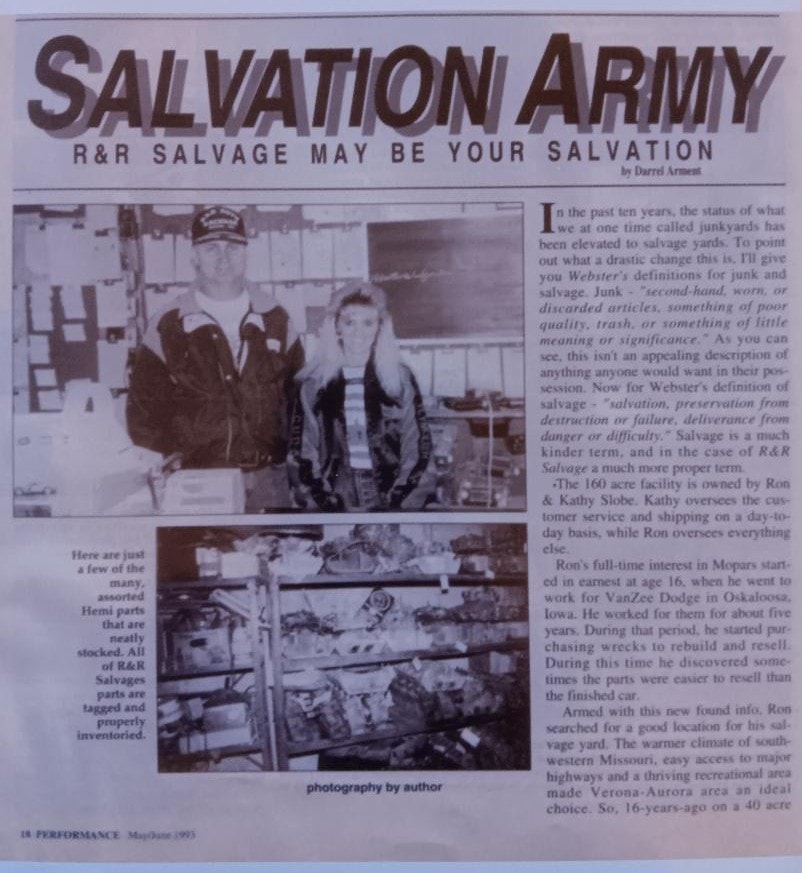
"Salvation Army — R&R Salvage May Be Your Salvation."
The Mopar world knew about R&R Salvage. Magazine features. Word of mouth. Collectors making pilgrimages to Verona from across the country. Ron's operation was legendary — not just for the parts, but for the complete cars he had quietly accumulated over two decades.
The Black Beast was in there. Invisible to the outside world. Documented nowhere. But safe — in the hands of a man who understood exactly what it was.
Scene — The Hunter
Dan Powell was not a casual collector. He was a World of Wheels Mopar restoration expert out of Oklahoma — the kind of man who hunted specific cars, who knew what to look for and where to look. When he found the Black Beast in Ron Slobe's covered barn, he knew what he had.
In 1997, after twenty years of silence in Verona, Missouri, the 'Cuda changed hands again. Dan Powell purchased it for restoration. The Lost Years were over. What came next would transform the Black Beast into something its original owner never imagined — and set it on a path toward the Nevada desert.
Collinsville, Oklahoma — The Restoration
Dan Powell
"Vietnam veteran. Purple Heart recipient. Award-winning 'Cuda builder. The man who flew through war, defied his doctors — and brought the Black Beast back to life."
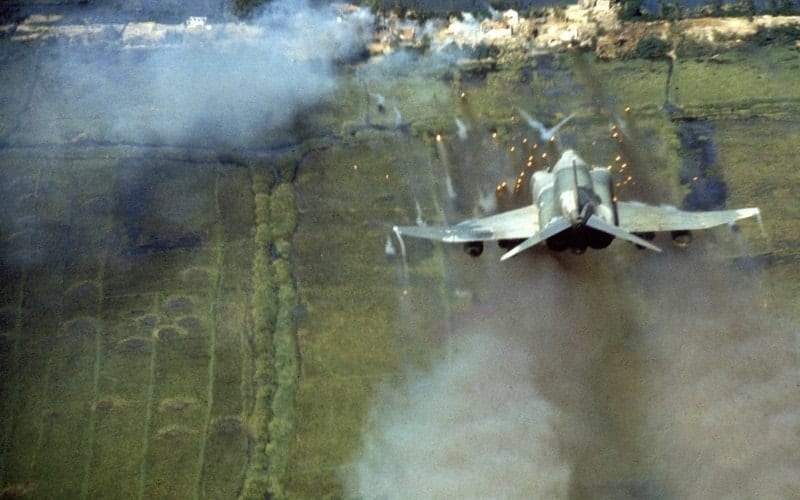
"The skies over Vietnam, 1968. Dan Powell flew through them — and came home."
In His Own Words
"While I was into cars as a teenager, my interest in them didn't take off until I was in my early 20s. See, I left for Vietnam in 1968 and after one year was sent home with shrapnel in my legs and in my back, and my right arm and right leg were almost completely torn off. The military awarded me a Purple Heart and an Army Commendation Medal for my service. That year I spent my 21st birthday in the hospital. While I wasn't doing well, I was alive."
"My doctors told me I likely would lose my right leg by the time I turned 30. Well, here I am in my 50s, and I still have both legs. I was determined to beat their predictions. To help me accomplish that goal, I decided I needed to get back into building and enjoying cars."
"To date, I have built over 15 'Cudas. The first was a '70 'Cuda racecar, a 340/automatic car, capable of running in the 9s, which at the time was unheard of. I was especially proud of it because I built the whole car in my garage, something I have gone on to do numerous times since then."
"He flew through Vietnam, survived wounds that should have taken his leg — and came home and built over 15 award-winning 'Cudas. Death couldn't stop Dan Powell. Neither could a 5.0 Mustang."
Dan Powell — The Record
Scene — The Third Black 'Cuda
"The black 'Cuda I have now is the third black 'Cuda I have built. The first was an original '71 with a 340 and a 4-speed. The next was an original double-black '71 440 Six-Pak car, which up until that point had spent its whole life as a drag car. As a result, the 'Cuda only had 19,000 original miles on it."
That drag car with 19,000 original miles — that was the Black Beast. The same car that left Rink Brothers Chrysler in Pennsylvania in 1971. The same car that sat in Ron Slobe's covered barn in Verona, Missouri for twenty years. Dan Powell knew exactly what he had found.
He took it back to his shop in Collinsville and went to work. The same hands that had flown aircraft through Vietnam, that had defied every medical prediction, now stripped the Black Beast down to bare metal and rebuilt it into something extraordinary. He ran it on aviation fuel — the same high-octane blend he'd trusted in the air — and built it specifically to hunt down 5.0 Mustangs on the street. It worked.
The Powell Restoration — Collinsville, Oklahoma
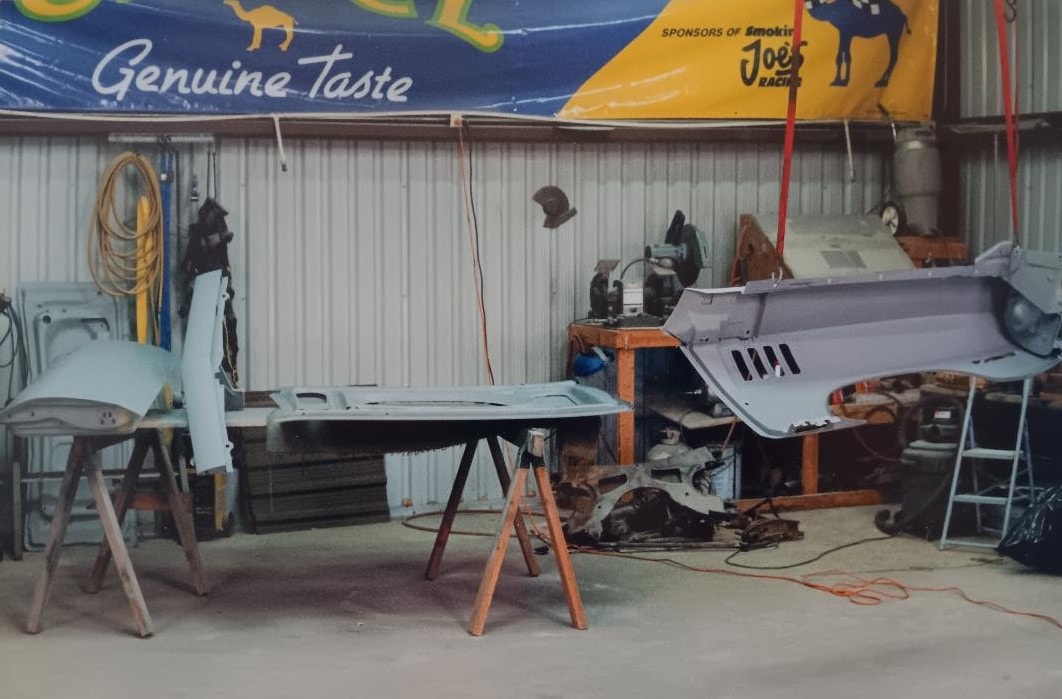
Body panels and fenders — stripped, media-blasted, and prepped. Every panel pulled and done right.
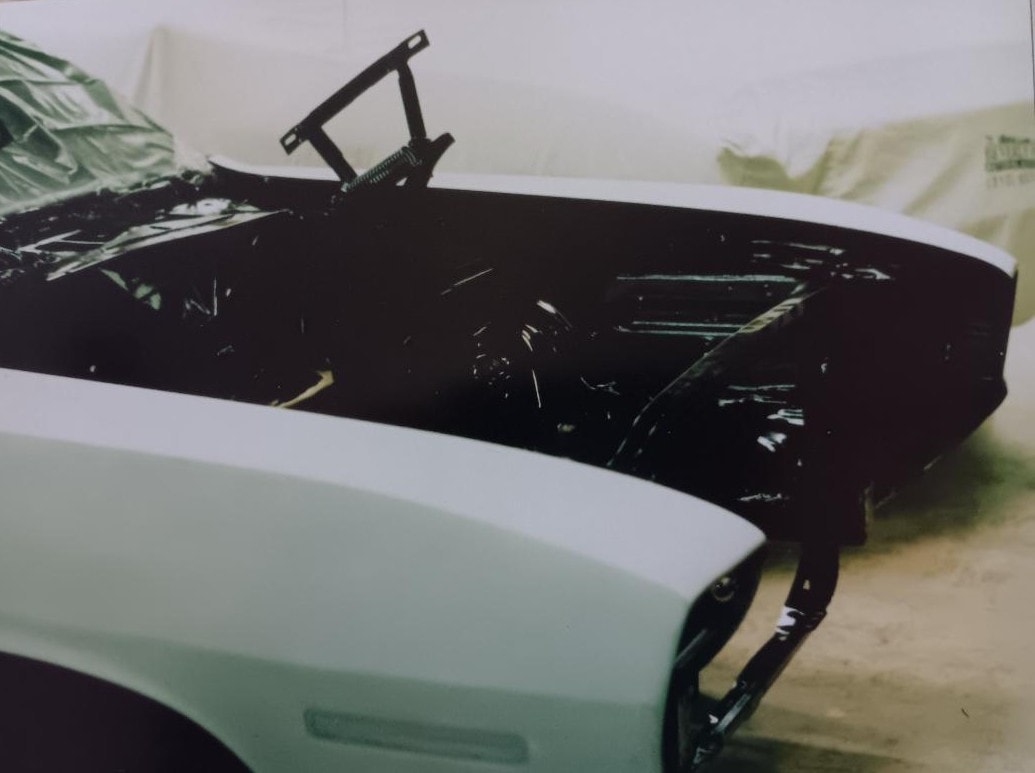
Engine bay and shaker hood — masked and ready for TX9 black. The color that started it all.
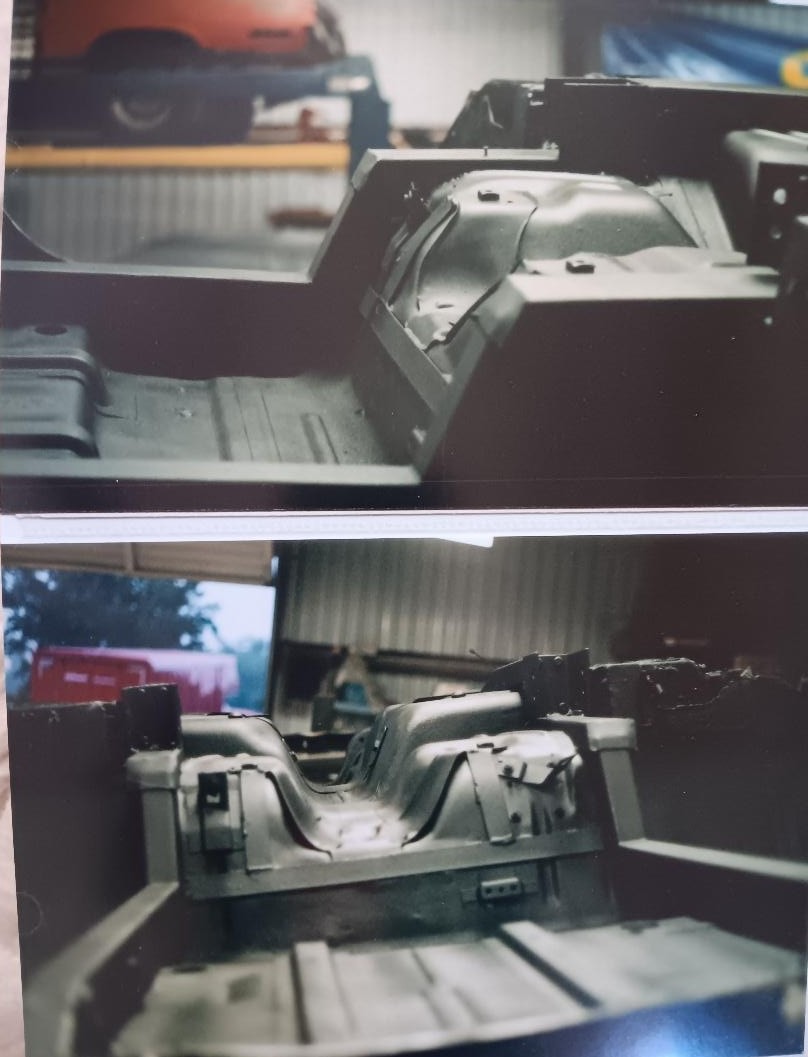
Floor pan — Por-15 sealed, frame rails welded. Built from the ground up, the way Powell always did it.
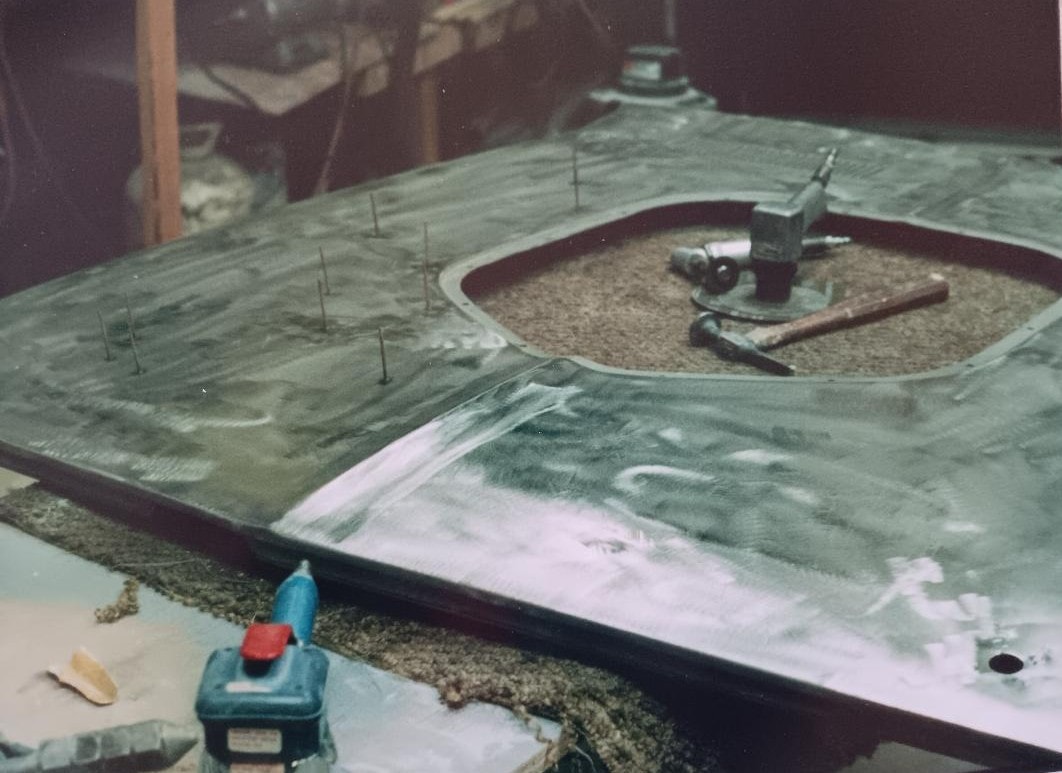
Shaker hood work — fitting the iconic scoop assembly. The detail that makes a 'Cuda a 'Cuda.
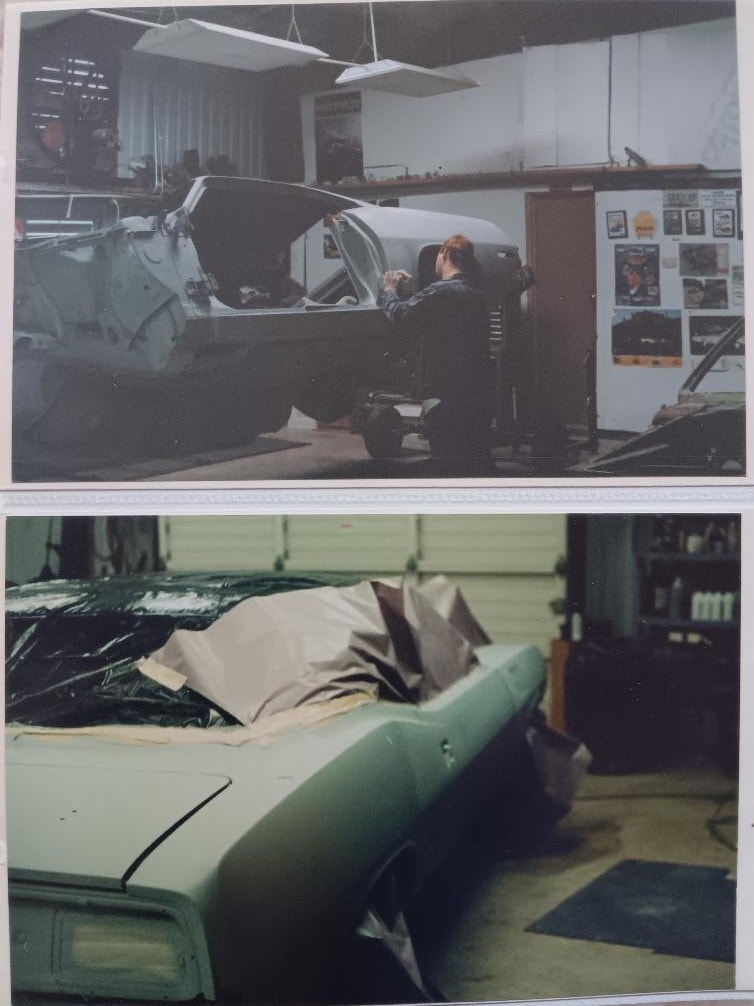
Rotisserie prep for paint — body stripped to bare metal, every panel accessible. Powell did it right, from every angle.
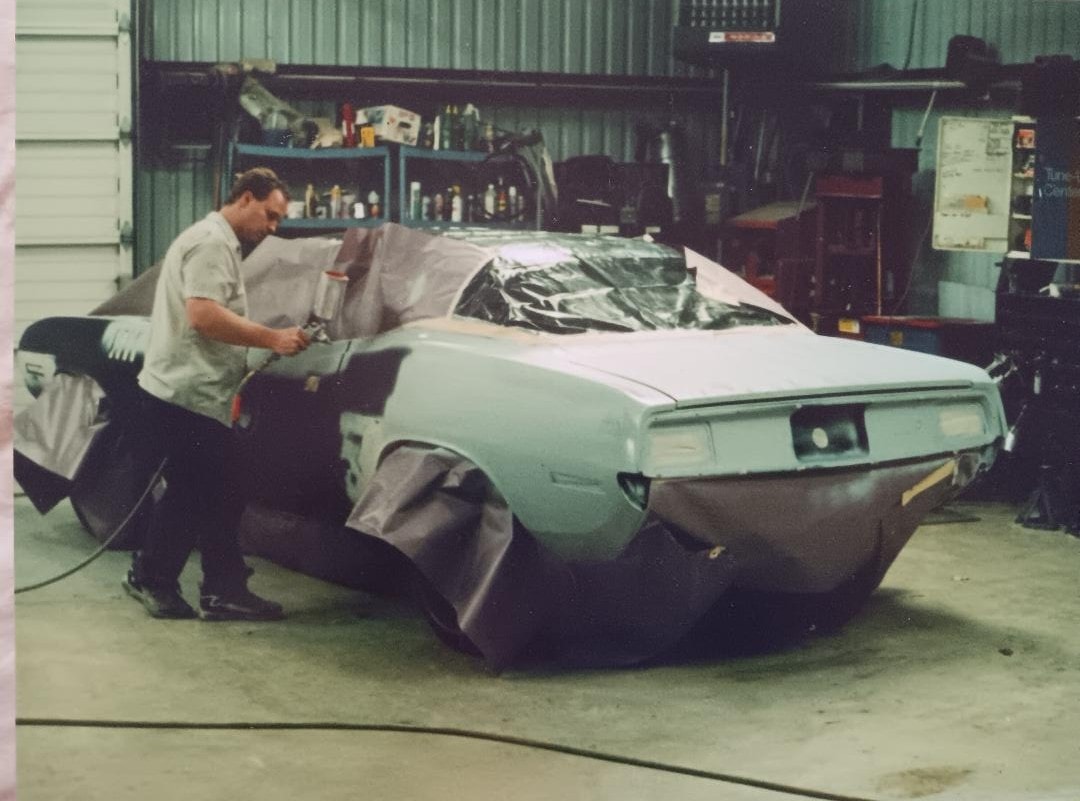
Dan Powell painting the 'Cuda — old school, no mask. Spray gun in hand, working the rear quarter panel himself. This is how a Vietnam veteran builds a car.
The Heart of the Beast
426 Super Stock Hemi
"Built from a 1966 Hemi block. Every spec documented. Every tolerance measured. Dan Powell didn't guess — he built it right."
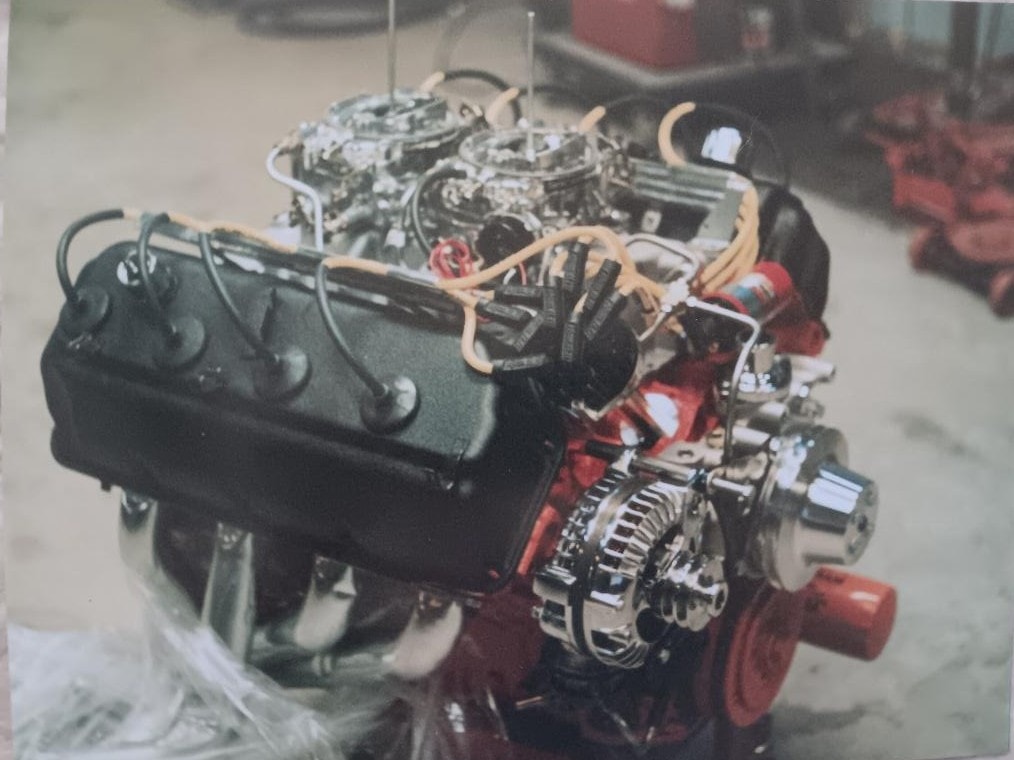
The 426 Super Stock Hemi on the stand — dual quads, black wrinkle rocker covers, chrome dress. Every spec documented. Dan Powell built it right.
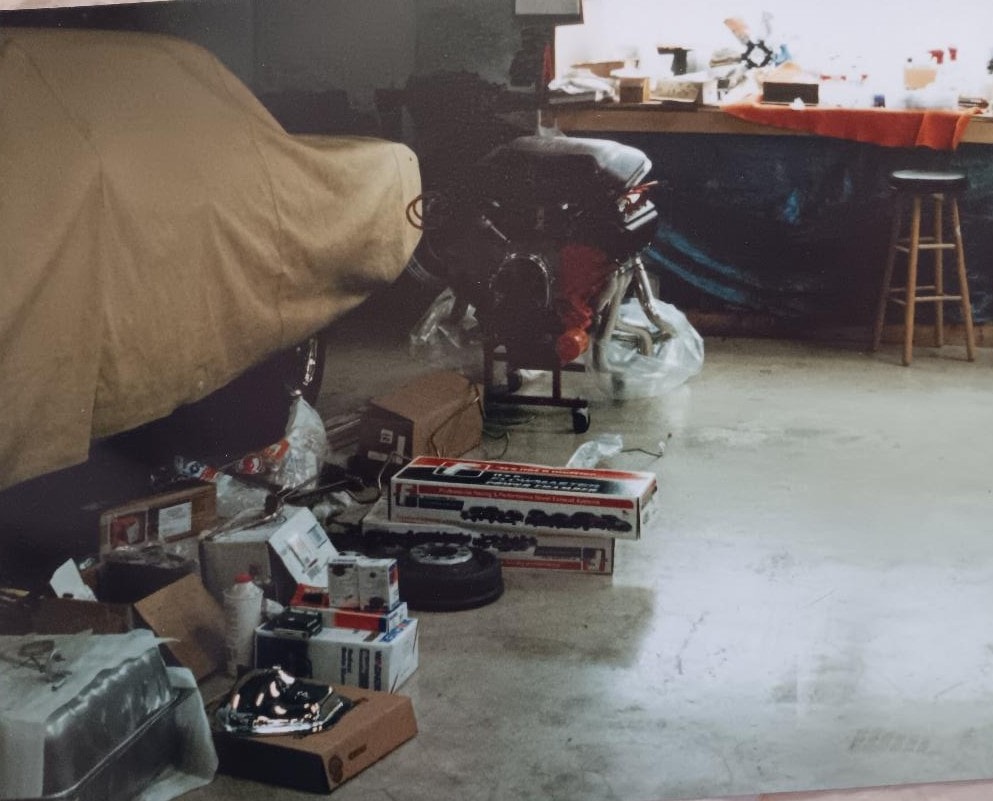
Powell's shop — the 426 Hemi on the stand, parts boxes across the floor. The covered 'Cuda waits in the background. The build is underway.
Official Engine Build Sheet — Dan Powell, Collinsville Oklahoma
426 Super Stock Hemi — Complete Build Specifications
Block & Rotating Assembly
Camshaft & Valvetrain
Induction, Ignition & Final Assembly
Balancing Weights
Builder's Note — Dan Powell
"Never let engine rev excessively when cold. You must allow time for pistons to expand. Cold starts should consist of 1 or 2 full pumps and feather gas around 1500 RPM until warm. You can't change your oil enough on these engines — very radical valvetrain geometry causes high wear. Should pull like gangbusters to 6500. BREAK ENGINE IN ON LEADED HIGH OCTANE FUEL. Put a couple tank fills through engine to properly seat valves."
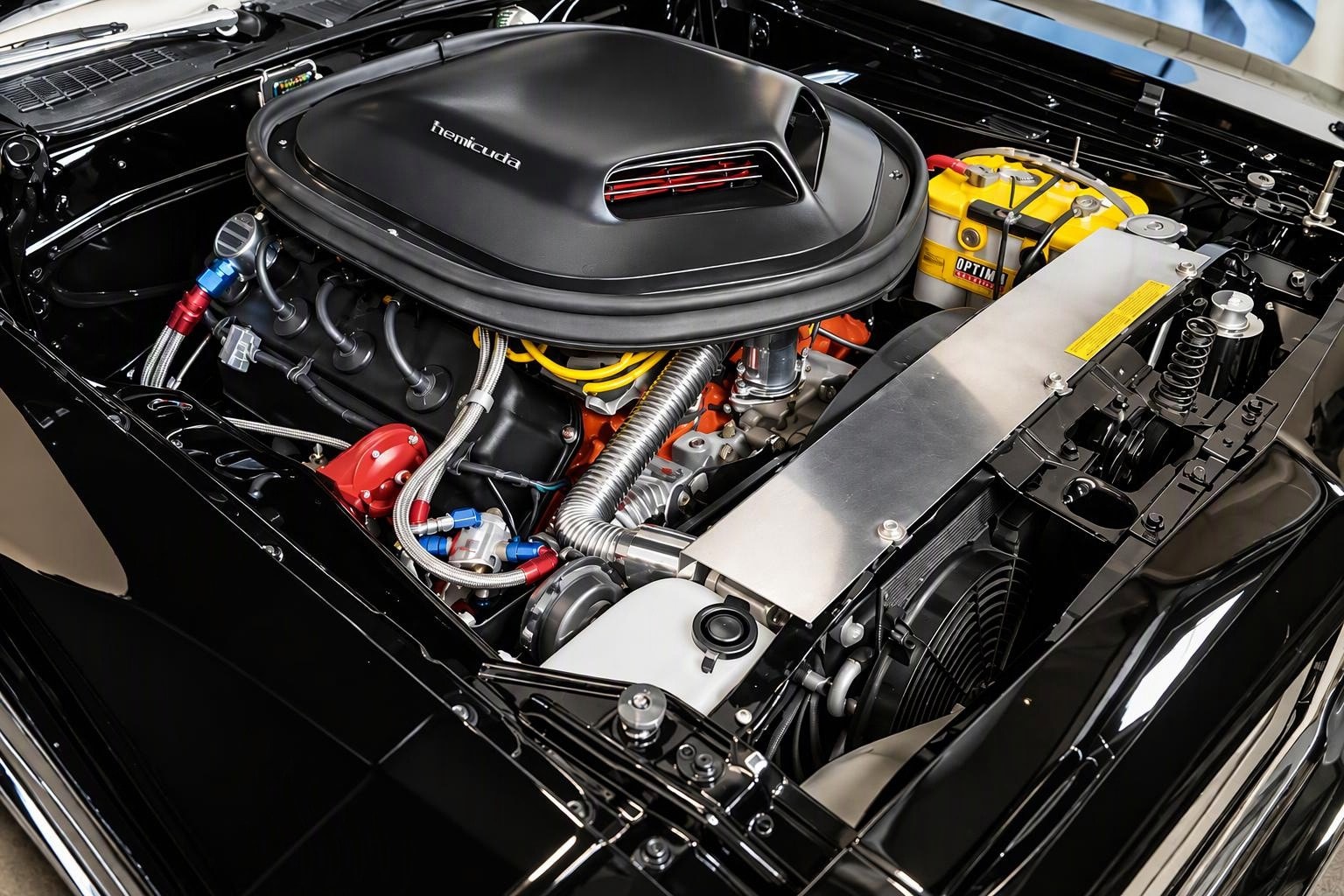
The finished 426 Super Stock Hemi — dual 4-barrel carbs, black wrinkle rocker covers, chrome accessories gleaming. Built by Dan Powell. Ready for the Black Beast.
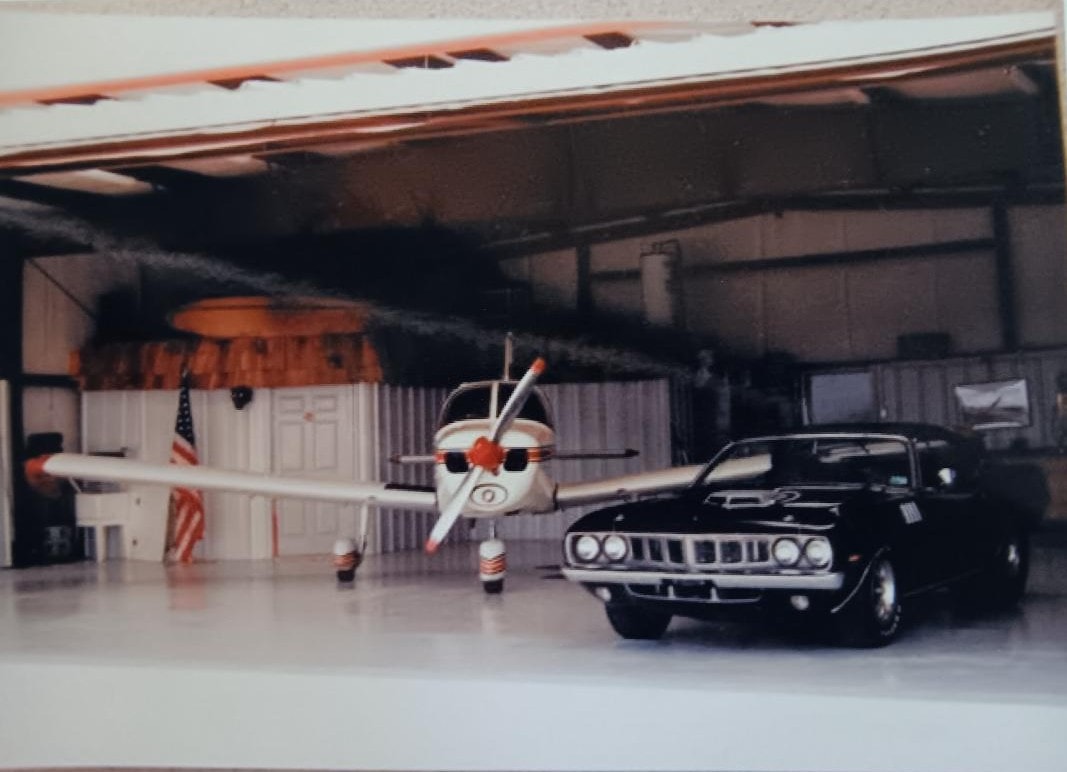
Dan loved to fly planes and build and restore Plymouth 'Cudas. By air or land, he made sure his travel was exciting.
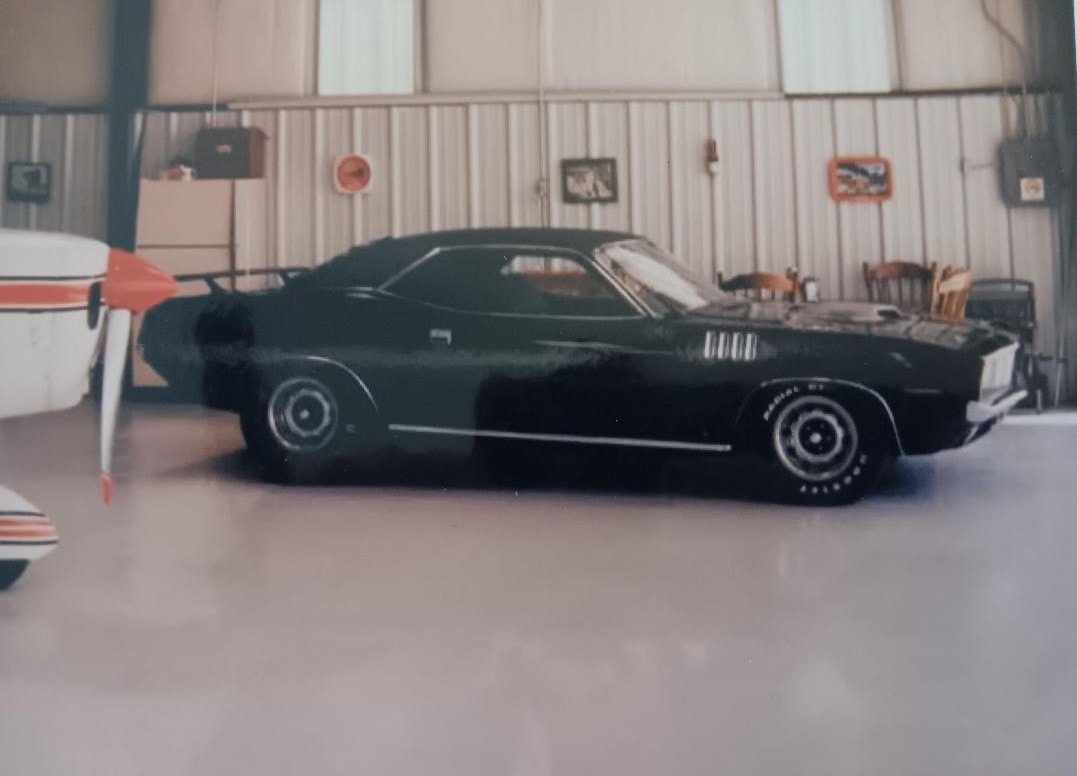
The 'Cuda at rest in the hangar — wings to the left, muscle to the right. Two machines. One man who mastered both.
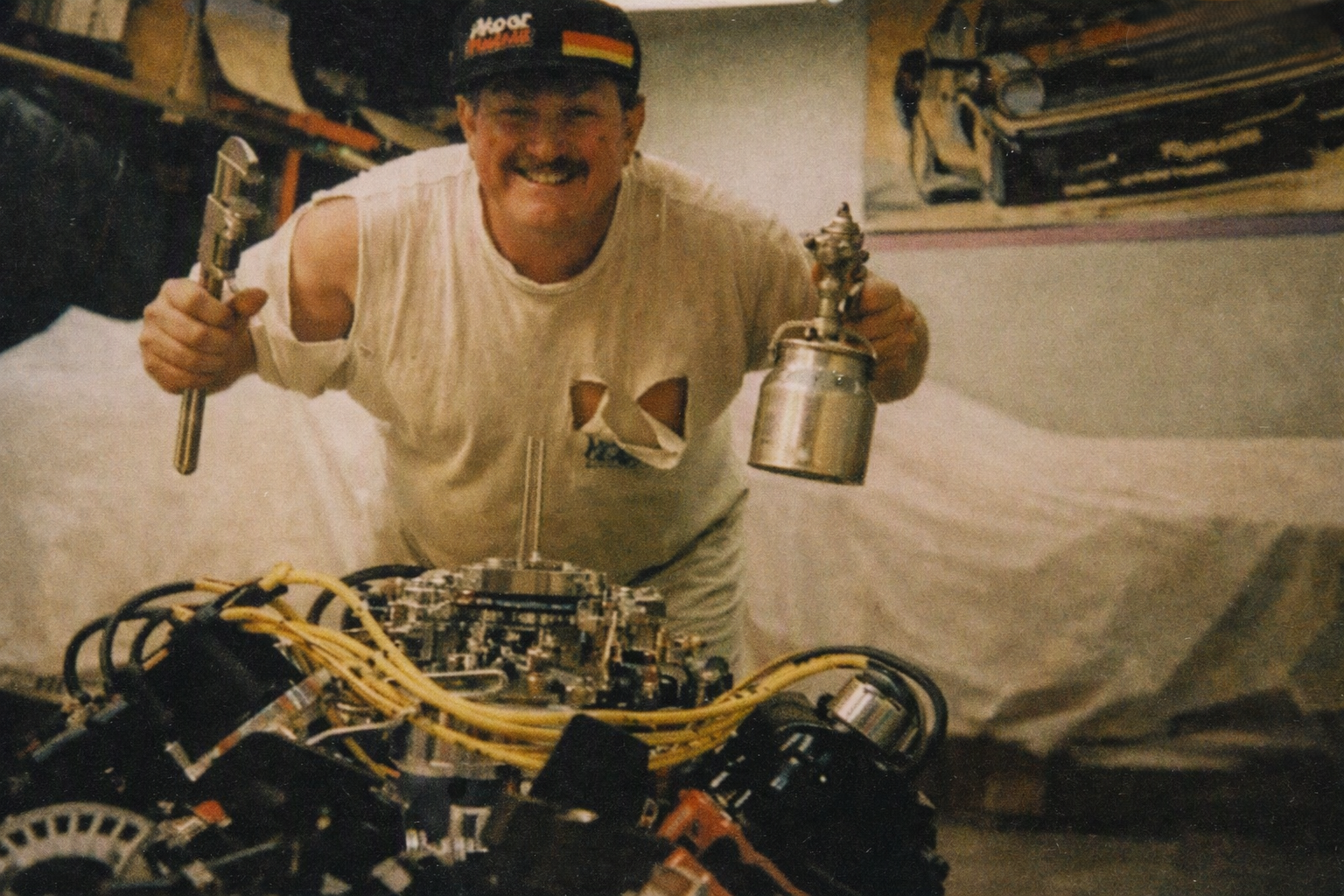
Dan Powell in his Oklahoma shop — wrench in one hand, spray gun in the other. The Hemi is ready. The man is ready.
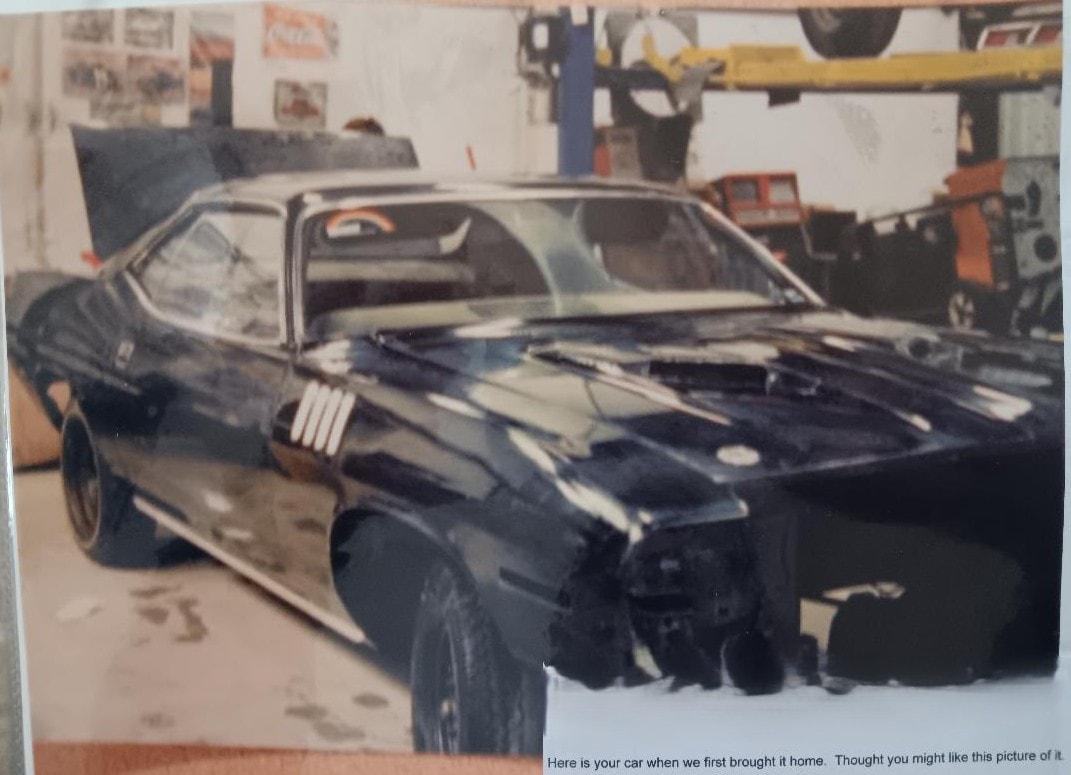
Day one — the Black Beast arrives at Powell's garage. "Here is your car when we first brought it home."
"Dan Powell has since passed. But the cars he built — the 15 'Cudas that came out of that Oklahoma barn — they're still out there. And the one he rescued from Verona, Missouri found its way back to northwestern Missouri, and eventually to the Curator's collection. Dan Powell's hands are in this car's story whether his name appears in the credits or not."
In Memory — Dan Powell, Collinsville, Oklahoma
"It was built to go fast. It went fast. And then it disappeared into the greatest Mopar collection in America — preserved by a man who understood its worth, waiting for the man who would bring it back."
Act II Follows Below
"Some cars you find. Some cars find you. And some cars — the ones that matter most — slip through your hands just once, just barely, and spend the next twenty years reminding you they were real."
Collinsville, Oklahoma — Early 2000
First Contact
I first made contact with Dan Powell in early 2000. Word had traveled through the Mopar community about a black 1971 440-6 Cuda sitting in a hangar in Collinsville, Oklahoma — a car with a history, a car with a Hemi dropped in where the original engine had been, a car that had won at World of Wheels and then gone quiet.
Dan told me he was not ready to sell. But he said something that stuck with me: if he ever decided to let it go, he would reach out to me first.
I believed him. I went back to work — finishing a mild restoration on a 1974 Pro Street Cuda at Restorations by Julius in Chatsworth, California. I waited.
The Car — As Advertised
2001 — Las Vegas, Nevada
The Letter
In 2001, Dan kept his word. An envelope arrived at my office at American Media Corp., 8375 West Flamingo Road, Las Vegas — handwritten in blue ink, three 33-cent stamps, and a note on the outside that read: "pictures do not bend."
Inside was a handwritten letter on yellow legal paper. Dan described the Black Beast in detail — the 1966 Super Stock 426 Hemi, the Super Track Pak, the 20,000 original miles, the 34-foot enclosed gooseneck race trailer. Asking $60,000 or best offer. He offered to make a video. He said the pictures do not do it justice. He said come see it in person.
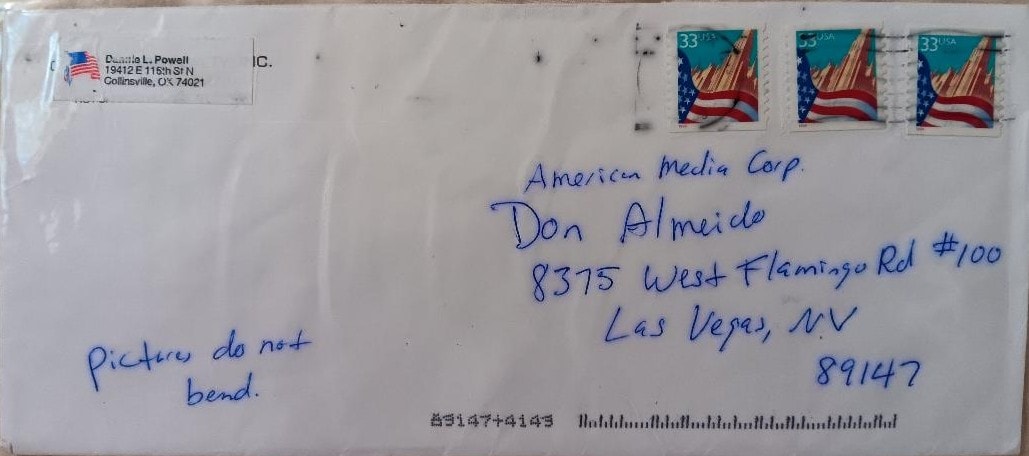
The envelope — Dan Powell, 19412 E. 116th St N, Collinsville OK. Addressed to Don Almeido, Las Vegas. "Pictures do not bend."
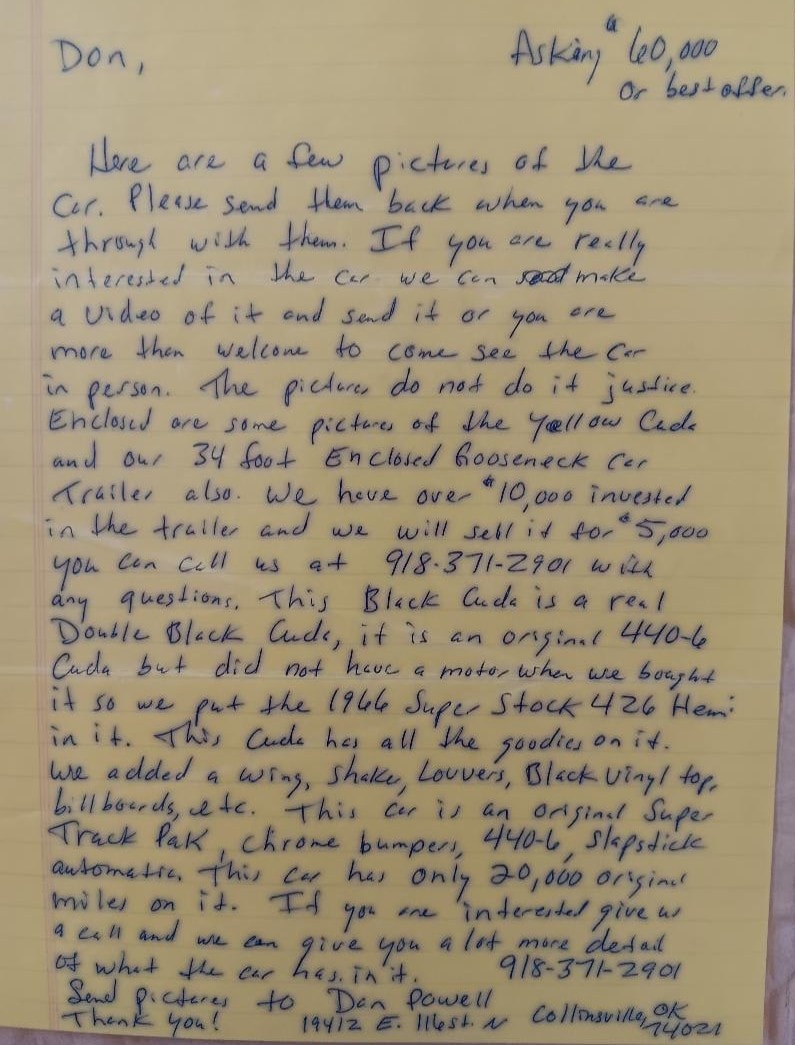
Dan's letter — yellow legal paper, blue ink. "This Black Cuda is a real Double Black Cuda... This car has all the goodies on it." Asking $60,000 or best offer.
June 29, 2001 — Cars On Line
SOLD
By the time Dan's letter reached me in Las Vegas, it was already too late. The ad had gone up on Cars On Line — 11,152 visitors had seen it. And by June 29, 2001, it was stamped with one word: SOLD.
A local Mopar collector from northwestern Missouri had caught wind of the 1971 Plymouth 440-6 Promo Cuda Dan had restored — a World of Wheels winner — and made the trip to Collinsville to purchase it. While he was there picking up the promo car, he spotted the Black Beast in the hangar. From what I was told, it did not take long.
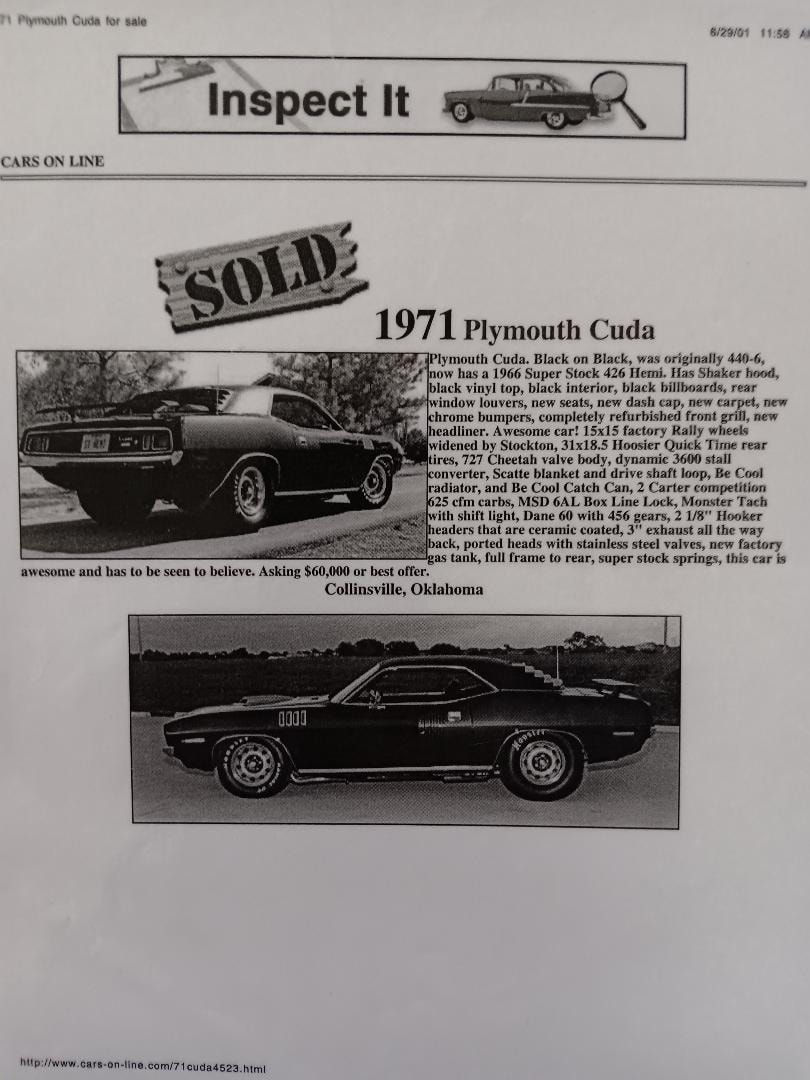
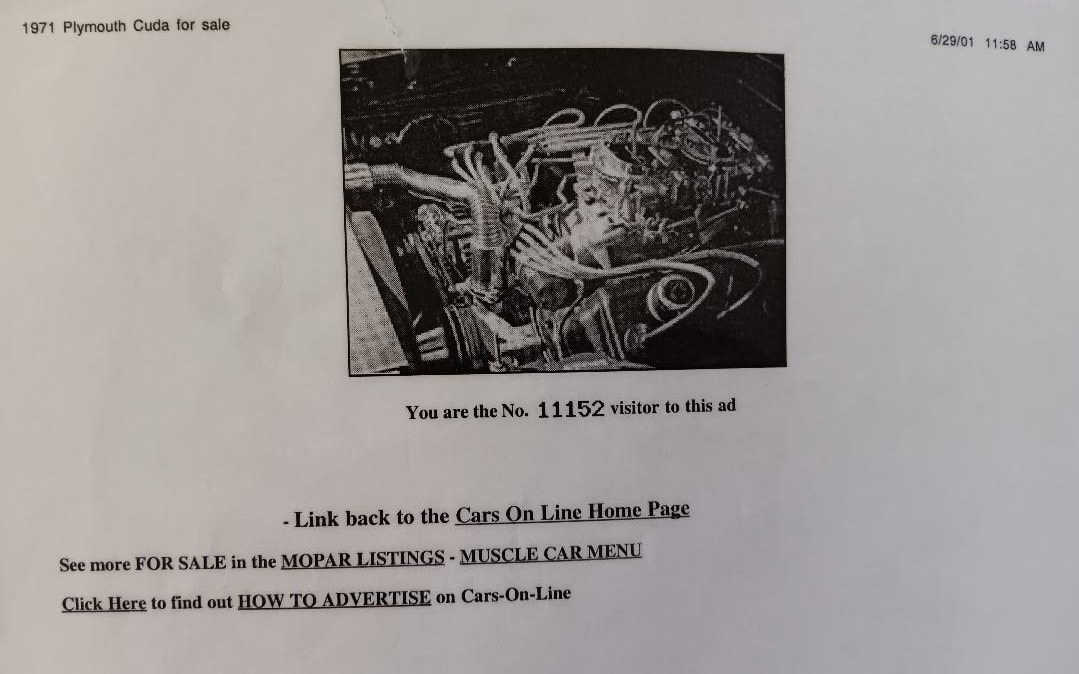
The Cars On Line listing — June 29, 2001. Visitor No. 11,152. The ad that confirmed what I already knew: someone else had gotten there first.
The Bait — Dan Powell's Promo Cuda
World of Wheels Winner
The Missouri collector had not come for the Black Beast. He had come for this — Dan's yellow and black 1971 440-6 Promo Cuda, a show car that had taken top honors at World of Wheels. It was the car that brought him to Collinsville. The Black Beast was the car he left with.
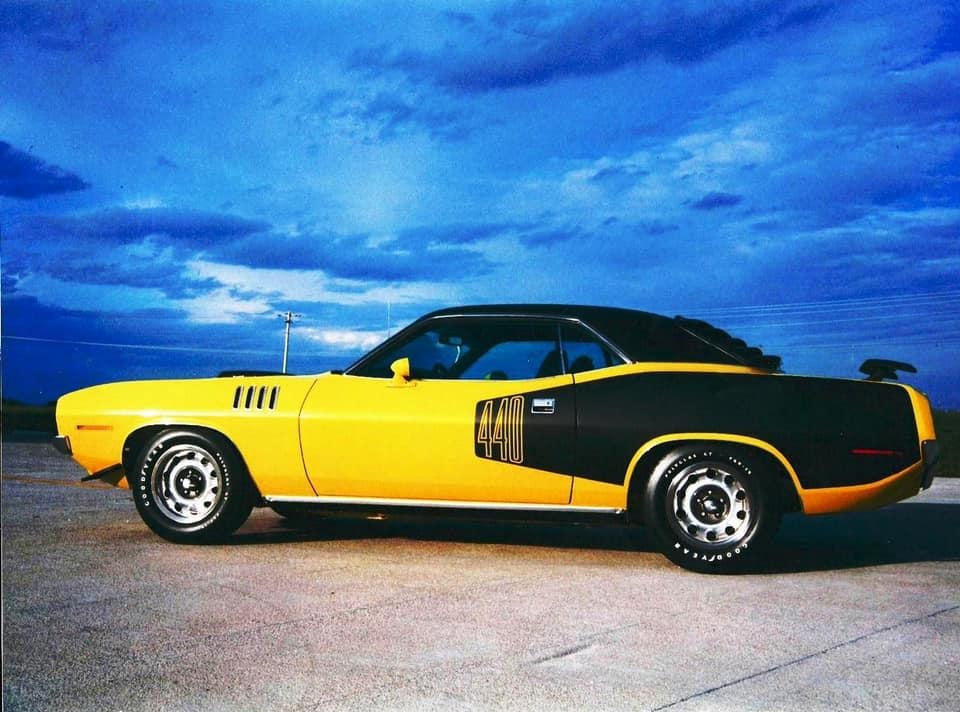
Dan Powell's World of Wheels winner — the yellow and black 1971 440-6 Promo Cuda. The car that brought the collector to Collinsville. The Black Beast was the car he drove home.
The Sale
The Black Beast Changes Hands
The collector was persistent. He had come a long way from northwestern Missouri, and he was not leaving without both cars. The Black Beast — and the 34-foot enclosed gooseneck race trailer — were purchased on the same trip. Dan always apologized to me afterward. He said the car was technically for sale, and the collector was simply more persistent than the mail.
Here is the detail that still stops me: the purchase was for his wife. The new owner of the Black Beast — a car built by a Vietnam veteran, powered by a 426 Super Stock Hemi, fueled by aviation gas — was a woman who wanted to go drag racing.
And drag racing they did.
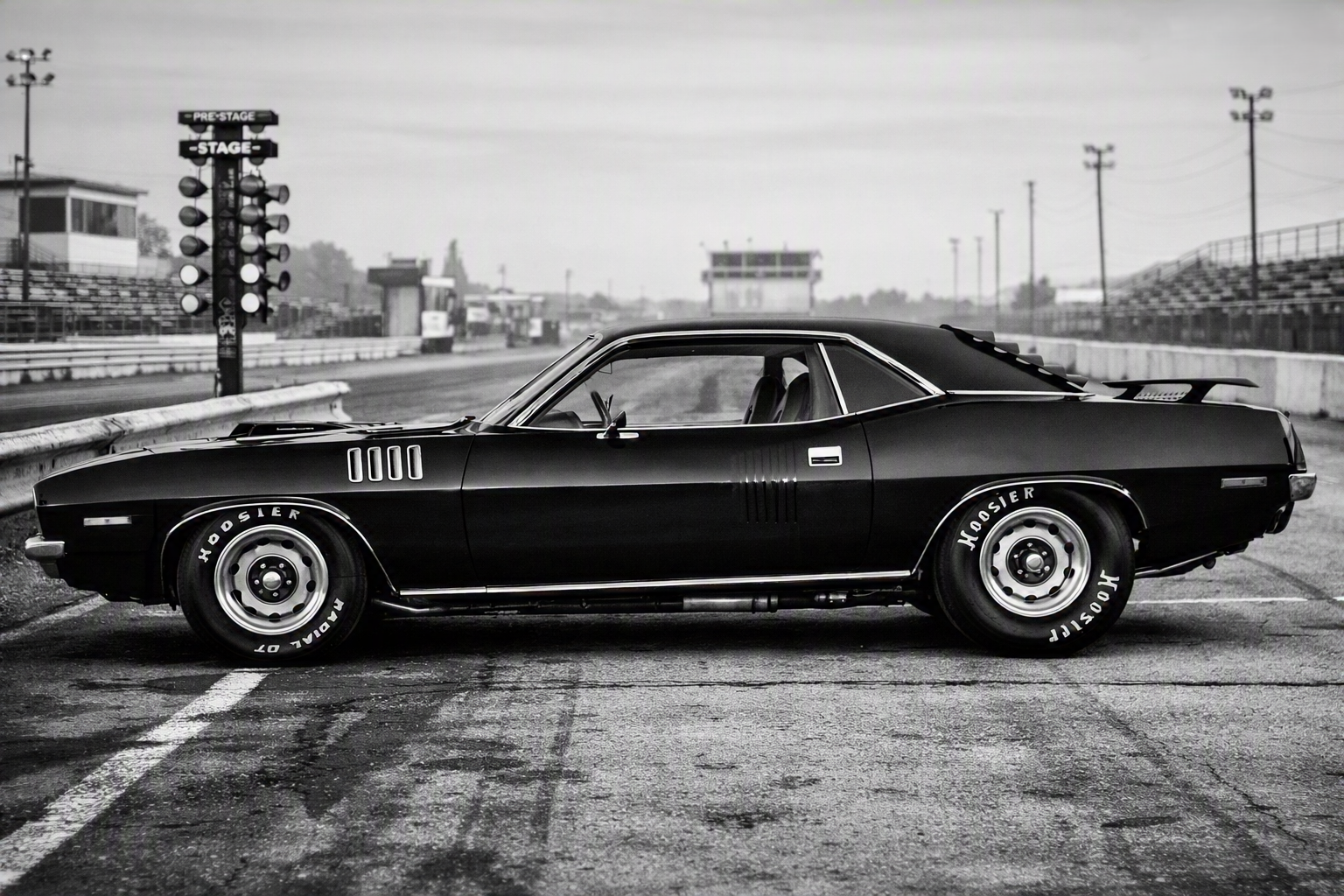
"The Black Beast went directly to Competition Fabrications in Maple Park, Illinois — a full drag race restoration. Brand new custom NHRA cage. Rear re-tub fabrication. Art Morrison bars. Upgraded suspension. No expense spared to bring the Powell Cuda up to NHRA specs."
Competition Fabrications — Maple Park, Illinois
Full NHRA Drag Race Restoration — The Black Beast
"Dan apologized. The collector was persistent. The letter arrived too late. And somewhere in northwestern Missouri, a woman was about to go drag racing in a double-black 426 Hemi Cuda built by a Vietnam veteran who ran it on aviation fuel."
Act III Follows Below
"I was thirteen years old in the summer of 1979. I sat in a theater and watched a black 1971 Cuda own the screen. That car never left me. Forty years later, I was still looking for it."
Summer 1979 — The Beginning
The Grail
I was thirteen years old when I first saw Phantasm in a theater in the summer of 1979. The black 1971 Cuda on screen was dressed up to impersonate a 440-6 — TX9 double-black, six-barrel, the car that stole the world's hearts. That was the movie car in my mind. That was the car I wanted. That was my grail.
And then the real car — the actual TX9 double-black 440-6 that had inspired the whole mythology — went missing. Just like the movie car. Both of them gone.
I spent sleepless nights with that knowledge. Big-block 1971 TX9 Cudas are rare. Losing out on the sale of one is not something that comes back around in a lifetime. I knew that. I felt it.
2001–2002 — The Consolation Run
Healing the Wounds
I tried to move on. I purchased a black 1968 R/T Charger 440 — a beautiful car, a serious car. It did not heal the wound. Not really. The 1974 Pro Street Cuda I had been finishing at Restorations by Julius in Chatsworth went up for sale. I was not done searching. I was never going to be done searching.
The internet was not what it is today. Finding and locating big-block Mopars was done through old-school print channels and persistence — classified ads, word of mouth, and the one publication that mattered most: Hemmings Motor News.
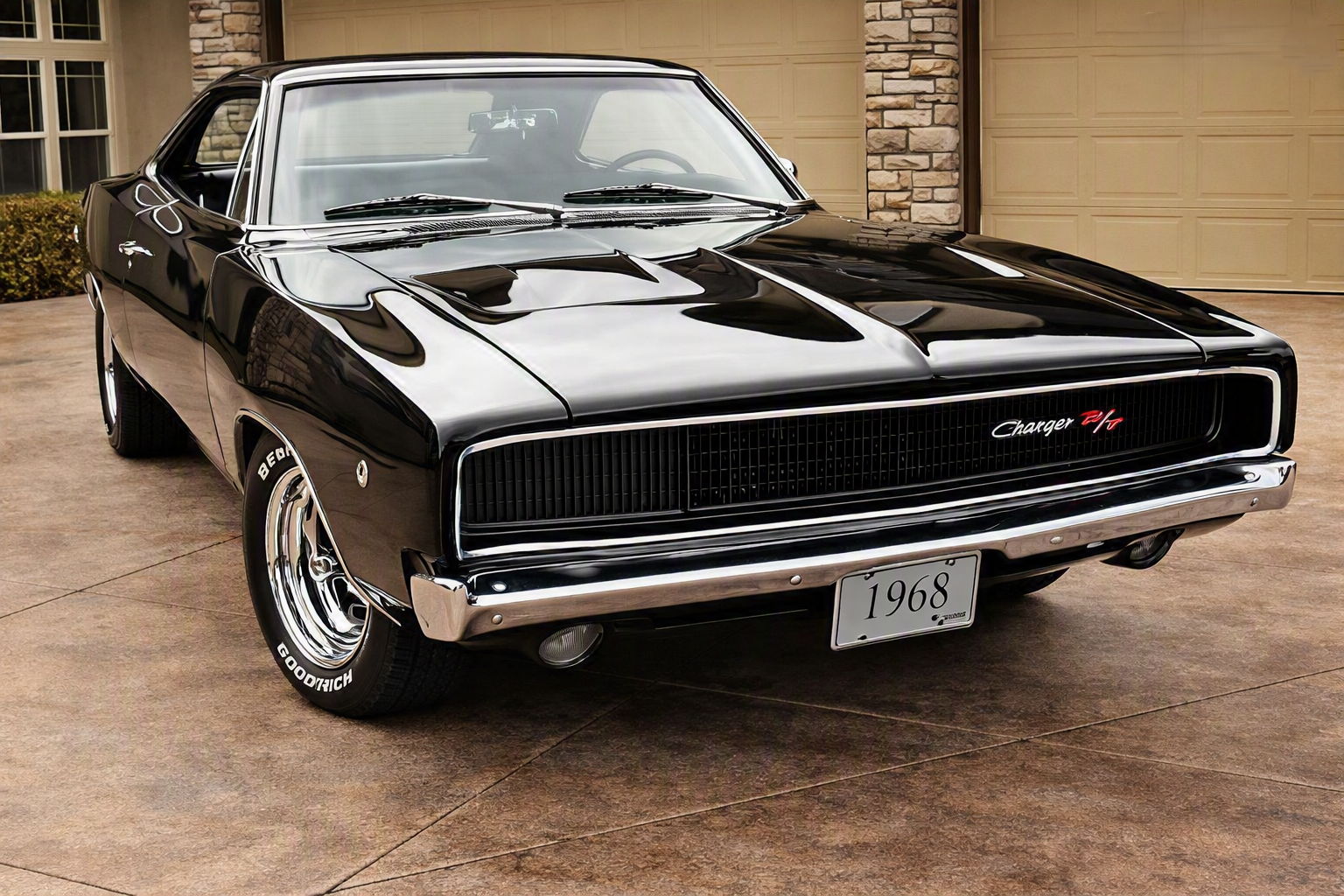
The 1968 Dodge Charger R/T 440 — black, serious, and beautiful. A great car. Not the right car. The search continued.
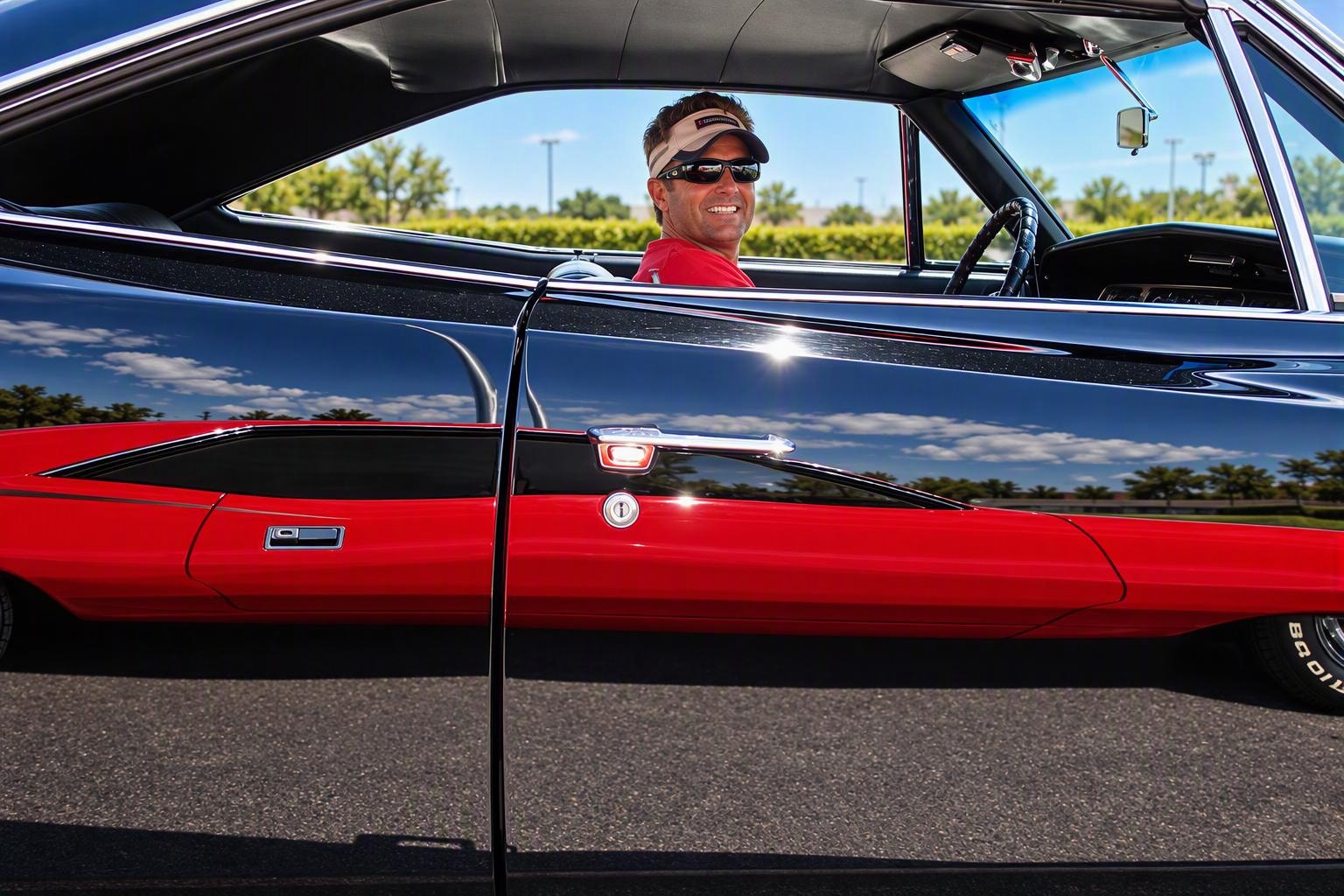
A good day, honestly lived. The smile was real. The wound just waited — patient as a road not yet taken.
"Only 24 months after losing the Black Beast, I flipped to page 586 in the June issue of Hemmings Motor News. And there it was."
Hemmings Motor News — June Issue, Page 586
THE BLACK BEAST
I knew what the car was the moment I saw the ad. I knew the history. I knew who had built it, who had restored it, and what was under the hood. The Black Beast — Dan Powell's double-black 1971 440-6 Cuda with the 1966 Super Stock 426 Hemi — had surfaced again. Twenty-four months after it slipped through my hands, it was back in print on page 586.
My holy grail had come back to me on a second-chance qualifier round.
I purchased it site unseen.
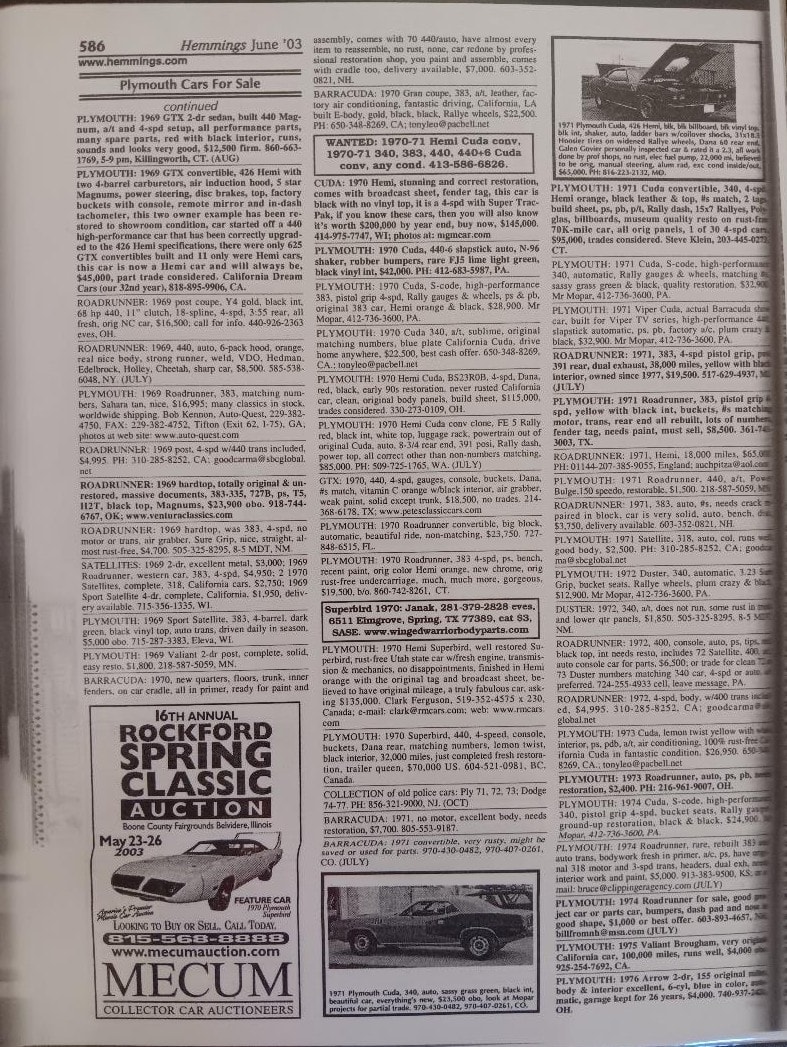
Hemmings Motor News — June issue, page 586. The ad that changed everything. The Black Beast, back in print. Purchased site unseen.
Dan Powell — The Apology
One More Letter
Dan Powell wrote again. He always apologized for selling the car to someone else. He knew what it meant. He knew I had been the first call, and that the letter had arrived too late. This follow-up was his way of closing the loop — a thank-you, an acknowledgment, the kind of correspondence that only happens between men who understand what these cars represent.
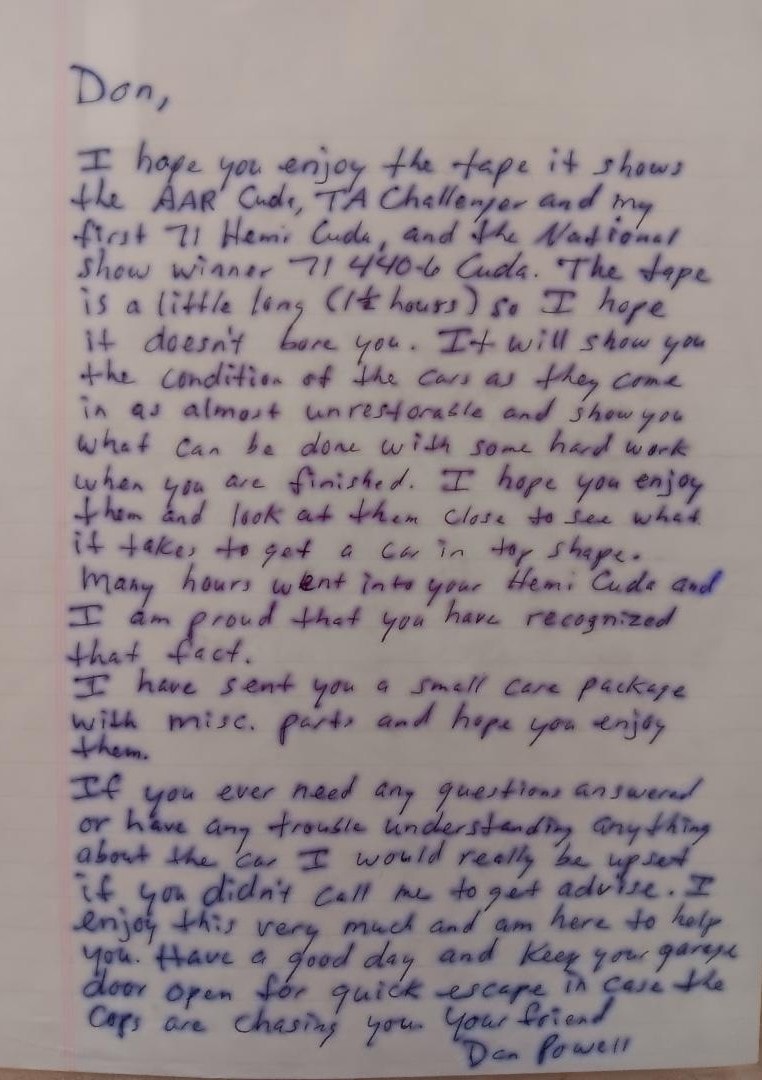
Dan Powell's follow-up letter — the apology, the acknowledgment. He always felt bad about the sale. This was his way of saying so.
The Delivery
The Black Beast Comes Home
Purchased site unseen. No test drive. No in-person inspection. Just the knowledge of what the car was, who had built it, and what it meant. The Black Beast — the car Dan Powell had restored from a 1966 Hemi block up, the car that had won at World of Wheels, the car that had gone to Competition Fabrications for a full NHRA build, the car that a woman from northwestern Missouri had drag raced — was on its way to me.
When it arrived, I was standing there waiting. Twenty-four years after I first saw a black 1971 Cuda on a movie screen at thirteen years old, my grail had come home.
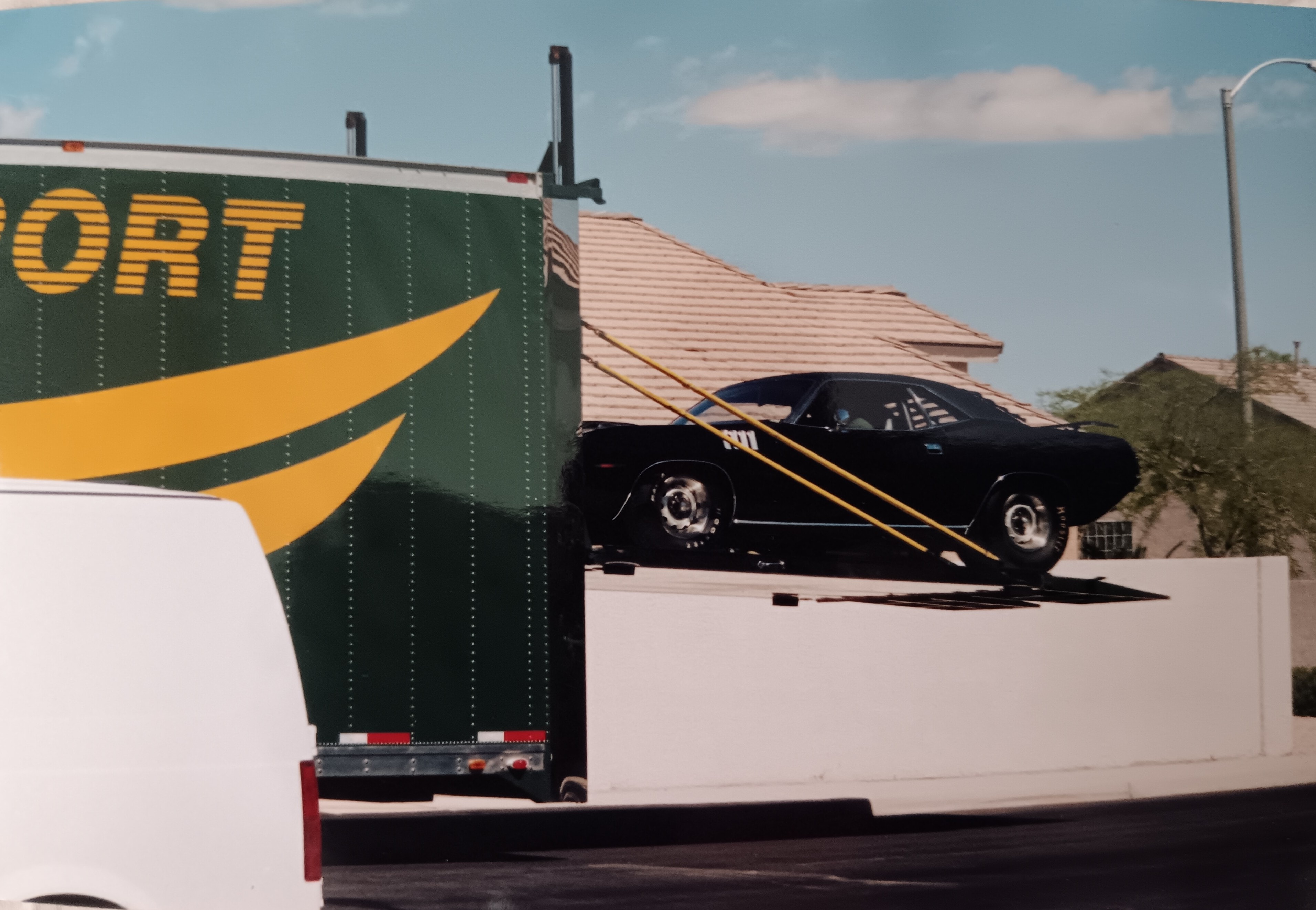
The Black Beast arrives. Purchased site unseen from page 586 of Hemmings Motor News. The grail, delivered.
The Curator's Cuda — What This Car Is
The Black Beast — Provenance Record
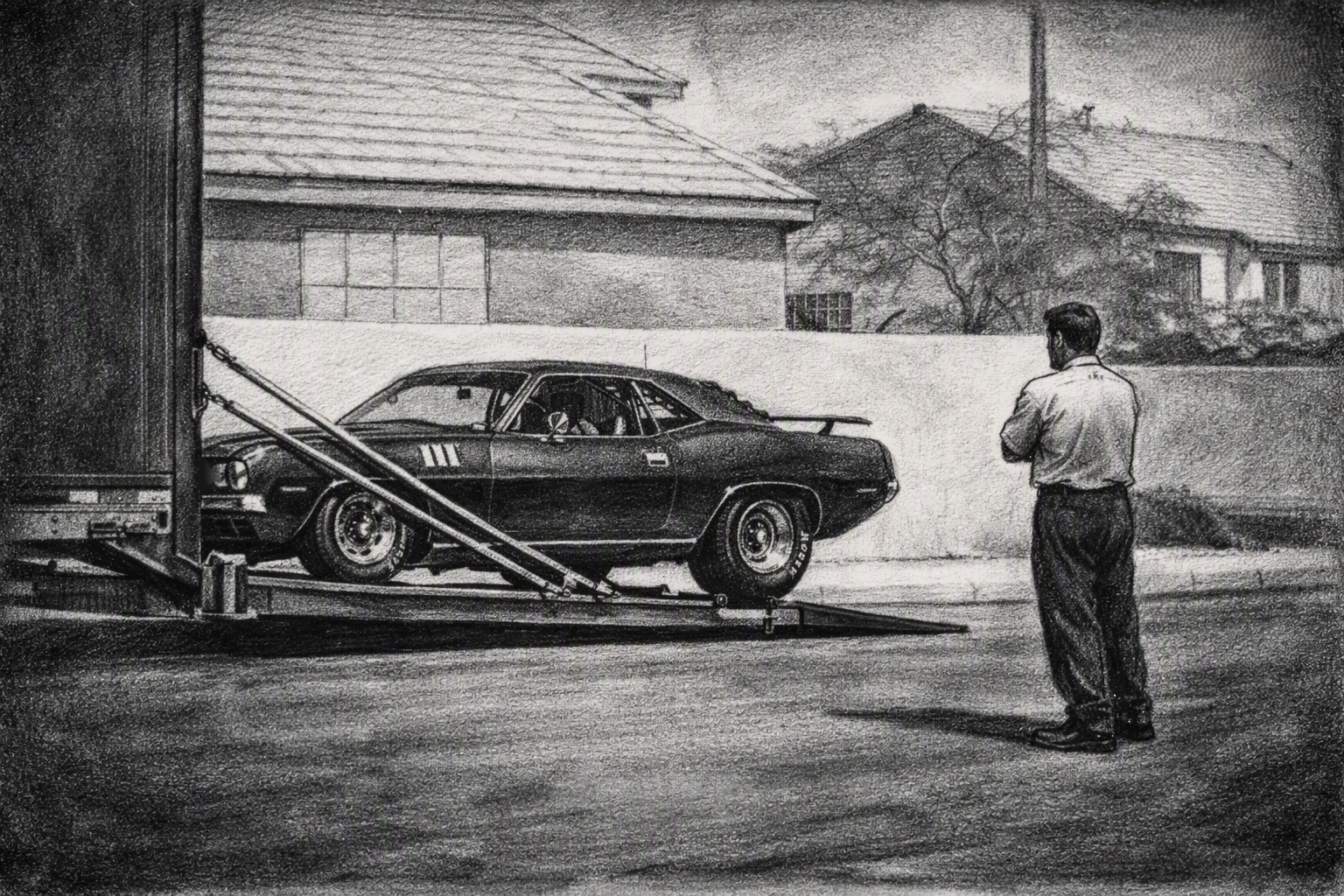
"I was thirteen years old in a theater in 1979. I was a grown man standing in a driveway when the trailer dropped the gate. The car that had been my grail since that summer — the car that had slipped through my hands once — had come back. The Black Beast was home."
Act V Follows Below
"The Black Beast was home. And the world was about to find out."
2003–2012 — The Circuit
Show Car Appearances
Once the Black Beast was home and sorted, it went out. The 2003–2012 period was the most active stretch of the car's public life — show circuits, special invitations, and appearances that put the TX9 double-black 426 Hemi Cuda in front of audiences who understood exactly what they were looking at.
Mopars at the Strip. Spring Fling. Woodley Park. The car drew crowds everywhere it went — hood up, Hemi on display, the provenance story told to anyone who asked. Dan Powell's build. The World of Wheels win. Competition Fabrications. Aviation fuel. The Hemmings page 586 acquisition. People listened.
This was not just a show car. This was a documented piece of Mopar history with a paper trail going back to a Chrysler dealership in Collinsville, Oklahoma, and a Vietnam veteran who built it right.
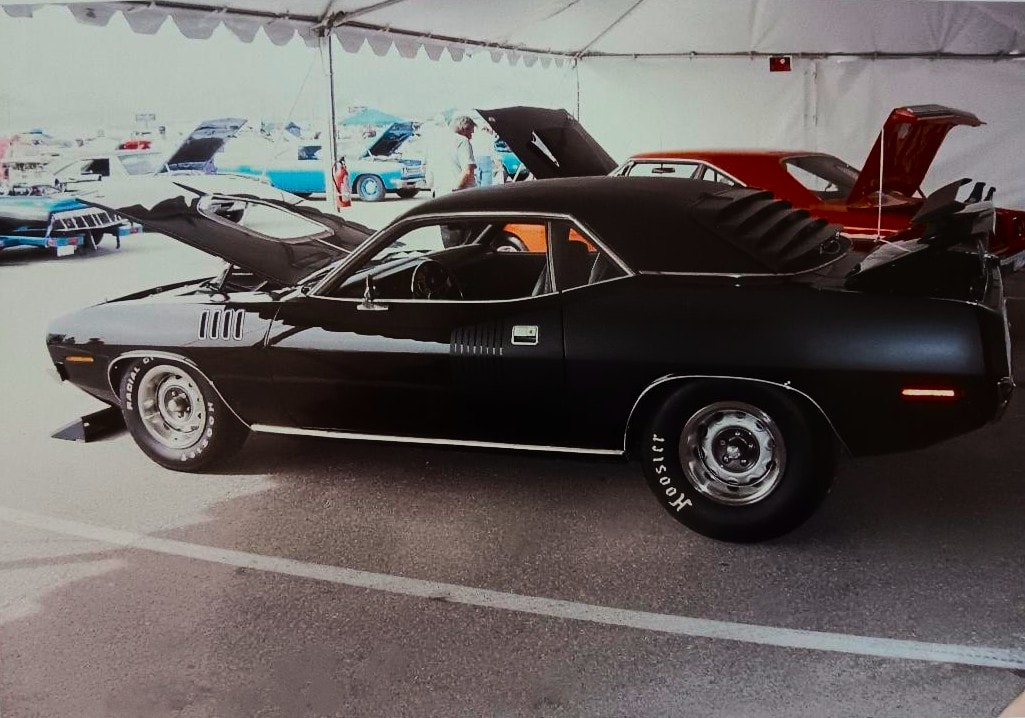
Mopars at the Strip — the Black Beast under the show tent, hood up, Hemi on display. The car that came back from page 586.
Show Car Record — 2003 to 2012
The Black Beast on the Circuit
2004 — On Set
Murder-Set-Pieces — A Horror Film Appearance
In 2004, the Black Beast went back in front of a camera. Director Nick Palumbo was shooting Murder-Set-Pieces — a horror film that would go on to become one of the most controversial entries in the genre, earning a Director's Cut release through Fright Flix Productions. The production needed a car with presence. They found one.
The Black Beast appeared on set in Las Vegas alongside the production crew, cast, and Gunnar Hansen — the actor best known as Leatherface in The Texas Chain Saw Massacre. The car that had been Dan Powell's restoration project, that had won at World of Wheels, that had been built for NHRA competition and run on aviation fuel, was now on a film set again — twenty-five years after a different black 1971 Cuda had made its screen debut in Phantasm.
The circle was closing.
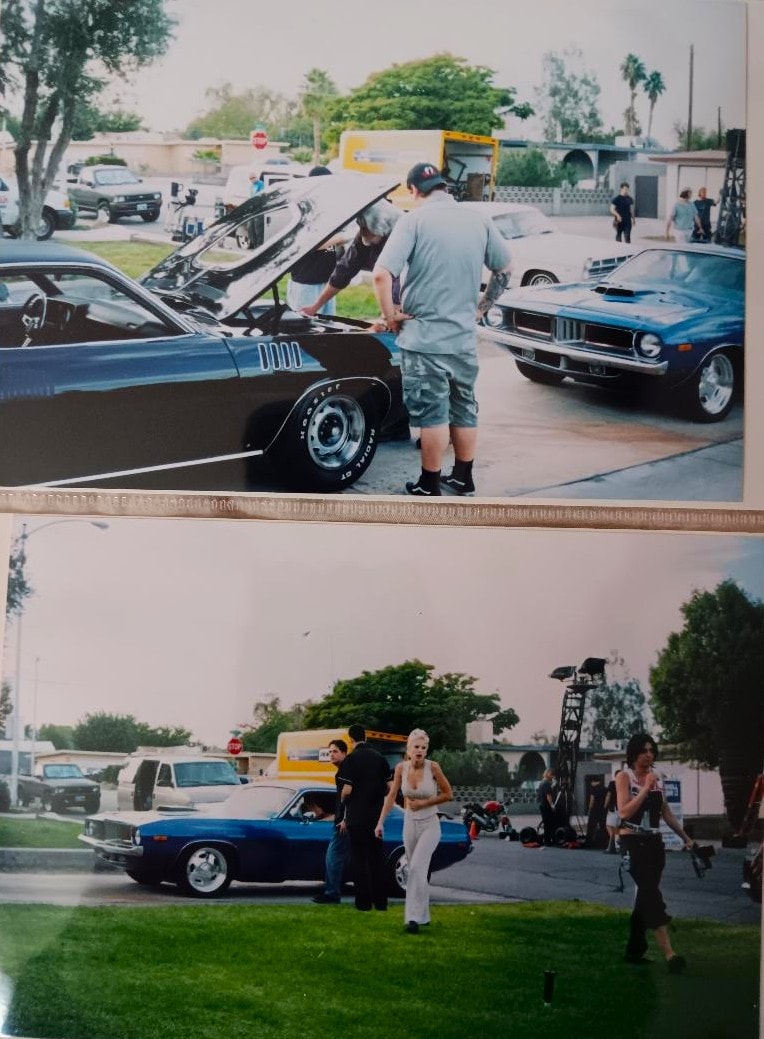
On set — Murder-Set-Pieces, Las Vegas 2004. The Black Beast with the production crew, film crane in the background.
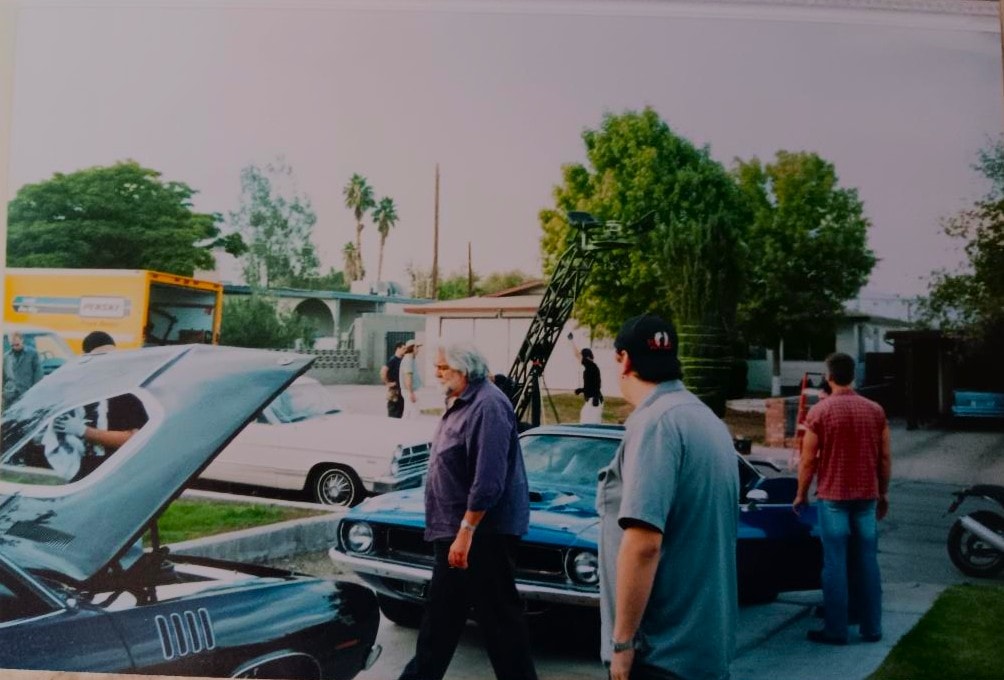
Gunnar Hansen before the scene — Leatherface himself, on set with the Black Beast. Las Vegas, 2004.
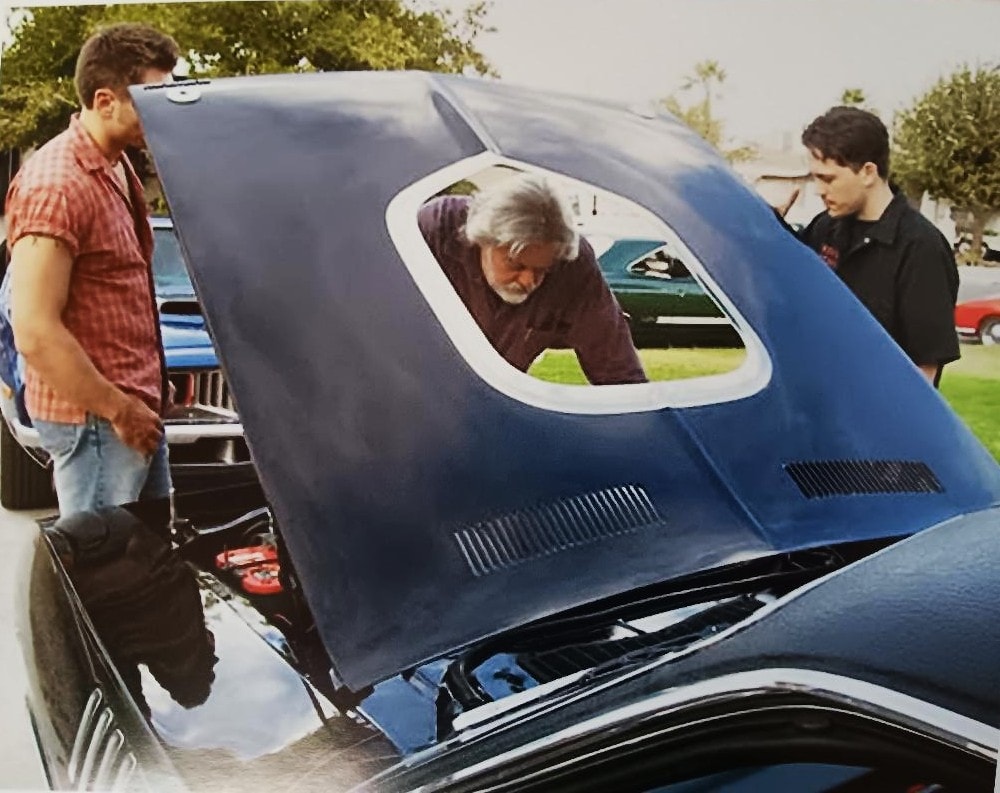
Director and cast go over the scene — leaning over the shaker hood. Las Vegas, 2004.
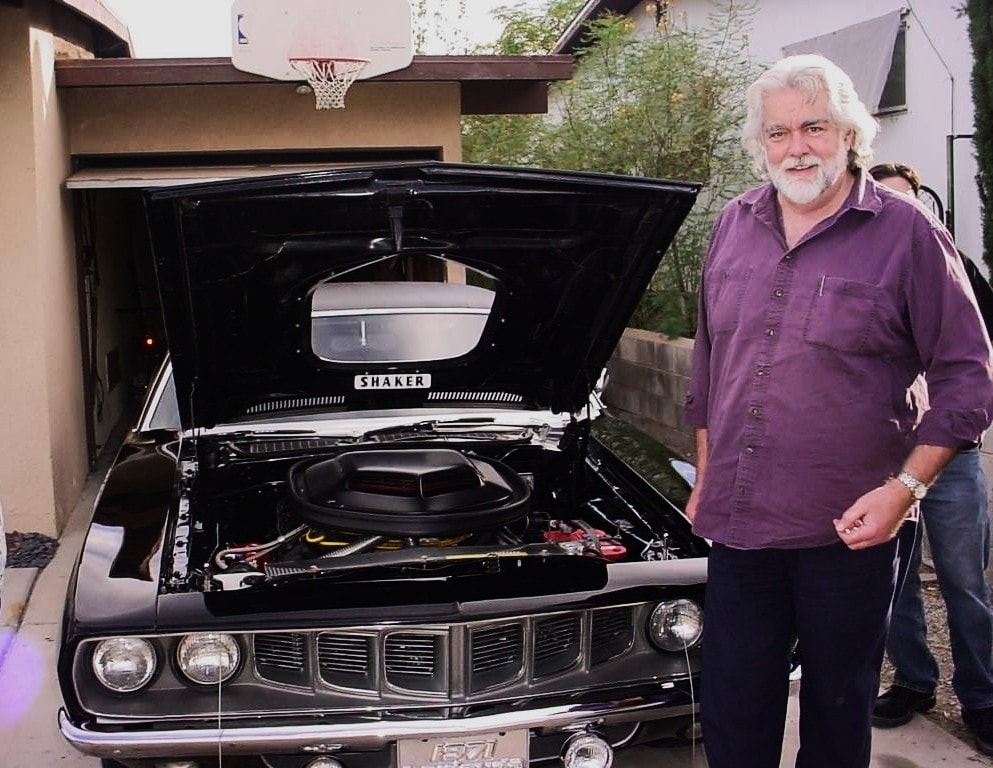
Gunnar Hansen with the Black Beast — 426 Hemi Shaker open, Las Vegas 2004. Leatherface meets the car that started it all.
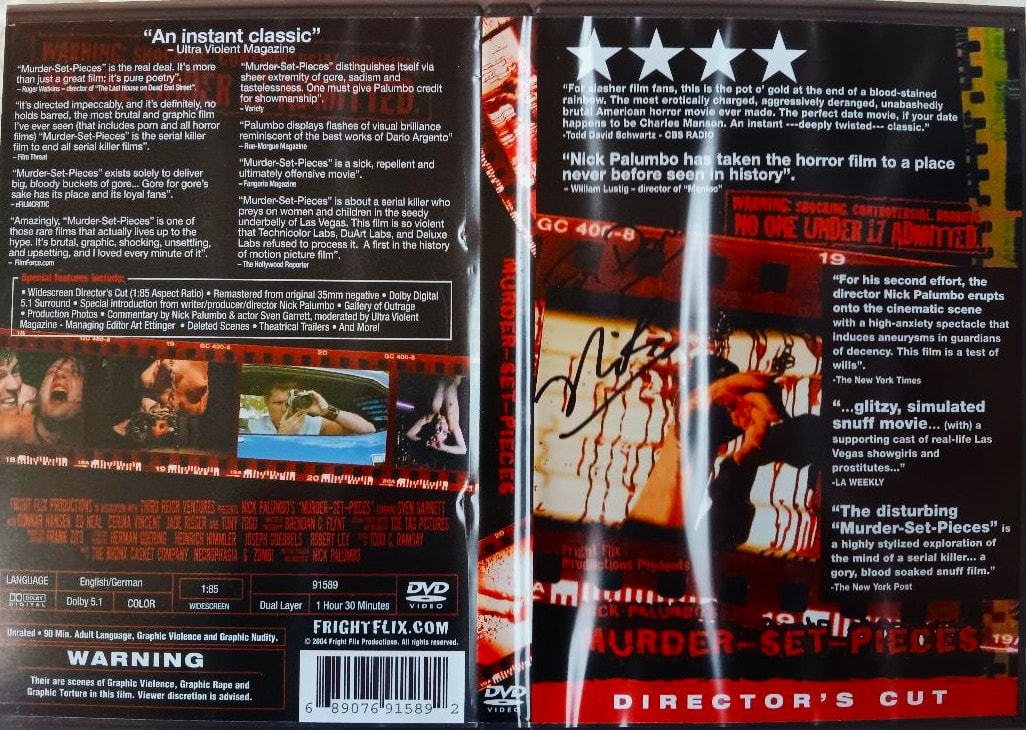
Murder-Set-Pieces — Director's Cut. Fright Flix Productions, 2004. The Black Beast on a film set for the first time since Phantasm.
"A TX9 double-black 426 Hemi Cuda with a documented Phantasm connection does not go unnoticed. The invitations came. The car answered every one of them."
Special Invitations
The Car That Got Called
Word traveled fast in the Mopar community. A TX9 double-black 1971 Cuda with a 426 Super Stock Hemi, a documented restoration by a Vietnam veteran, a World of Wheels win, an NHRA Competition Fabrications build, and a direct connection to the most iconic muscle car in horror film history — that car gets invited places.
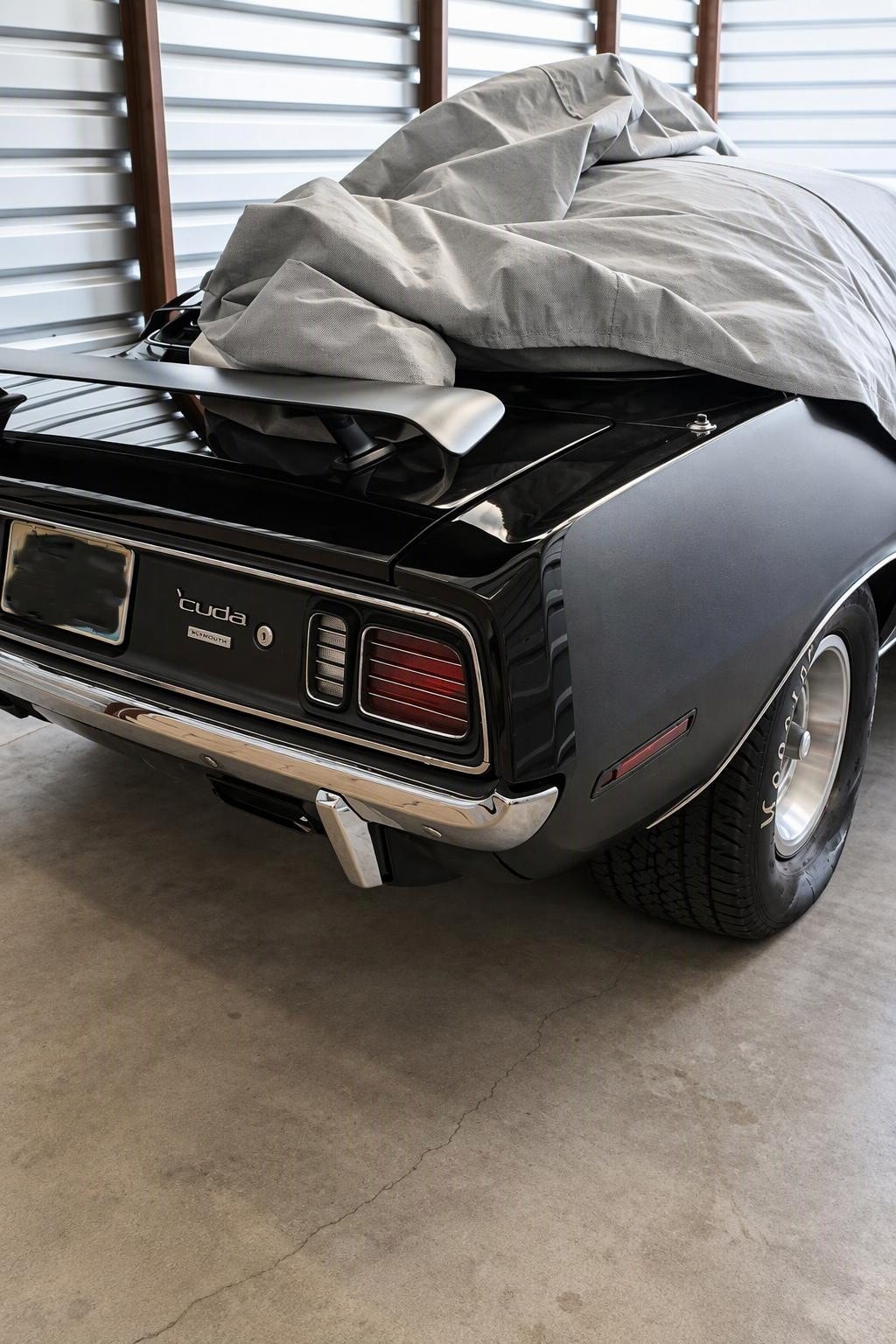
The Black Beast coming out of storage. The cover comes off. The circuit calls.
Spring Fling. Woodley Park. Mopar shows up and down California. The Black Beast was a regular presence on the circuit from 2003 through 2012 — always with the full story available for anyone who wanted to hear it, always with the Govier report, always with the provenance.
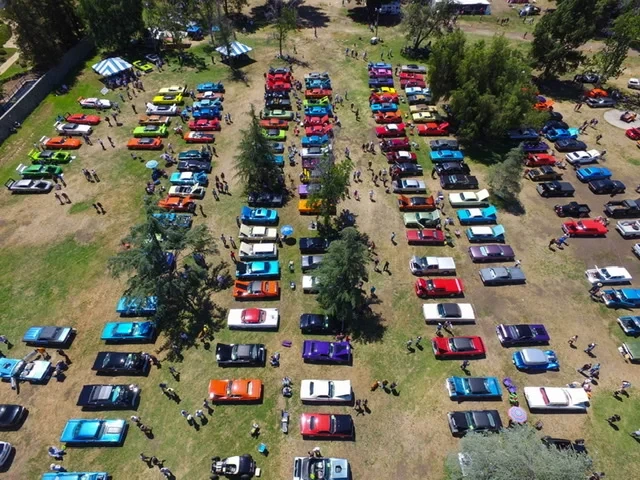
Spring Fling, Woodley Park — the Black Beast on the circuit with the best Mopars in the country.
This was the car's most public era. The grail that had been found on page 586 of Hemmings Motor News was now known. The Black Beast had a reputation, and it had earned every bit of it.
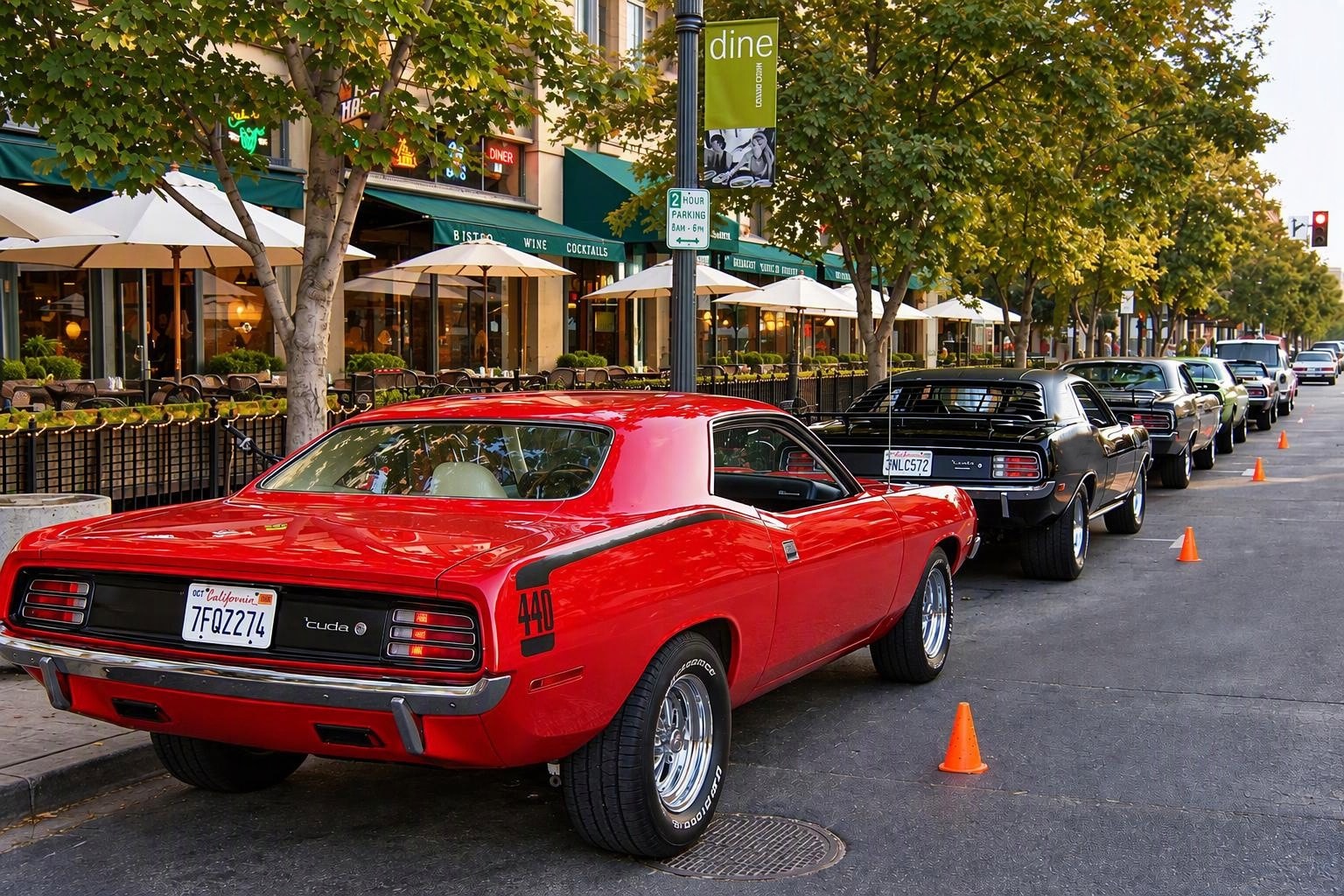
8th Street, Boise — the Idaho circuit. The Black Beast earned every invitation it received.
"From a film set in Las Vegas to the show tents at Mopars at the Strip — the Black Beast spent four years reminding the world what a real TX9 Hemi Cuda looks like. The story was always the same. The car always delivered."
Continued — Act V Below
Act V · The Final Chapter
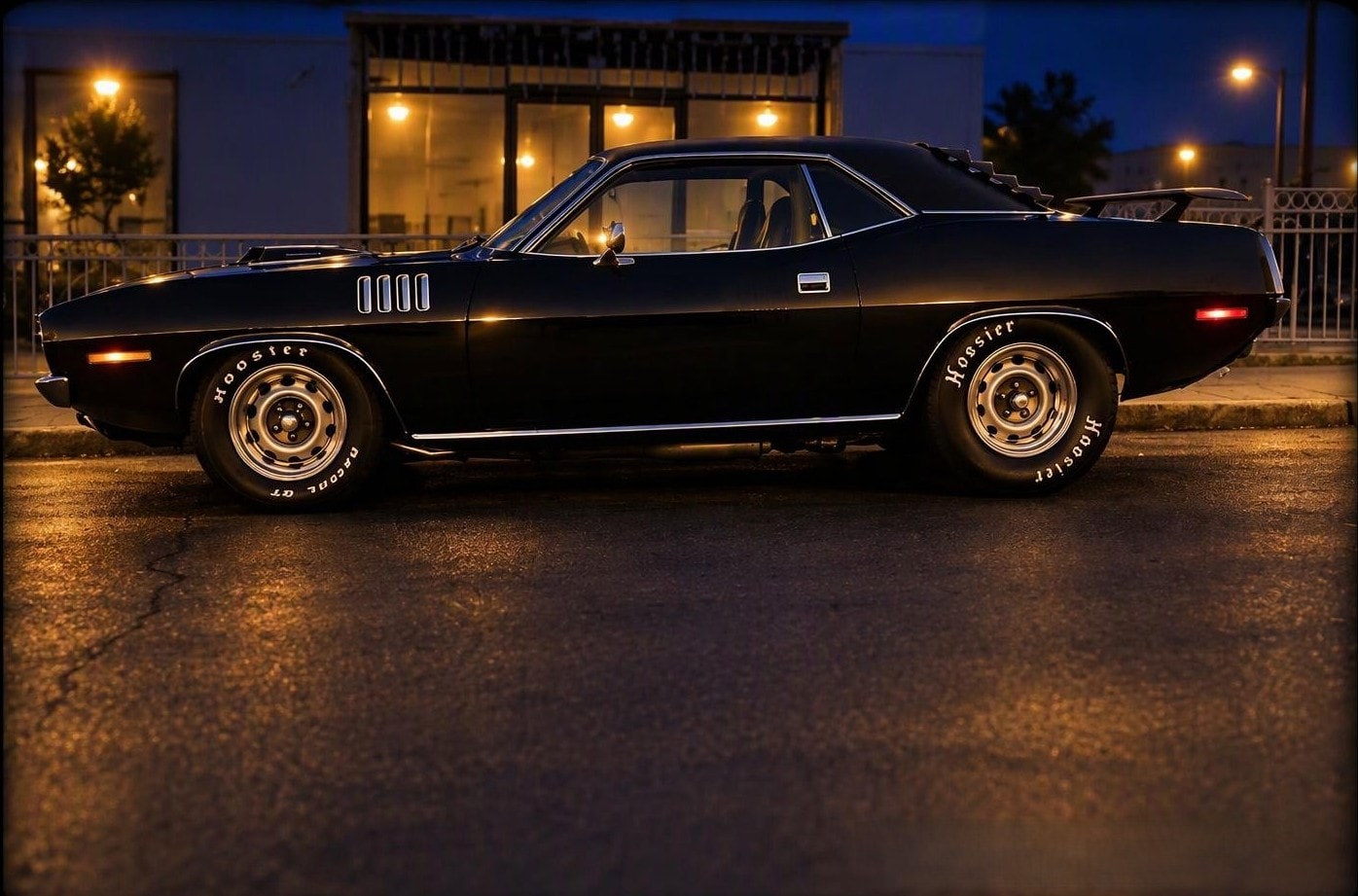
Where It Stands Today
The Black Beast — Still Running
"Every car has a last chapter. Most of them end quietly — a garage, a cover, a key that stops turning. The Black Beast never agreed to that arrangement."
The Record, Closed and Open
After the show years wound down and the circuit quieted, the TX9 double-black 426 Hemi Cuda settled back into the care of the archive. The Govier report is intact. The fender tag is documented. The provenance record — from the Rink Brothers Chrysler dealership floor in 1971, through R&R Salvage in Verona, Missouri, through Dan Powell's hangar restoration, through the Cars Online listing that almost let it disappear again, through the Hemmings ad on page 586 that brought it home — is as complete as any film car's record gets.
The show appearances are logged. The Murder-Set-Pieces set in Las Vegas is documented. The Mopars at the Strip trophy is part of the record. The Special Invitations — the ones that came because people recognized what they were looking at — are preserved here.
What the archive cannot fully close is the larger question — the one this entire site was built around. The original 1979 Phantasm production car, the Baker Cuda, remains unaccounted for. The Black Beast carries that story forward not as a replacement, but as proof that these cars existed, that they mattered, and that the record is worth keeping.
Current Status Record
"Out here, when the desert settles and the night leans in, you can sense it — the quiet truth that this car's story still moves, drifting forward even when the road has long slipped into darkness."
End of the Curator's Cuda
The archive remains open. The search continues.
A Tribute
A Moment for the Ones Who Were There
Before I close this chapter, there's something I need to acknowledge about that era. Back then, I wasn't out there racing alone. I had two Mopar brothers who were right there with me — lining up on the street, wrenching late into the night, talking cars, talking life, and living like the world was wide open in front of us.
We shared runs, laughs, close calls, and the kind of moments you only get when you're young, fearless, and behind the wheel of something loud and fast. Those were some of the best times of my life — the kind you don't realize are golden until they're gone.
Both of those friends are no longer here. Their stories ended far too early, in ways that still sit heavy with me. I won't mention their names, but they were part of that era… part of those nights… part of the reason those memories still mean something.
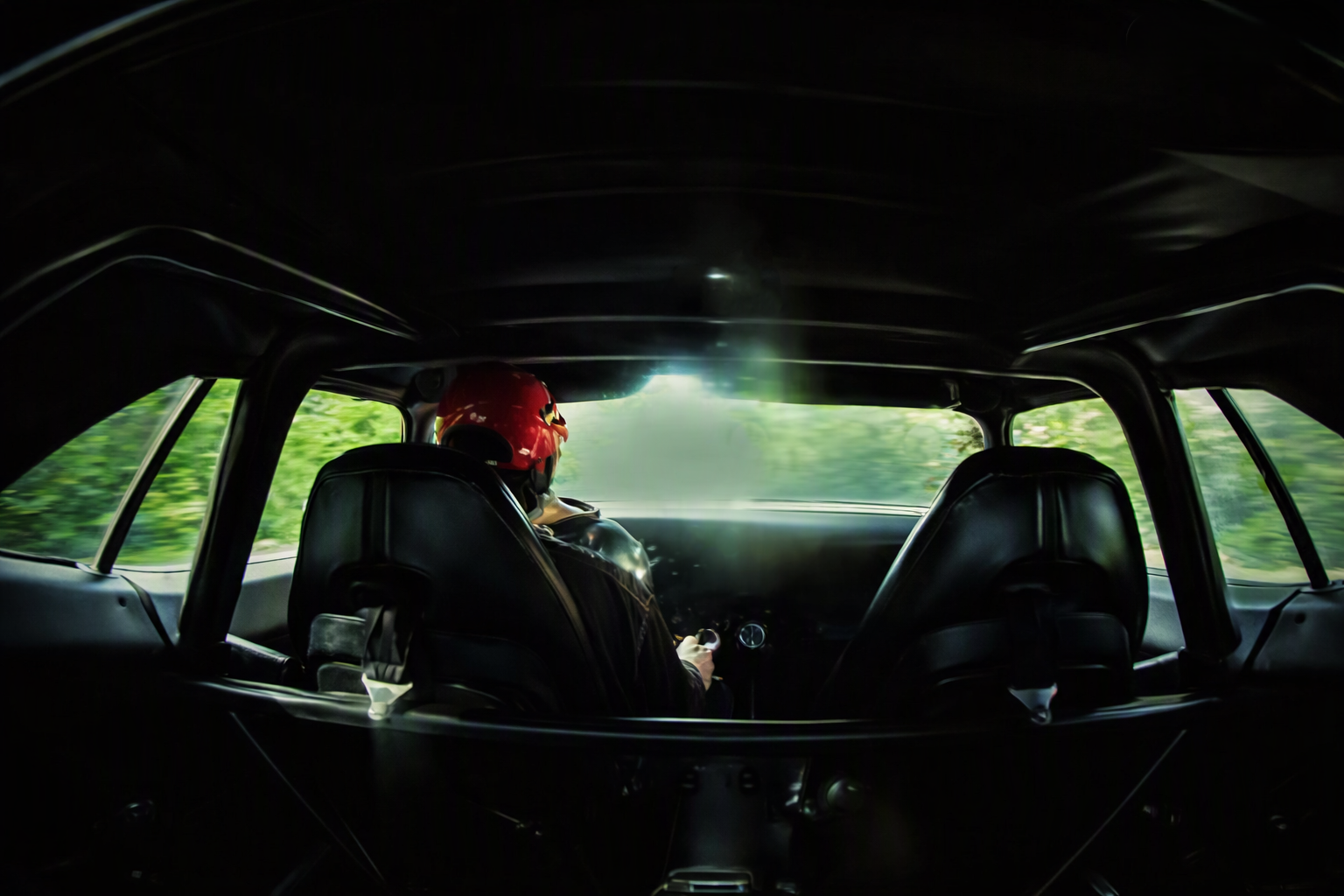
And every time I look at the Cuda, I remember them.
I remember who we were.
I remember the roads we ran.
And I carry those moments with me.
Epilogue
The Keeper of the Story
I've lived with this car for so many years that sometimes I have to remind myself it all really happened. I dreamed of a black '71 Cuda when I was thirteen years old, sitting in a theater in the summer of '79, watching that car own the screen. I didn't know it then, but that moment would follow me through my entire life.
And now, after everything — all the places I've lived, all the chapters I've survived, all the roads I've taken — that same dream sits in my garage today.
Keeping it wasn't always easy. There were years when the temptation to cash out was loud, years when the car was shipped, stored, moved, driven, stored again, shipped again, and kept alive through sheer stubbornness and belief. But I never let it go. I couldn't. I always remembered the stories people told me growing up:
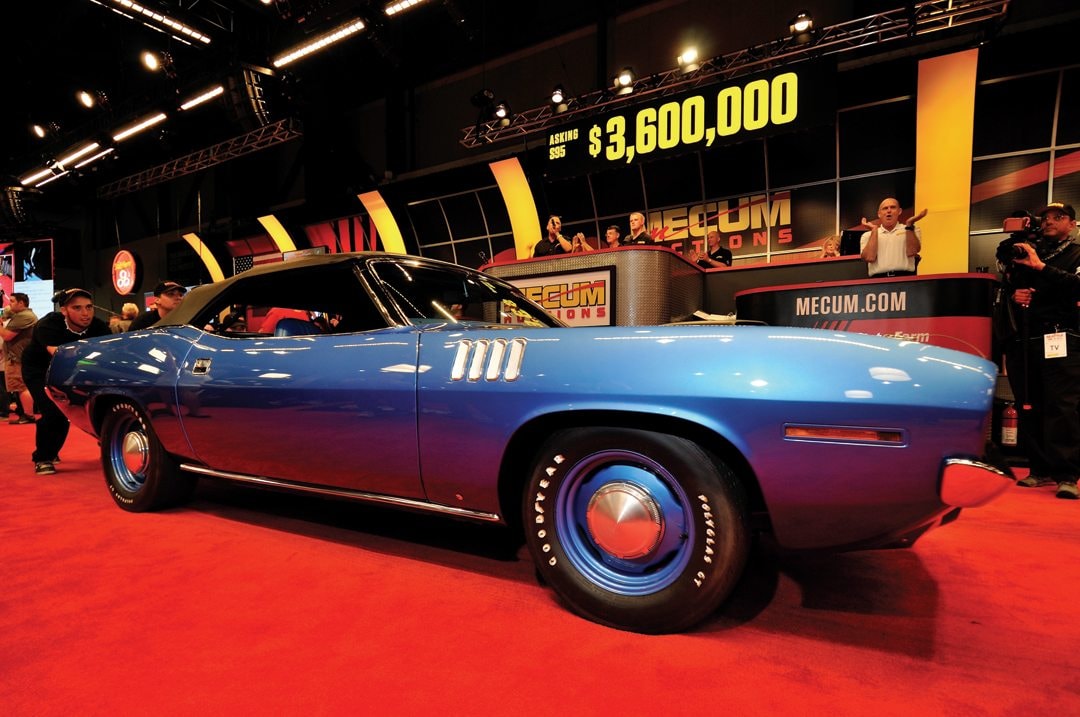
"I had a Plymouth Cuda back in the day… shouldn't have sold it… biggest regret of my life."
Those words stuck with me. They became a warning, a reminder, a promise. I wasn't going to be one of those stories. I wasn't going to spend the rest of my life wishing I had held on.
So I did.
And now, for the first time, I can sit back, breathe, and reflect on what it has meant. This car didn't just give me memories — it created them. It shaped moments, friendships, chapters, and entire eras of my life. It carried me through the years, and I carried it right back.
The car and the story are a part of me. They always have been. And after everything… I'm still here. And the Black Beast is still here. The dream I had at thirteen never left — because I never let it.
This is the first time I've been able to share what it truly meant. And maybe that's the real ending to this chapter: the realization that the story wasn't just about the car — it was about the man who never stopped believing in it.
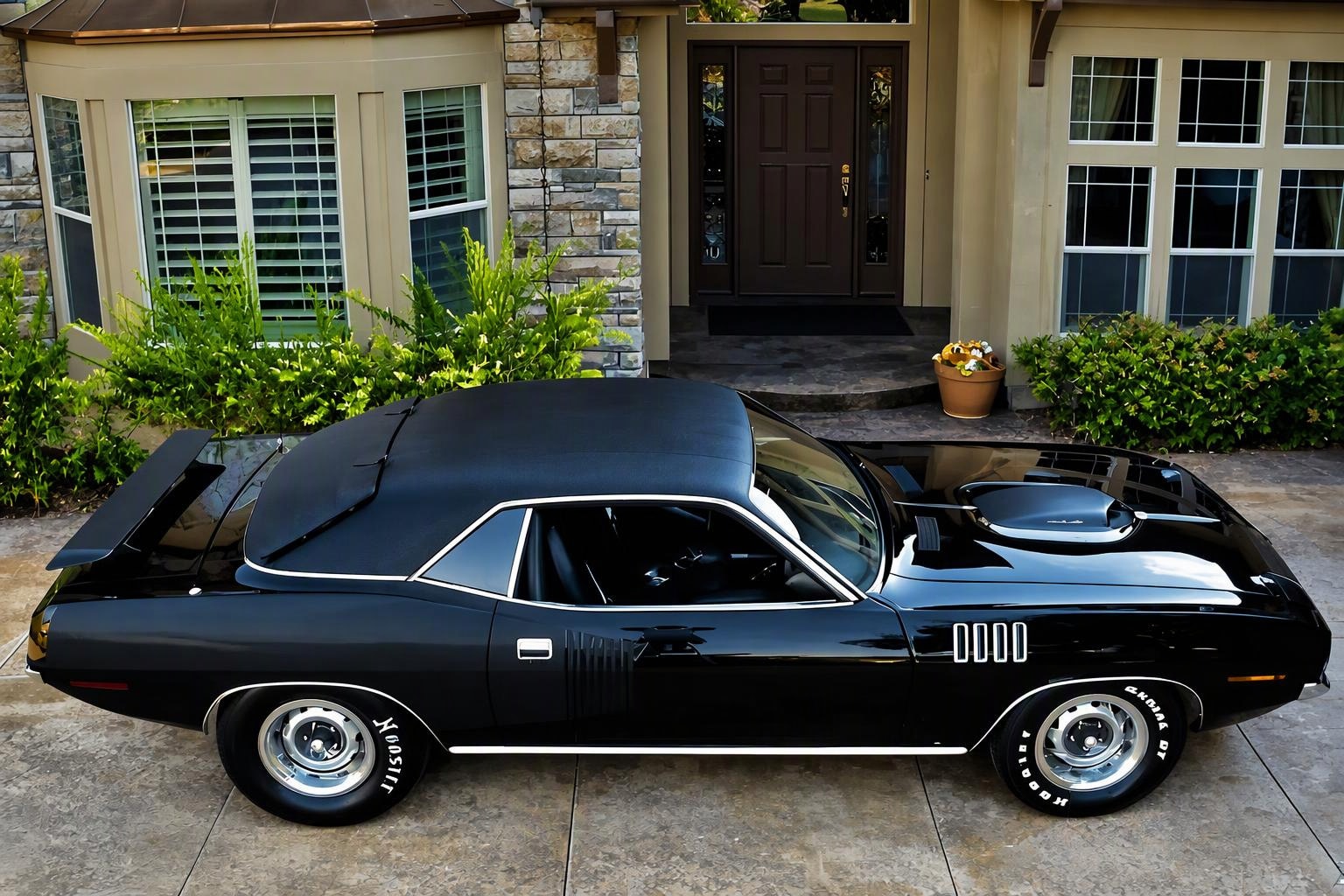
"Some men lose the cars that shaped their lives. I never did. I kept mine, and it kept me."
Don Almeido — Curator

Preserving film history, one discovery at a time.
Your evidence could rewrite the record.