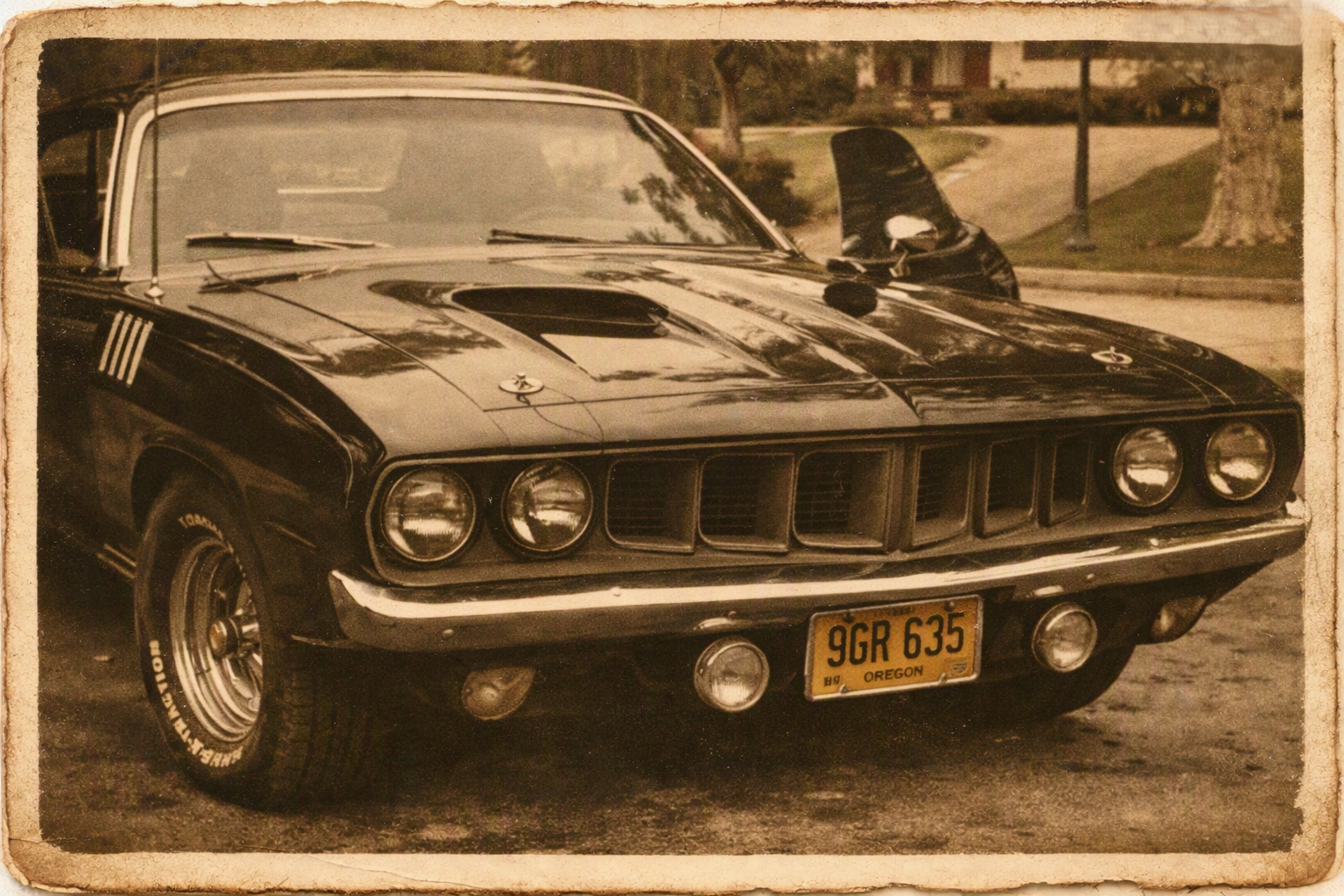
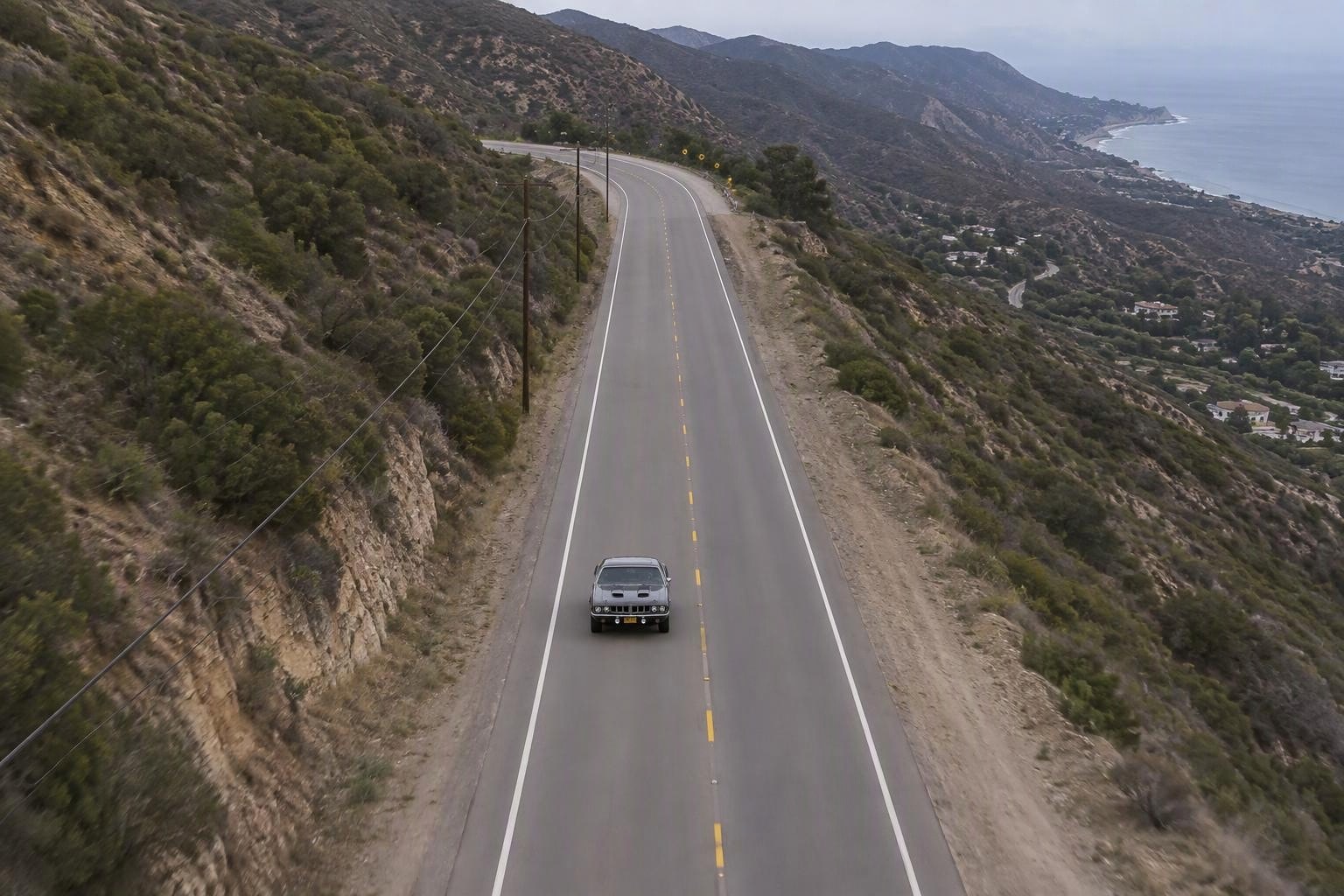
Lead 01
The 1980 handoff
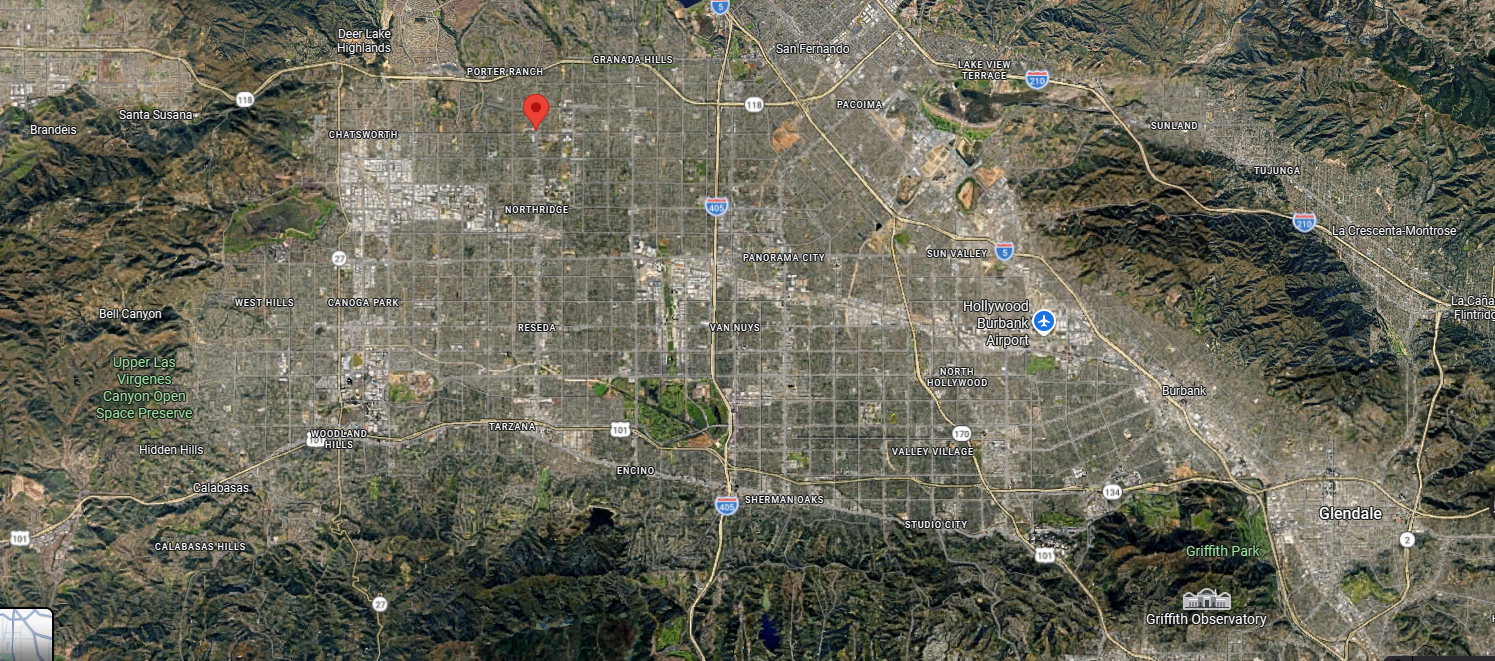
A prospective buyer encountered the original movie car in the San Fernando Valley, then exchanged it for a custom van after a brief roadside negotiation.

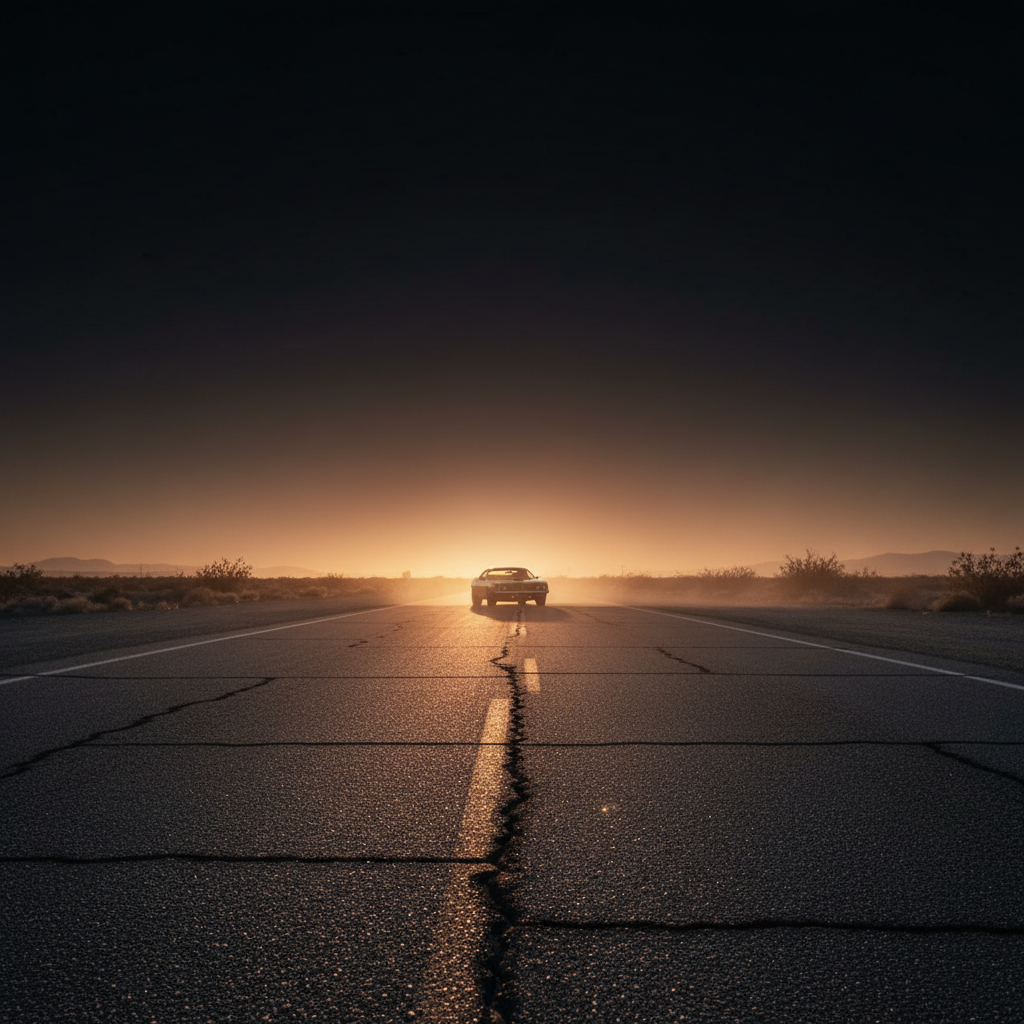
Active case file
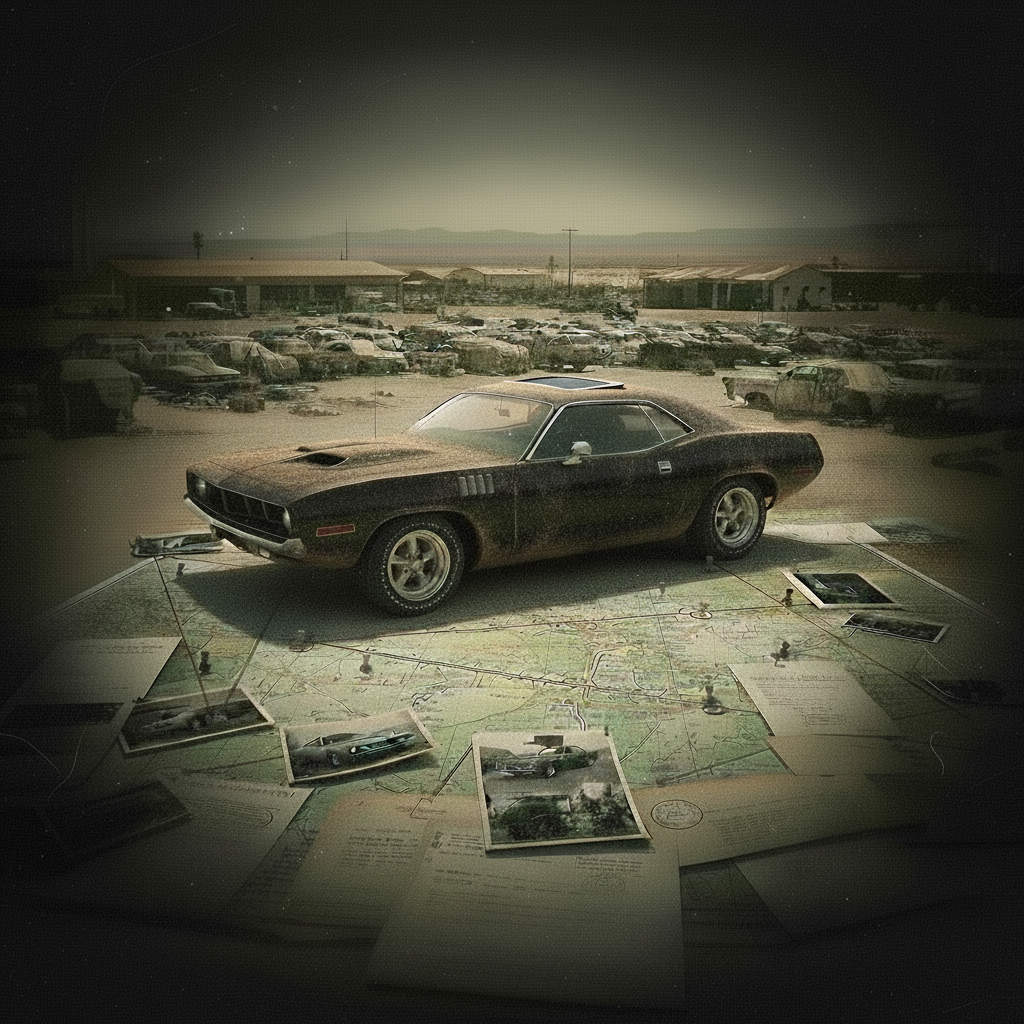
A living research ledger for the original 1971 Phantasm movie car — tracing the leads, evidence, and unanswered questions surrounding its whereabouts.
Investigation status
The original movie Cuda passed through several hands after filming. James Baker’s 1980 account supplies the most detailed known description of the car and its final documented exchange, but the trail goes quiet after that point.
This page gathers the working clues in one place. It is not a final verdict; it is an invitation to preserve details before they disappear.


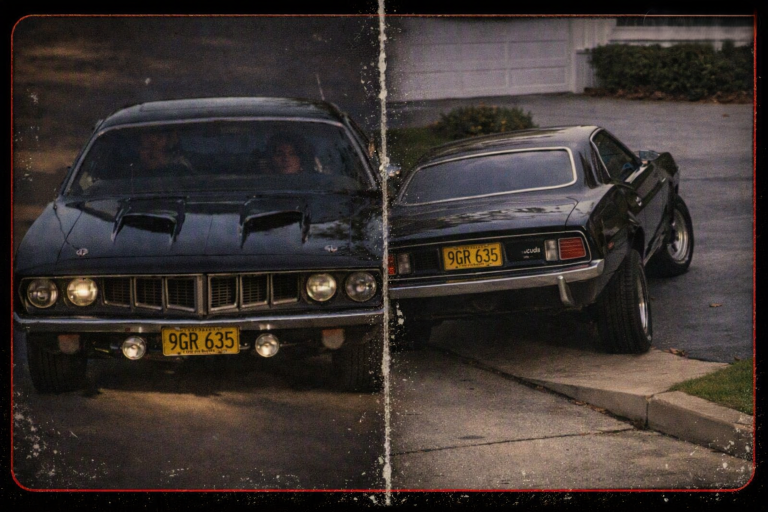
Final confirmed sighting
Courtesy of Juan Marchant
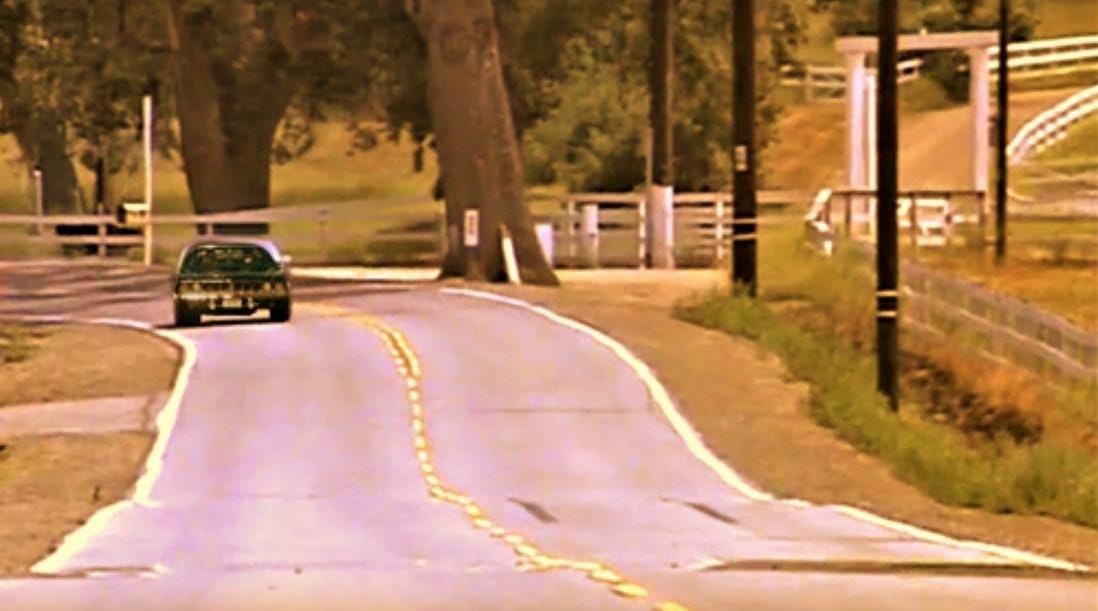
During the early 1980s, the James Baker ’Cuda made a brief but unforgettable appearance in an episode of CHiPs, the popular California Highway Patrol TV series. The car was used as a background and action vehicle during production, seen on-screen in several shots that highlighted its aggressive stance and unmistakable Phantasm-style presence.
The vehicle was brought to the studio lot specifically for filming, and production notes from the era suggest it was temporarily held on-site during shooting. After the episode wrapped, the ’Cuda was reportedly moved off the Warner Bros. lot — but no official record shows where it went next.
This CHiPs appearance is the last confirmed public sighting of the James Baker ’Cuda. Every lead, rumor, and clue on this board traces back to that moment in television history. The car was real, it was present, and then it vanished into the cracks of Hollywood’s backlots.
The CHiPs episode remains the anchor point of the investigation — the final known chapter before the trail goes cold.
Evidence ledger
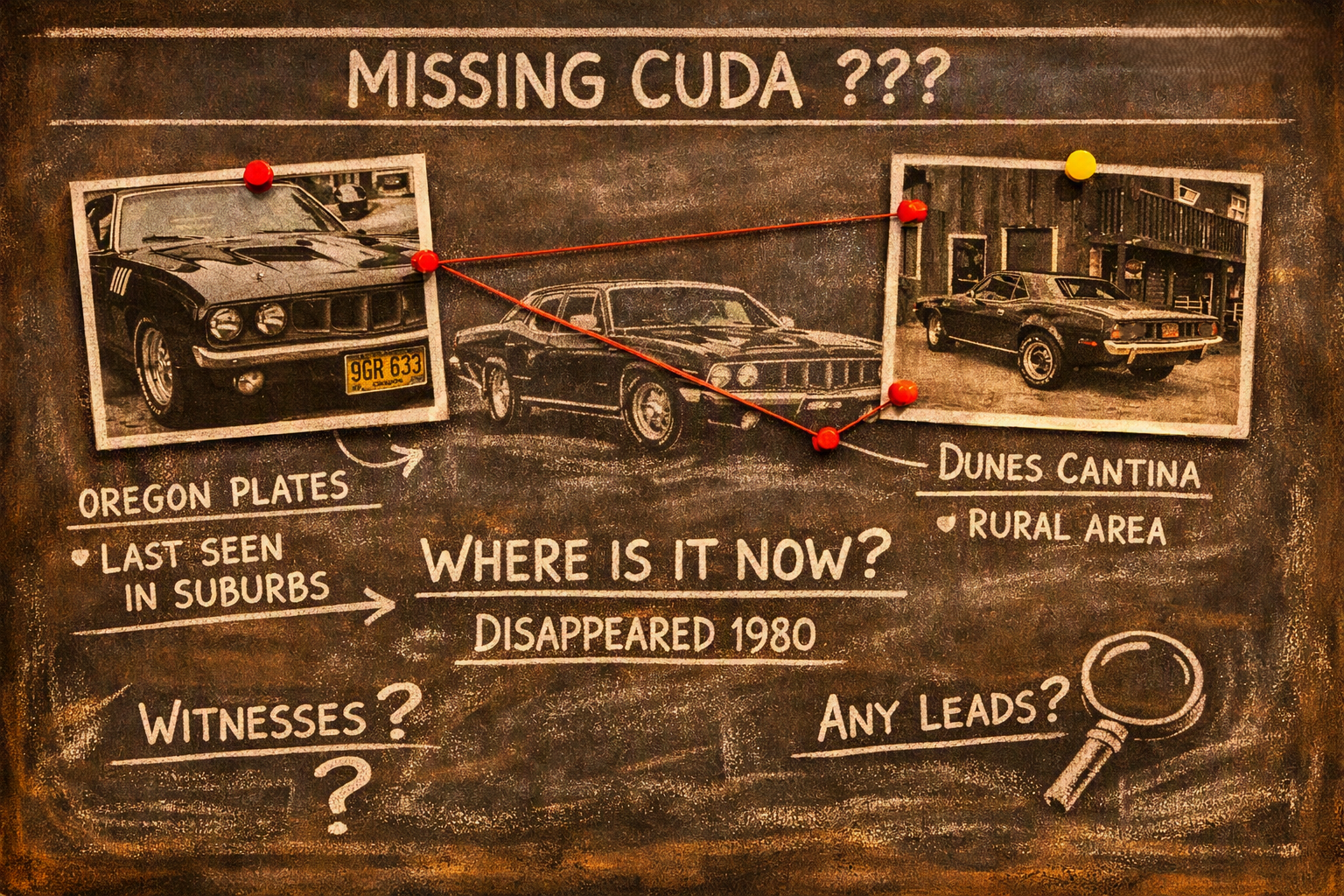
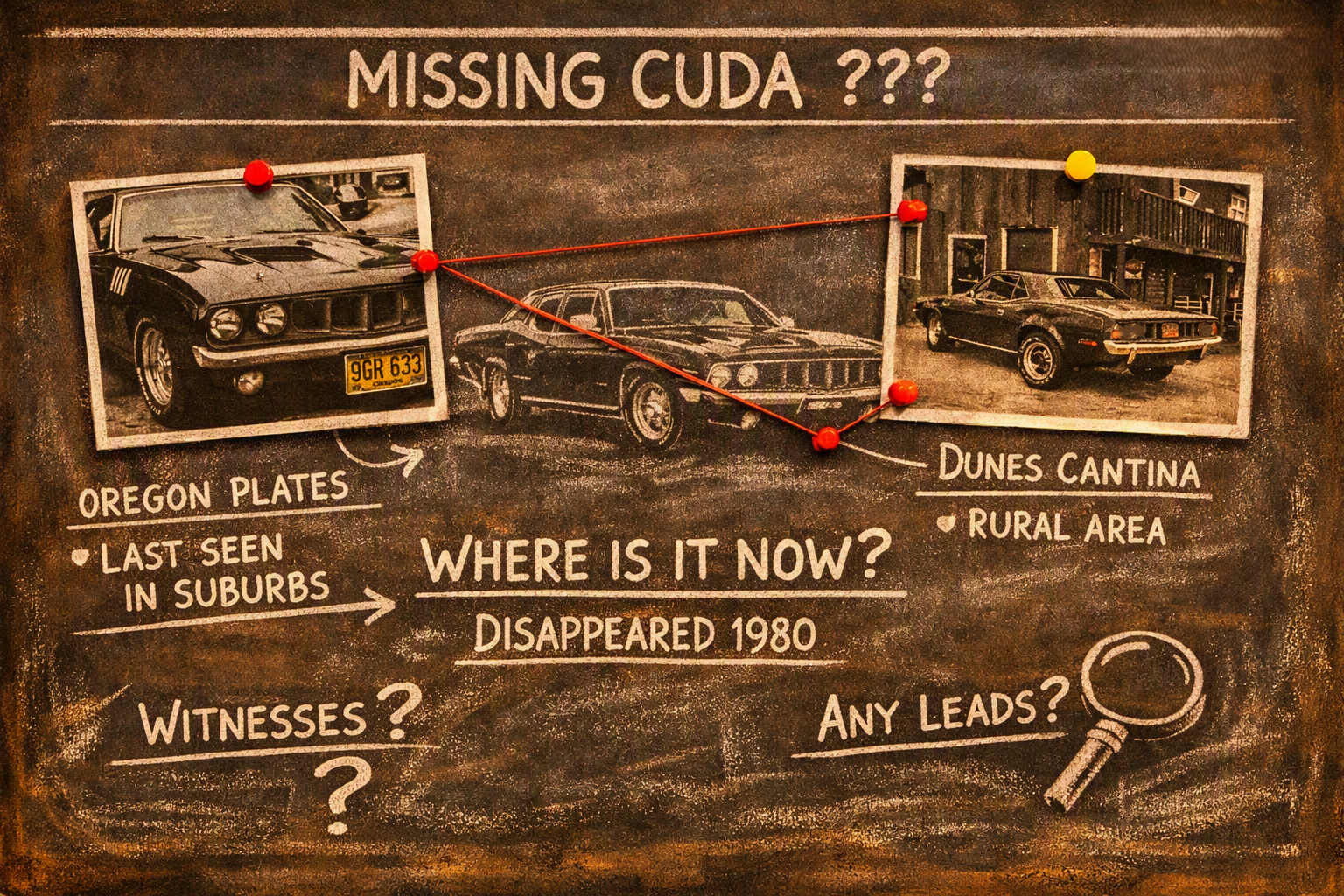
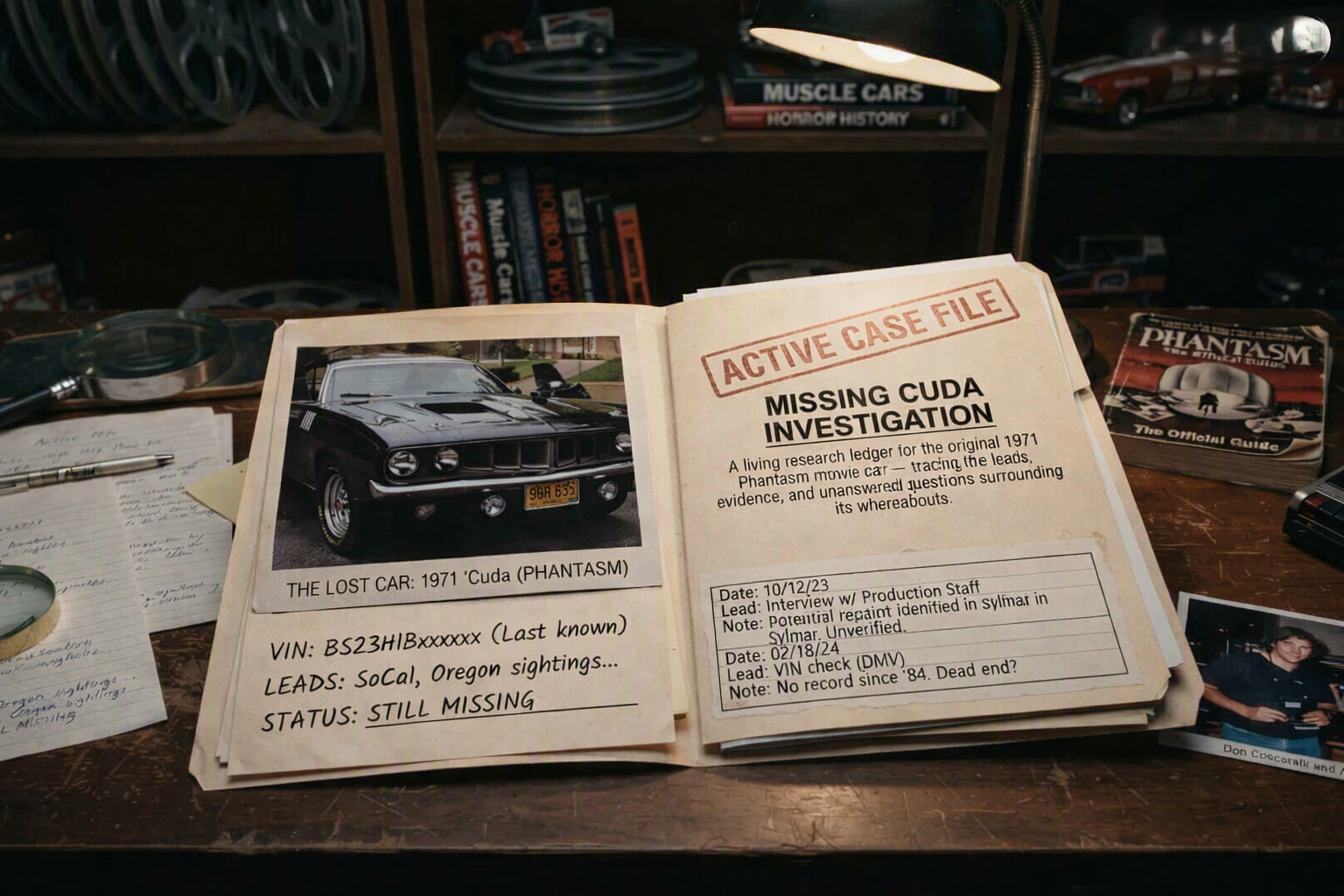
Lead 01
A prospective buyer encountered the original movie car in the San Fernando Valley, then exchanged it for a custom van after a brief roadside negotiation.
Lead 02
The account describes black-on-black-on-black finishes, flared rear fenders, an oversized tinted sunroof, a pistol-grip four-speed, rally dash, and surviving production marks.
Lead 03
No confirmed later sighting, registration record, or restoration trail has yet been connected to this specific car.
Research request
Period photographs, registration records, garage memories, production paperwork, or sightings tied to the original 1971 movie car may help extend the timeline.
All leads are treated as research material pending corroboration. PhantasmCudas.com preserves accounts and evidence for historical documentation; it does not claim ownership of the vehicle or its history.
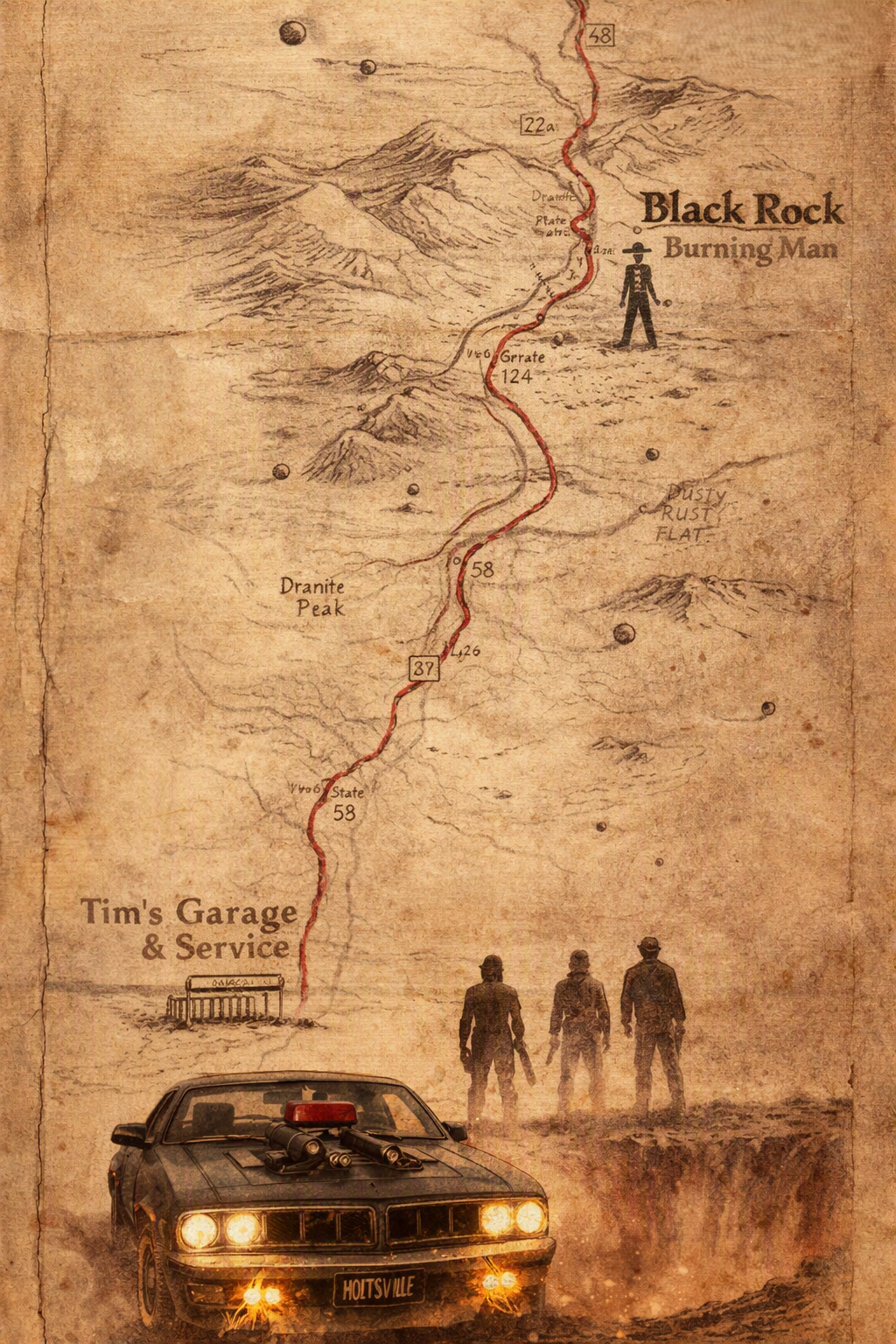
The archive has received credible intelligence that a sixth chapter in the Phantasm saga is in active development. Preliminary research suggests the iconic 1971 HemiCuda will once again anchor the film's visual identity — returning to the screen in a role that honors its legacy as the most recognizable muscle car in horror cinema history.
Whether the production will seek out the original Baker car, commission a new build, or draw from the existing documented fleet remains an open question. What is certain: the Cuda is inseparable from the Phantasm universe, and any new chapter will require its presence.
PhantasmCudas.com will monitor this development closely. If the production surfaces, the archive will be positioned to serve as a historical resource — connecting filmmakers with the documented record of every known Phantasm Cuda, the builders who shaped them, and the witnesses who remember them.
The investigation continues. The Cuda is out there. And when Phantasm VI rolls cameras — it will need to come home.
Phantasm VI — Prologue
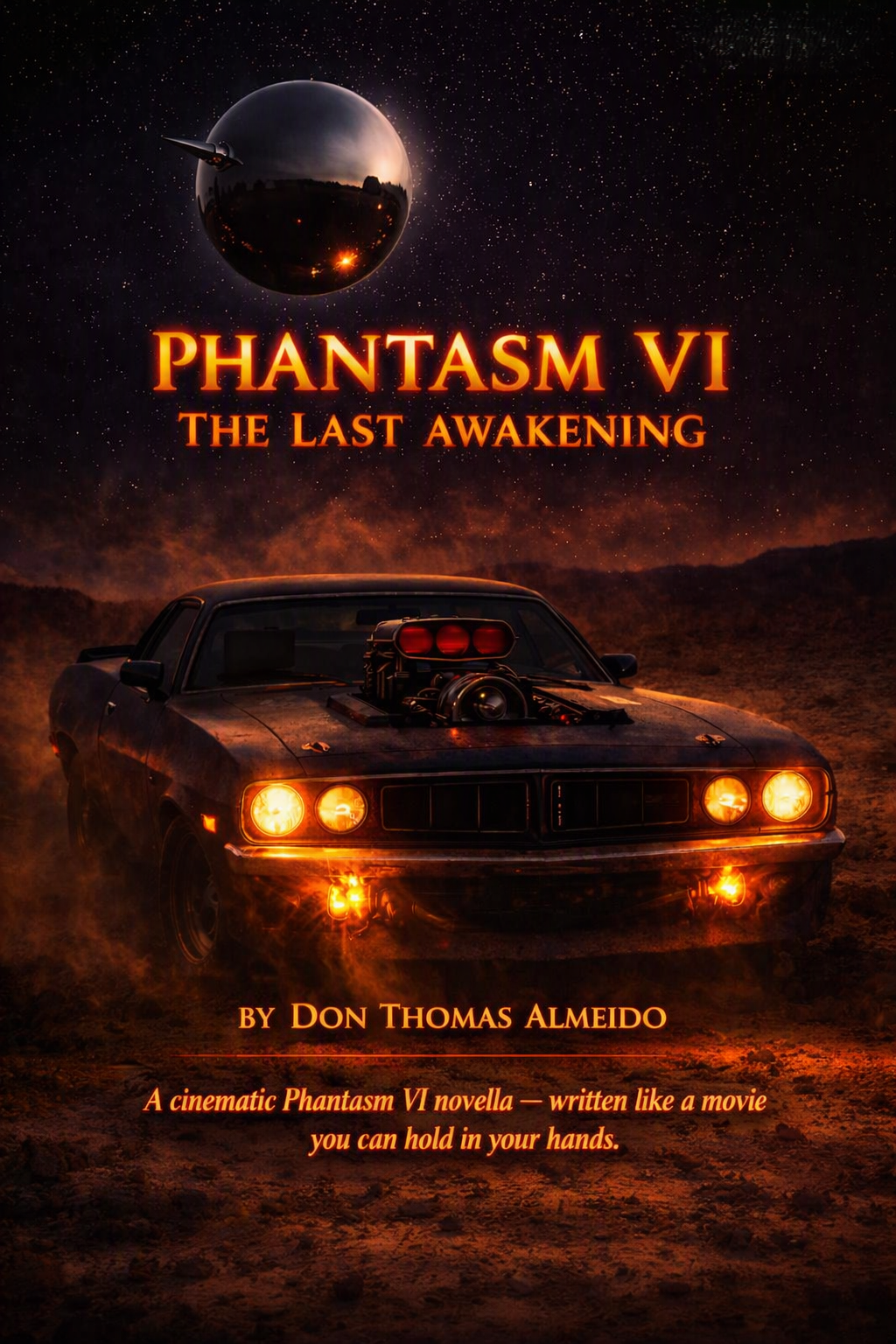
The Tall Man has returned.
The desert is waking.
And the war for our world is about to ignite.
On a forgotten stretch of Nevada highway, the Battlecuda limps into a dying service station carrying the last men still willing to hunt the Tall Man. Inside the dust-choked garage, Tim — older, hardened, and armed with secrets — reveals a machine built for a war no one else can see: the RPC-6, the Red Planet Cuda, a matte-black weapon forged from nightmares and drag-strip fury.
When silver spheres begin descending across the desert sky, Mike, Jody, and Tim launch north toward the Black Rock Desert — straight into the heart of Burning Man, where the Tall Man has been harvesting souls for decades. What begins as a rescue mission becomes a full-scale siege as the RPC-6 tears through fire, art installations, and a storm of molten spheres.
But the Tall Man's true gateway lies beneath the desert — a living crater pulsing with red light, feeding an underground network of drums, cores, and human vessels. When the brothers destroy the portal, the Tall Man shifts the war to the skies.
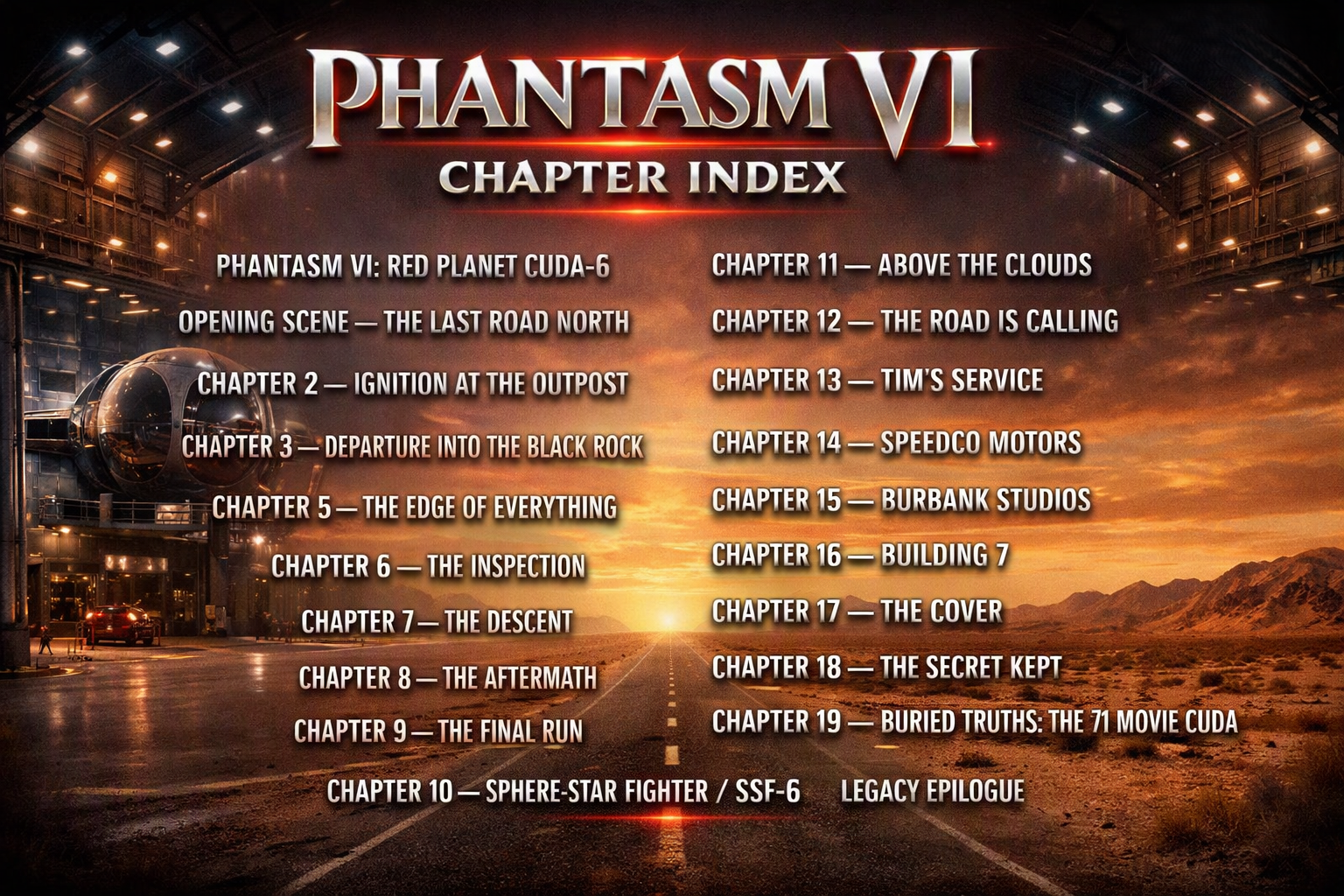
Phantasm VI — Chapter Index
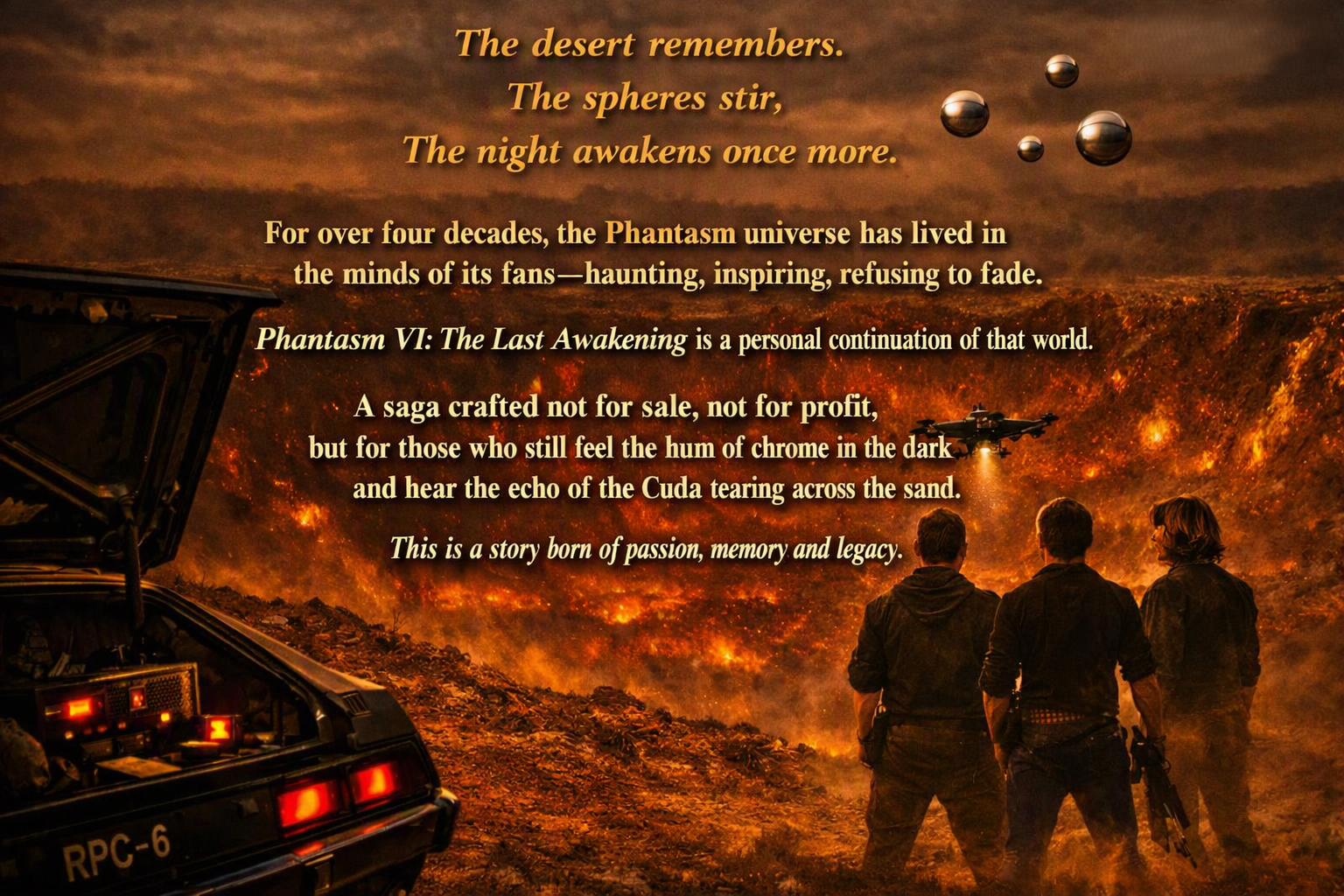
Hidden inside a classified bunker waits the SSF-6 Sphere-Star Fighter, a three-seat stealth craft built from forbidden designs. The next battle won't be fought on the ground. It will be fought above the clouds.
Phantasm VI: Red Planet Cuda Awakens is a cinematic continuation of the legendary horror saga — blending desert warfare, cosmic terror, muscle-car mythology, and the relentless pursuit of the Tall Man. This is the next chapter fans have waited decades to see.
Inside Cover — Curator's Introduction
A cinematic Phantasm VI novella — written like a movie you can hold in your hands.
The desert remembers every road, every scream, every engine that ever dared to challenge the Tall Man.
This book is one of those engines.
What you're about to read is not a script, not a treatment, and not a distant retelling. It is a direct continuation — a living extension of the Phantasm mythos, forged in the same dust, chrome, and cosmic terror that shaped the original saga.
Here, the Battlecuda limps into a dying service station.
Here, Tim unveils the RPC‑6 — a matte‑black war machine built for a fight no one else can see.
Here, the spheres fall across the Nevada sky, Burning Man becomes a battlefield, and the Tall Man shifts the war to the clouds.
This is Phantasm VI as it was meant to be experienced: fast, visual, atmospheric, and relentless.
A story told in scenes.
A world built in fire.
A road that never stops going north.
Hold tight.
The ignition is already hot.
The road goes north.
The spheres are falling.
And the war has only begun.
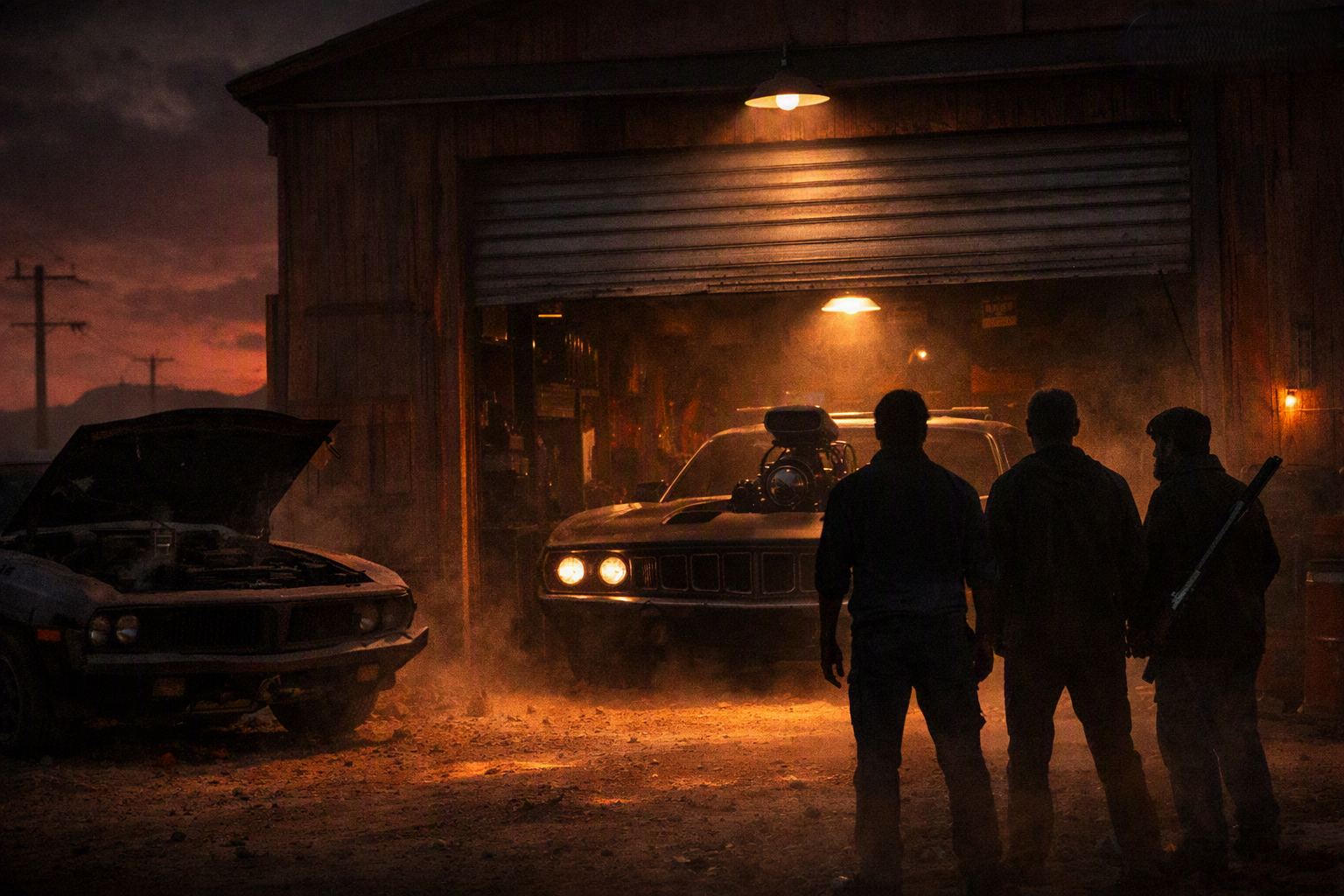
Classified archive — development intel
Somewhere along a forgotten stretch of Nevada highway, a lone service station stands against the desert wind. The Battlecuda limps in from the south, carrying the last of the warriors who still dare to hunt the Tall Man. Inside the garage, beneath flickering lights and dust-choked rafters, something waits. Something built for a war no one else can see. The ignition hasn't been fired. Not yet. But the desert already knows what's coming.
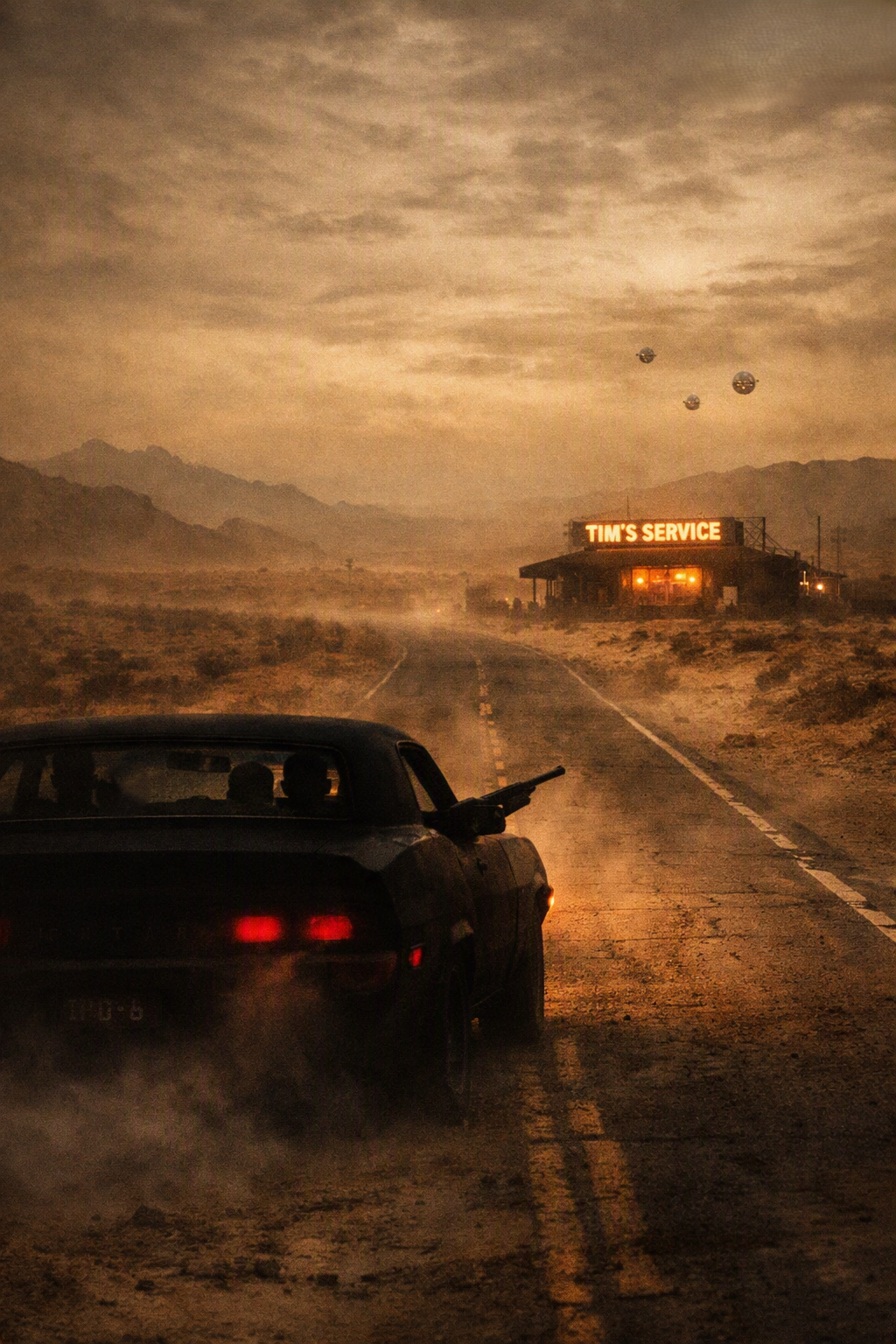
"The station door swung open. Tim stepped out."
Recovered treatment — opening scene
PHANTASM VI: RED PLANET Cuda‑6
Opening Scene — "The Last Road North"
The Nevada desert didn't care who lived or died. It stretched forever in every direction, a cracked red wasteland under a sky the color of old bone. The wind carried dust, secrets, and the faint metallic echo of spheres drifting somewhere out of sight.
The Battlecuda growled up the forgotten highway, its once‑glorious black paint now sun‑bleached and scarred. The dual blower machine fender guns coughed like an old man clearing his throat. Every mile felt like a mile too many.
Inside, Mike kept his eyes forward. Jody watched the horizon like he could see through time. And Reggie… Reggie was fading. His breaths were shallow, his skin pale, but his grip on the shotgun never loosened.
"North," Reggie whispered. "He's moving north."
Mike nodded. "We're close."
The highway bent toward a lonely shape in the distance — a tiny gas station, half‑collapsed, half‑alive. A single flickering sign buzzed in the heat: TIM'S SERVICE.
Jody exhaled. "Haven't seen that kid since the mausoleum."
The Battlecuda rolled to a stop. The engine ticked like cooling metal bones.
The station door swung open.
Tim stepped out — older now, lean, desert‑tough, a welding apron still tied around his waist. His eyes widened when he saw Reggie.
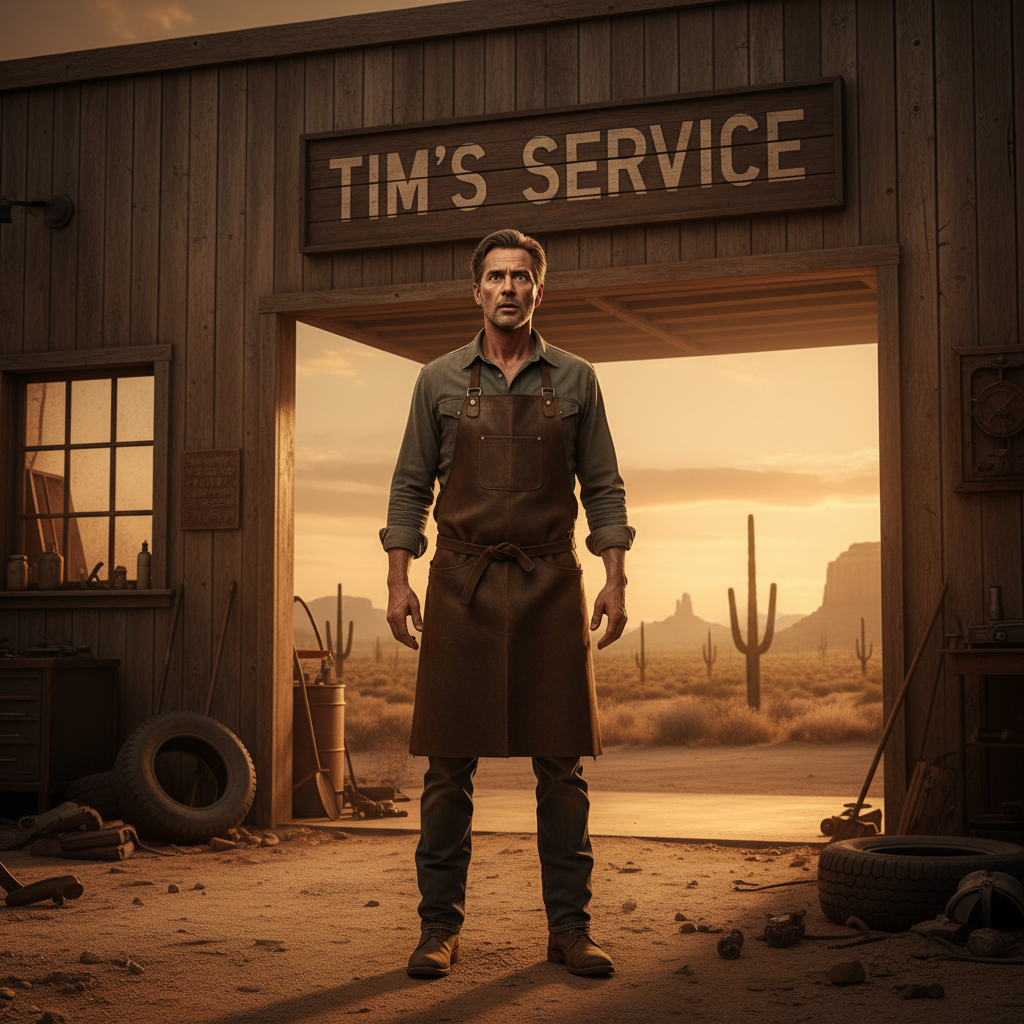
"Jesus… Reg?"
Reggie managed a smile. "Hey kid."
Tim rushed over, helping him out of the car. "You look like hell."
"Tall Man's been busy," Reggie muttered.
Tim's jaw tightened. "I know."
He motioned them toward the back of the station. "Come with me. I've been working on something."
The brothers exchanged a look.
Tim grabbed a chain and pulled. The roller door rattled upward.
And the desert seemed to hold its breath.
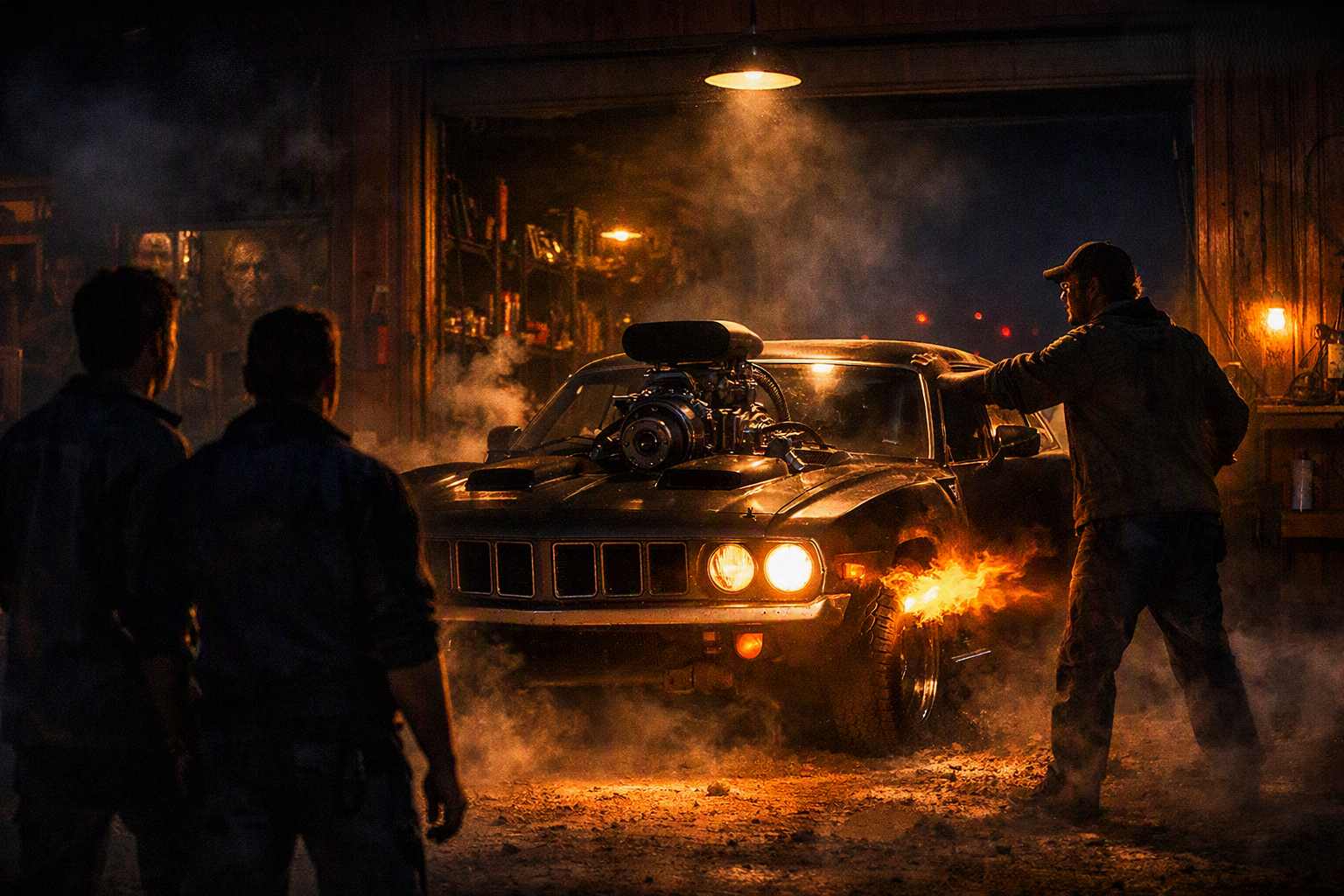
Inside the shop sat a machine that looked forged from nightmares and drag‑strip dreams — matte black, wide‑stance, blower taller than a man, open headers like cannons, Hoosier monsters ready to chew the earth. The classic '71 Cuda body remained, but everything else screamed war.
A red emblem glowed on the fender: RPC‑6.
Tim stepped beside it, pride and fear mixing in his voice. "Red Planet Cuda‑6. Built for one purpose."
Mike stared. "To kill him."
Tim nodded. "To end him. Once and for all."
Jody walked around the machine, running his hand along the welded bar frame. "This thing… it's not just a car."
"No," Tim said. "It's a weapon."
Reggie coughed, leaning against the Battlecuda. "Boys… you're gonna need it."
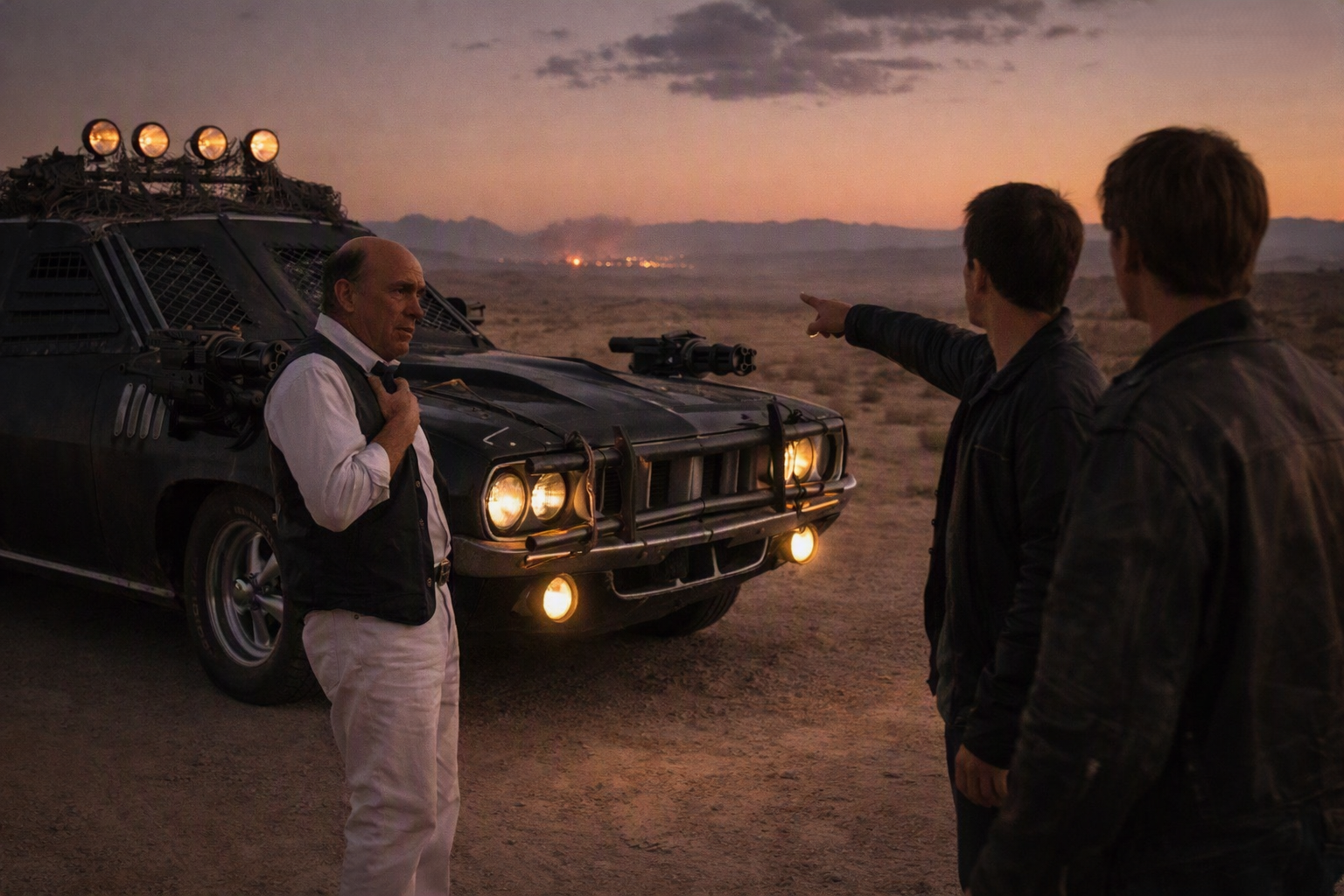
Tim looked at him, eyes heavy. "Reggie… you're not coming with us, are you?"
Reggie shook his head. "My road's almost done."
Mike swallowed hard. "Then ours isn't."
Tim pointed north, toward the invisible expanse of the Black Rock Desert. "Burning Man starts tonight," he said. "And the Tall Man's been behind it since day one."
Jody's eyes narrowed. "Then we end it tonight."
The wind picked up, carrying a faint metallic hum — spheres, somewhere out there, drifting closer.
Mike opened the RPC‑6's door.
"Let's finish this."
Recovered treatment — chapter two
The garage shook when the RPC‑6 fired.
It wasn't just noise — it was a summoning. The matte‑black blower screamed as the nitro hit, flames ripping from the side pipes and lighting the desert night like a war flare. Dust exploded off the floor. Tools rattled on the walls. The old rafters groaned like they remembered something terrible.
Mike stepped forward, eyes locked on the machine. Jody stood beside him, jaw tight, the glow reflecting off his half‑spectral skin. Tim held the driver's door, leaning into the blast of heat like he'd been waiting years for this moment.
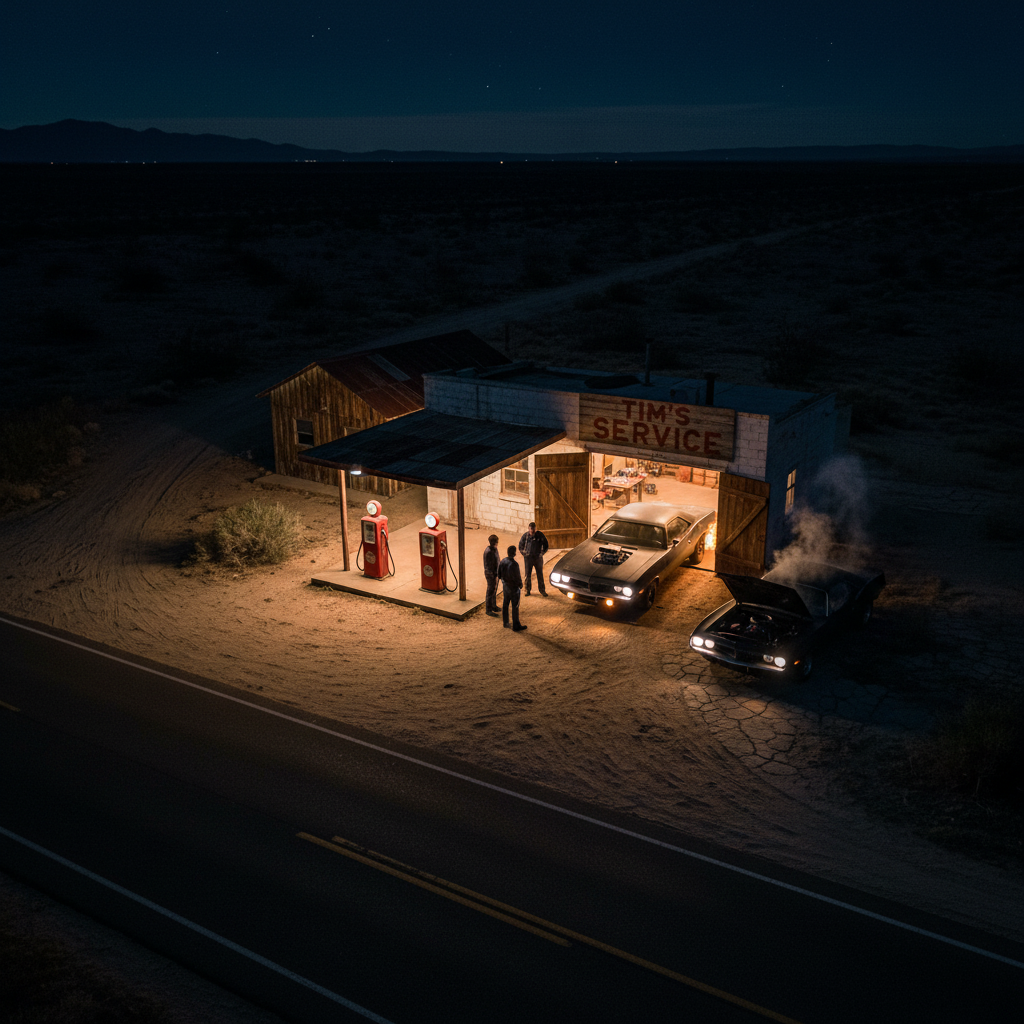
Inside the garage, the RPC‑6 roared again, louder this time. The blower spun like a turbine. The Hoosiers clawed at the concrete. The rear wing vibrated under the force.
Mike felt the vibration in his bones.
"This thing…" he whispered. "It's alive."
Tim nodded. "Built to be."
Jody stepped closer, the engine glow lighting his face. "What's the fuel mix?"
Tim smirked. "Nitro for the first run. Jet propulsion after that."
Mike exhaled. "Jesus."
Tim pointed out the garage door toward the desert. Small red lights flickered in the distance — faint, drifting, watching.
Spheres.
"They've been circling for hours," Tim said. "They know you're here. They know he's here."
The RPC‑6 growled, the idle uneven, angry, hungry.
Reggie's reflection shimmered faintly in the dusty garage window — a ghost watching the machine he'd never get to ride. His voice echoed softly behind them.
"Boys… you better move."
Mike swallowed hard. "We're going north."
Tim nodded. "Black Rock Desert. Burning Man. He's already started."
Jody placed a hand on the RPC‑6's roof. "Then we finish it."
The engine surged again, flames blasting from the pipes, lighting the silhouettes of the brothers like warriors standing at the edge of a new war.
The desert outside pulsed with red lights.
The Tall Man was waiting.
And the RPC‑6 was ready.
Recovered treatment — chapter three
The desert swallowed the sound of the garage behind them.
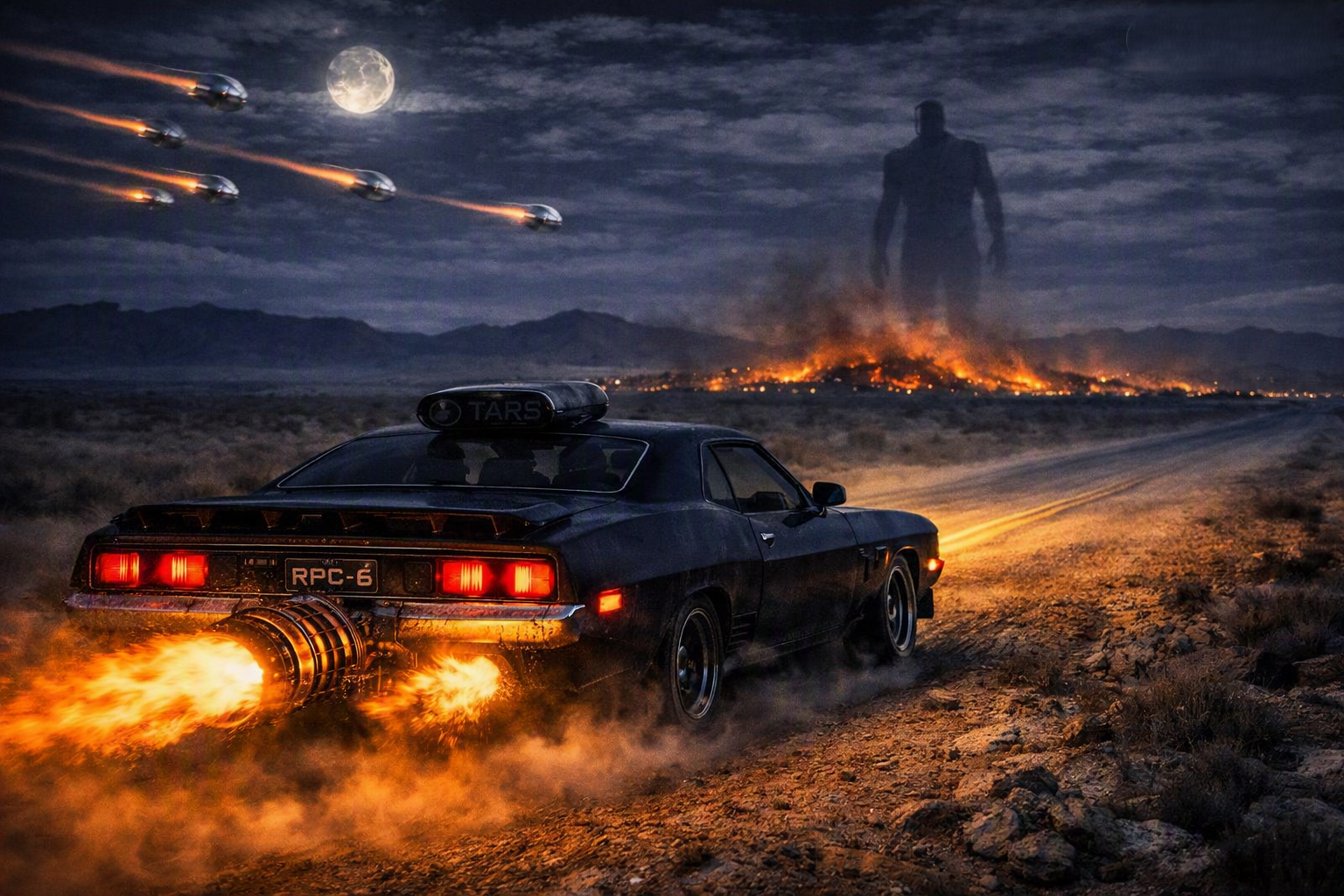
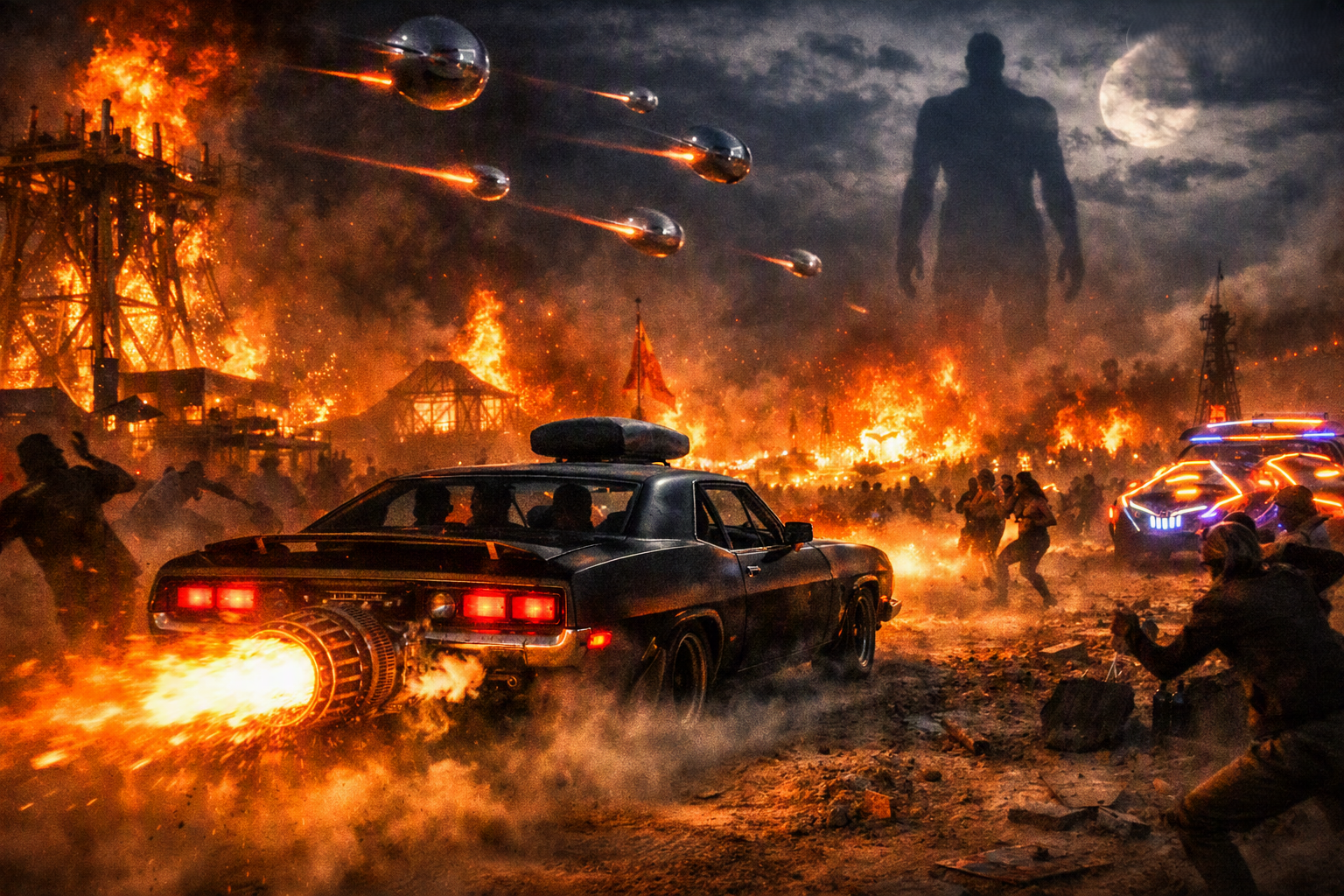
The RPC‑6 tore north, its tires throwing gravel and sparks, the nitro flames painting the sand in streaks of orange. The night was endless — a black ocean stretching toward the horizon.
Inside, Tim gripped the wheel, eyes locked ahead. Mike watched the sky. Jody flickered in and out of the dashboard light, half‑ghost, half‑guardian.
The car's blower screamed, the jet system primed. Every mile brought them closer to the Tall Man's domain — the Black Rock Desert, where the Burning Man festival pulsed like a beacon for the damned.
Spheres drifted overhead, silent and silver, their reflections flashing across the windshield. Mike could feel them — thousands, maybe more — moving in formation.
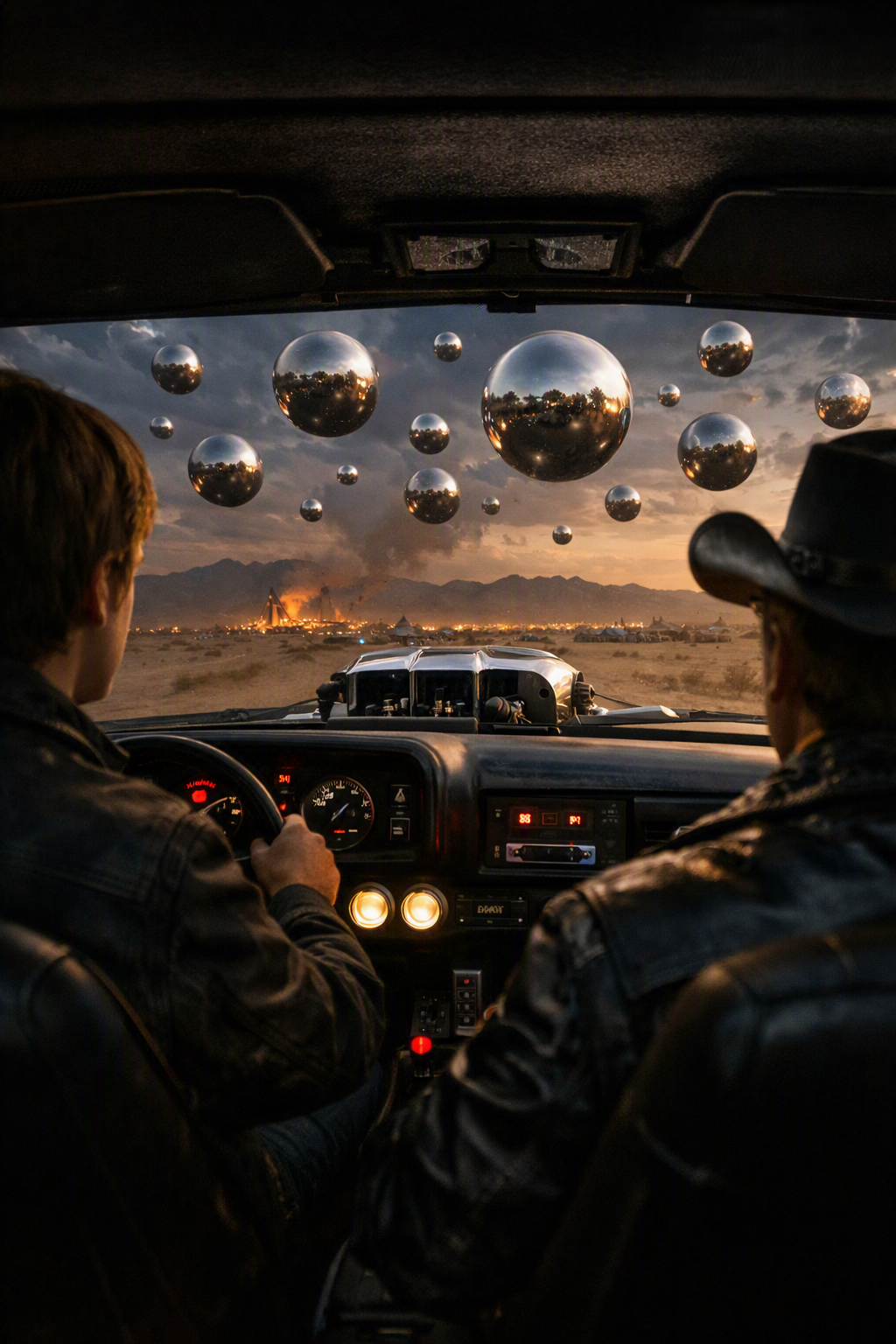
"He's building something," Mike said quietly.
Tim nodded. "A world."
Jody's voice was low. "Then we burn it."
The RPC‑6 hit the flats, the nitro fading, the jet propulsion kicking in. The rear thrusters ignited, blasting a column of fire that split the night. The car lifted slightly, skimming the cracked earth like a predator.
In the distance, the festival lights shimmered — towers, flames, silhouettes dancing in the dark. But beneath the music, beneath the laughter, something else moved. Something mechanical. Something alive.
Mike leaned forward. "He's already here."
Tim tightened his grip. "Then we don't stop."
The RPC‑6 roared, the jet flame cutting through the desert haze. Behind them, the spheres descended — hundreds of them, glowing red now, their hum merging into a single, terrible frequency.
The brothers didn't look back.
The desert was awake.
And the war had begun.
Recovered treatment — chapter four
The festival was alive — music, fire, and madness. But beneath the laughter, the ground trembled.
The RPC‑6 tore through the outer ring, its jet thruster screaming, flames slicing the night. Crowds scattered, thinking it was part of the show. They didn't see the silver spheres descending from the sky.
Mike slammed the throttle. "They're here!"
Jody's spectral form flickered, his voice echoing. "Too many!"
Tim gritted his teeth. "Then we burn them all."
The first sphere hit the sand beside them, detonating in a burst of red light. The air filled with metallic shrieks — hundreds of them, slicing through tents and towers. The Tall Man's voice rolled across the desert like thunder.
"You cannot kill what is already dead."
The brothers didn't answer. The RPC‑6 roared, its nitro fading, jet propulsion kicking in. Flames erupted from the side pipes, turning the car into a comet of fury.
Reggie's voice whispered through the radio — faint, ghostlike.
"Finish it, boys."
The car plowed through the center of the festival, smashing through art installations and fire sculptures. Each sphere that touched the jet flame exploded in molten shards. The desert became a battlefield of light and shadow.
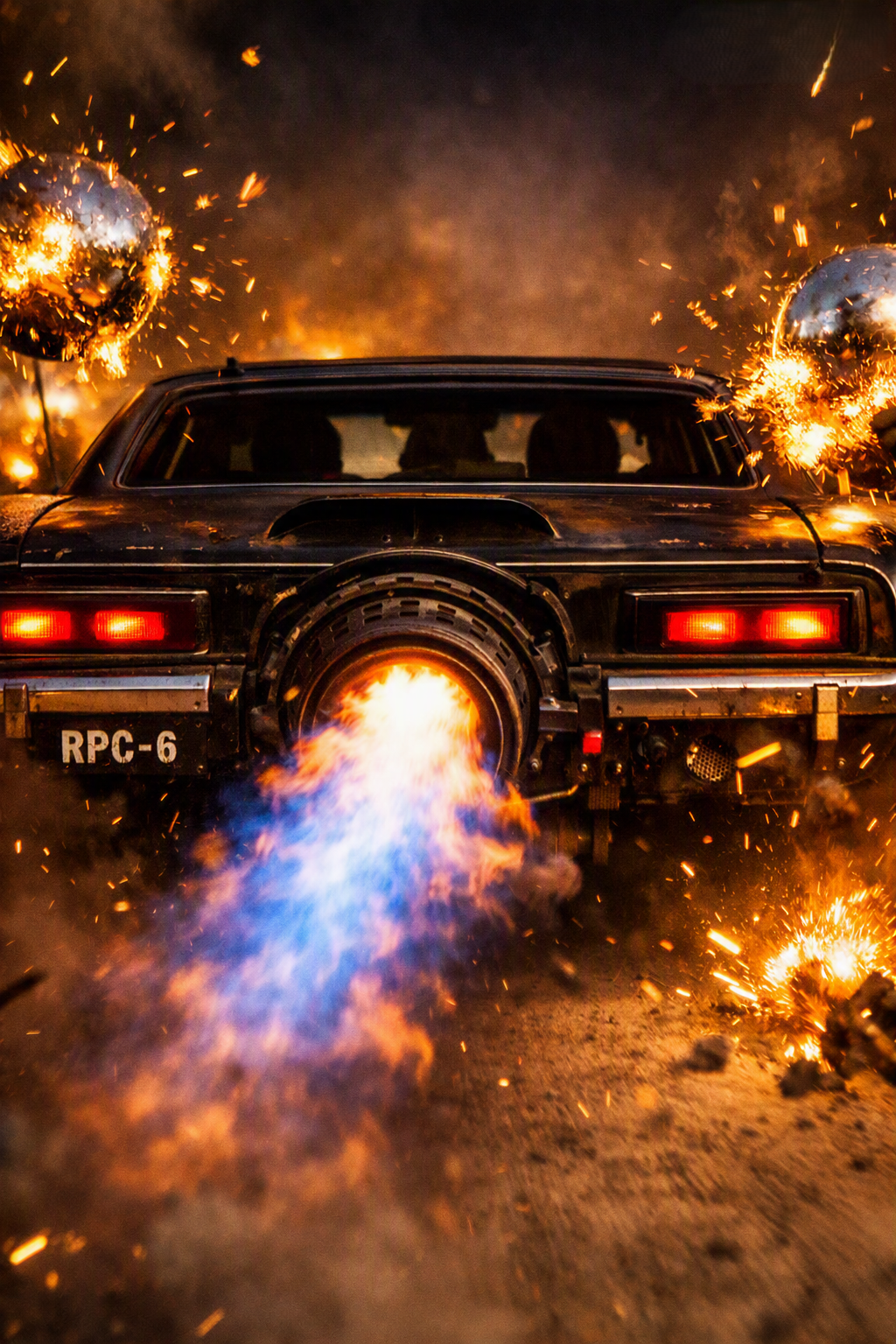
In the distance, the Tall Man's silhouette towered above the chaos, his hand raised, commanding the swarm.
Mike looked at Jody. "We end it now."
Jody nodded. "Together."
The RPC‑6 turned toward the horizon, the jet flame burning brighter than the fires around them. The brothers charged straight into the storm.
The desert screamed.
The spheres fell.
And the war began.
Recovered treatment — chapter five
The desert has gone silent.
The fires have burned out.
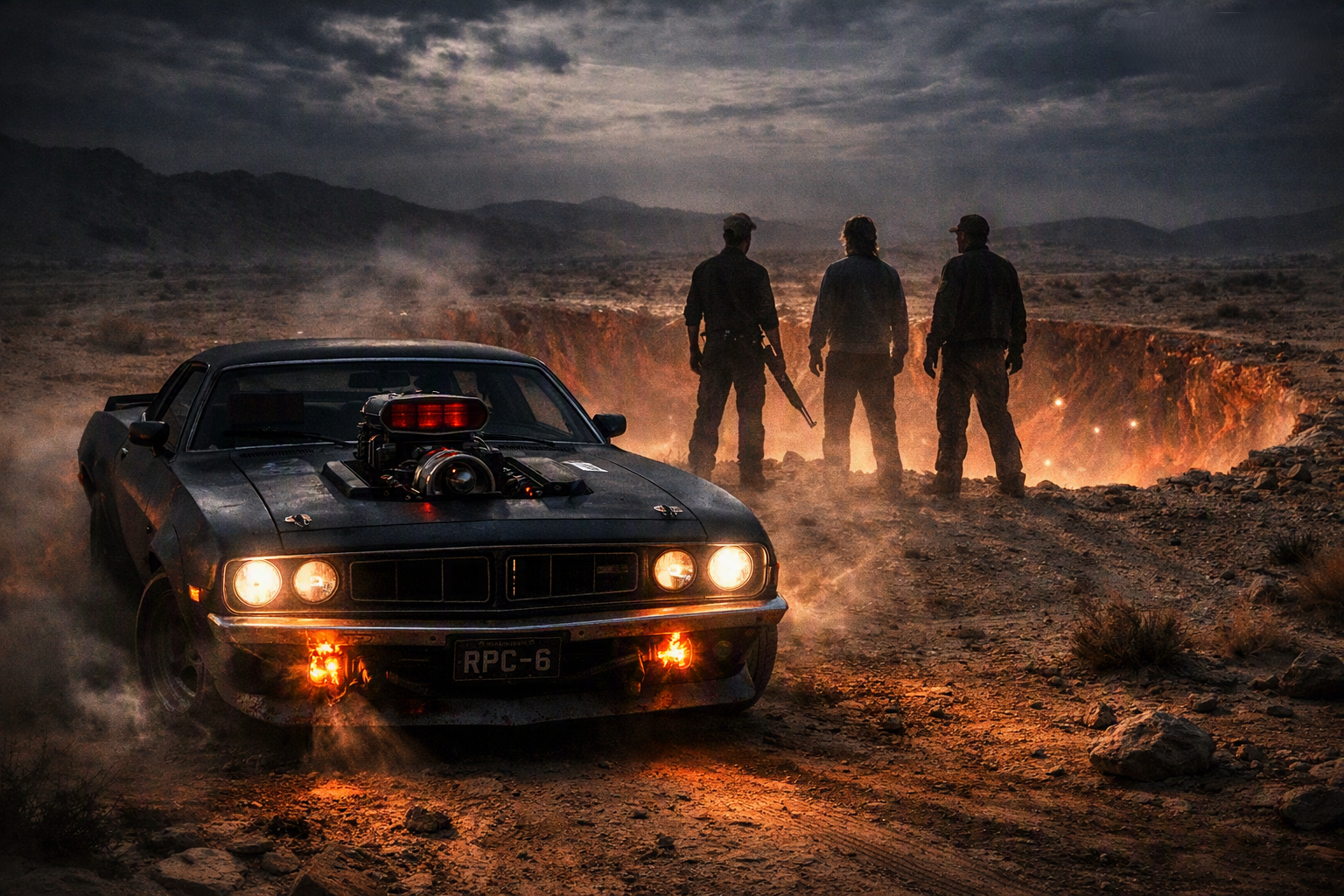
The brothers stand at the edge of something that isn't earth anymore.
The RPC‑6 idles before a crater that breathes light and shadow — a doorway to the Tall Man's world.
No one speaks.
The wind carries the sound of spheres somewhere below.
The ignition is still hot.
The next move will decide everything.
Recovered treatment — chapter six
The crater wasn't just a hole — it was a wound.
A perfect circle carved into the desert, humming with a low metallic vibration that made the sand tremble under their boots. The glow from below pulsed like a heartbeat.
Tim stepped forward, jaw tight, eyes locked on the abyss.
"Alright," he muttered. "Let's see what he's hiding."
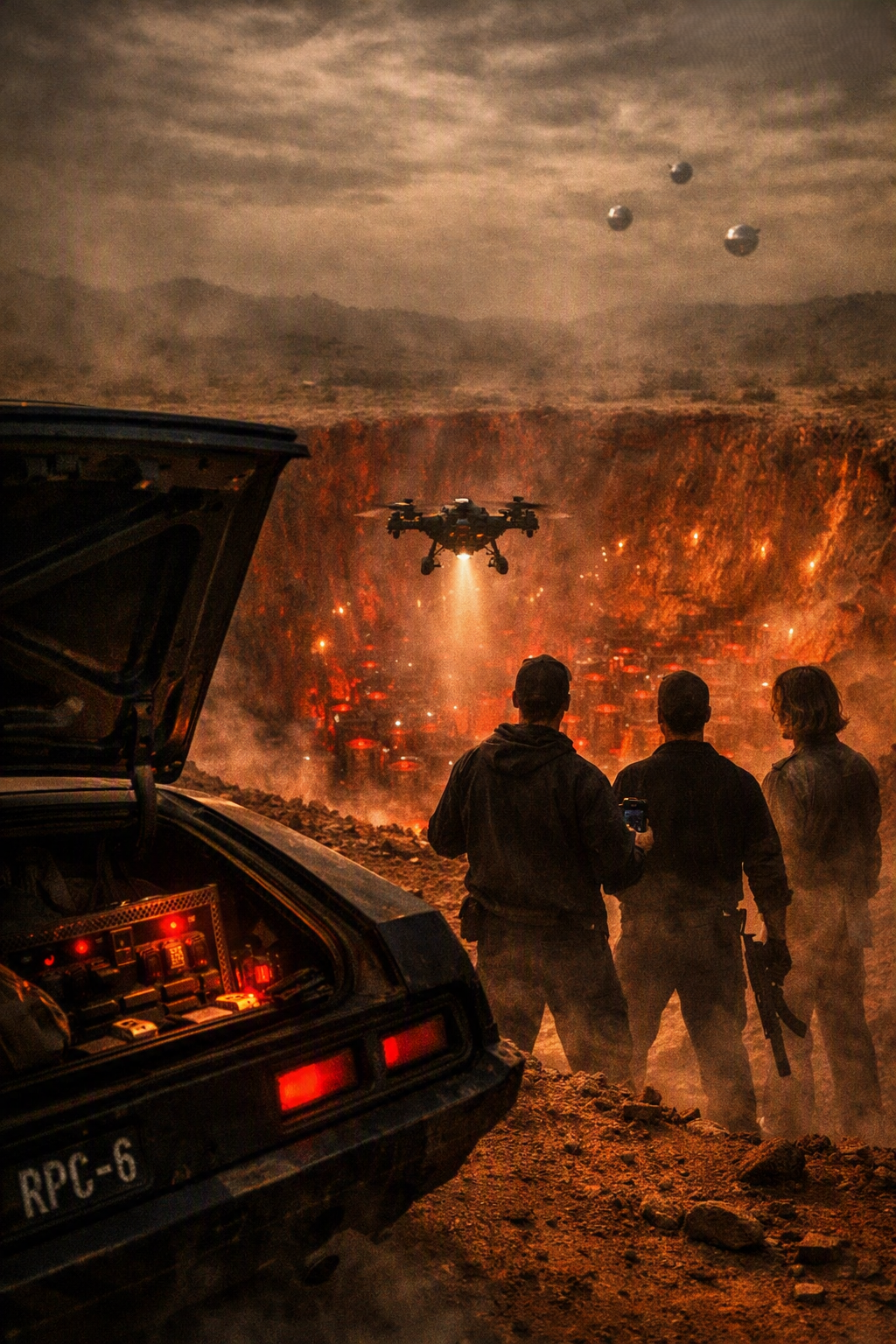
He popped open a reinforced case he'd dragged from the RPC‑6's trunk. Inside sat a compact military‑grade recon drone — desert‑tan, armored, with a downward‑facing spotlight and a stabilizer rig he'd welded himself.
Mike raised an eyebrow. "You came prepared."
Tim smirked. "I've been watching his patterns for years. He always leaves a trail."
Jody stared into the crater, his half‑spectral outline flickering in the glow. "This isn't just a trail. It's a supply line."
Tim powered the drone. The rotors spun up with a sharp whine, and the machine lifted off his palm, drifting over the crater's edge. Its spotlight cut through the swirling dust as it descended.
The three of them watched the live feed on Tim's handheld monitor. At first, only darkness. Then shapes. Then clarity.
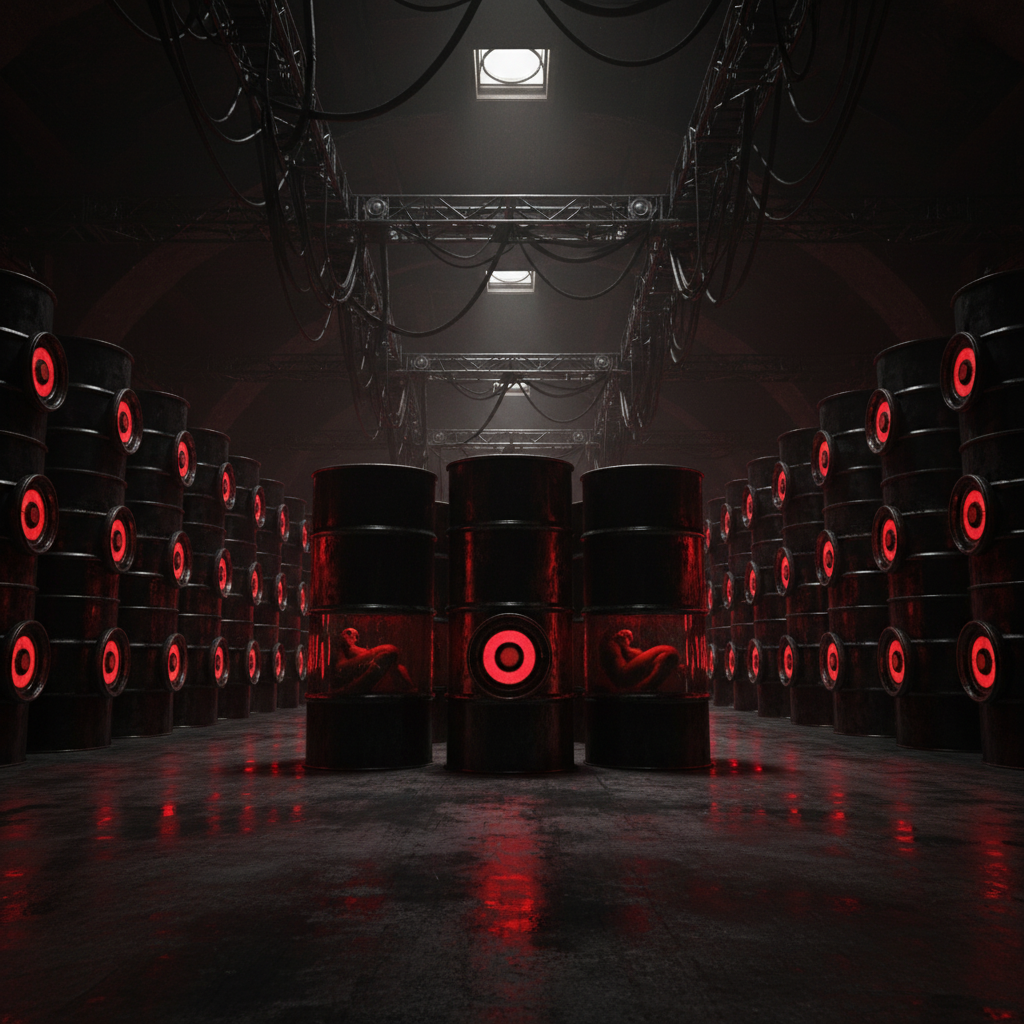
Mike's breath caught. "Jesus… he's harvesting them."
Jody's voice was low, grim. "Burners. Every year. He's been taking them since the first incineration."
The drone dipped lower, revealing conveyor arms, sphere‑drones, and a massive vertical shaft leading even deeper underground — a transport tunnel.
Tim swallowed hard. "He's shipping them out. To his world."
The monitor flickered as the drone passed a cluster of drums. Inside one, a faint silhouette moved — a human shape, curled, suspended, unconscious.
Reggie's voice echoed in their memory: He's moving north.
Mike clenched his jaw. "This is his porthole."
Jody stepped closer to the edge, eyes burning with resolve. "Then we blow it."
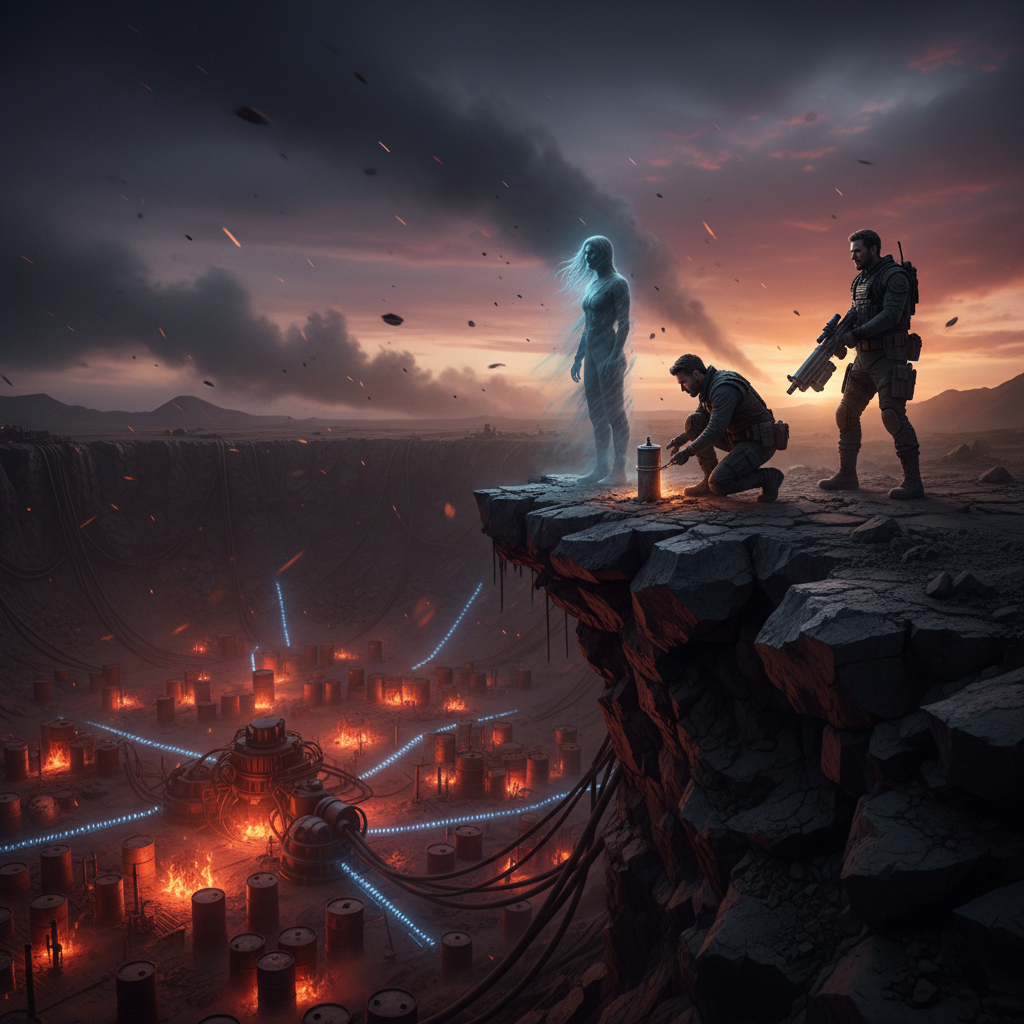
Tim nodded, already reaching back into the RPC‑6's trunk. He pulled out a heavy duffel bag — reinforced canvas, desert‑worn, stuffed with shaped charges and detonator rigs.
Tim came prepared.
He dropped the bag at their feet. "I brought enough to collapse the entire shaft."
Mike looked at him. "You sure?"
Tim stared into the crater, the glow reflecting in his eyes. "We stop the infestation here. Tonight."
Jody placed a hand on the RPC‑6's fender, the red emblem glowing under his touch.
"Let's end his pipeline."
The wind shifted — carrying the faint metallic hum of spheres rising from below.
Mike chambered a round. Tim armed the first charge. Jody whispered, "Tall Man… your road ends here."
And together, the trio prepared to descend.
Recovered treatment — chapter seven
The drone feed went dead.
One flash of static, then nothing but the hum of the crater.
Tim lowered the controller, jaw set. "He knows we're here."
Mike stared into the red glow below. "Then we move now."
The RPC‑6's trunk slammed shut, the detonator case locked and armed. Dust swirled around the car as the wind picked up — the desert itself seemed to recoil from what was about to happen.
Jody stepped forward, half‑spectral, his outline flickering in the heat. "We go together."
Tim nodded, grabbing the duffel of charges. "We plant them along the rim first. Then we drop the rest down the shaft."
Mike chambered a round, the sound echoing like thunder. "Once the fuse runs, there's no turning back."
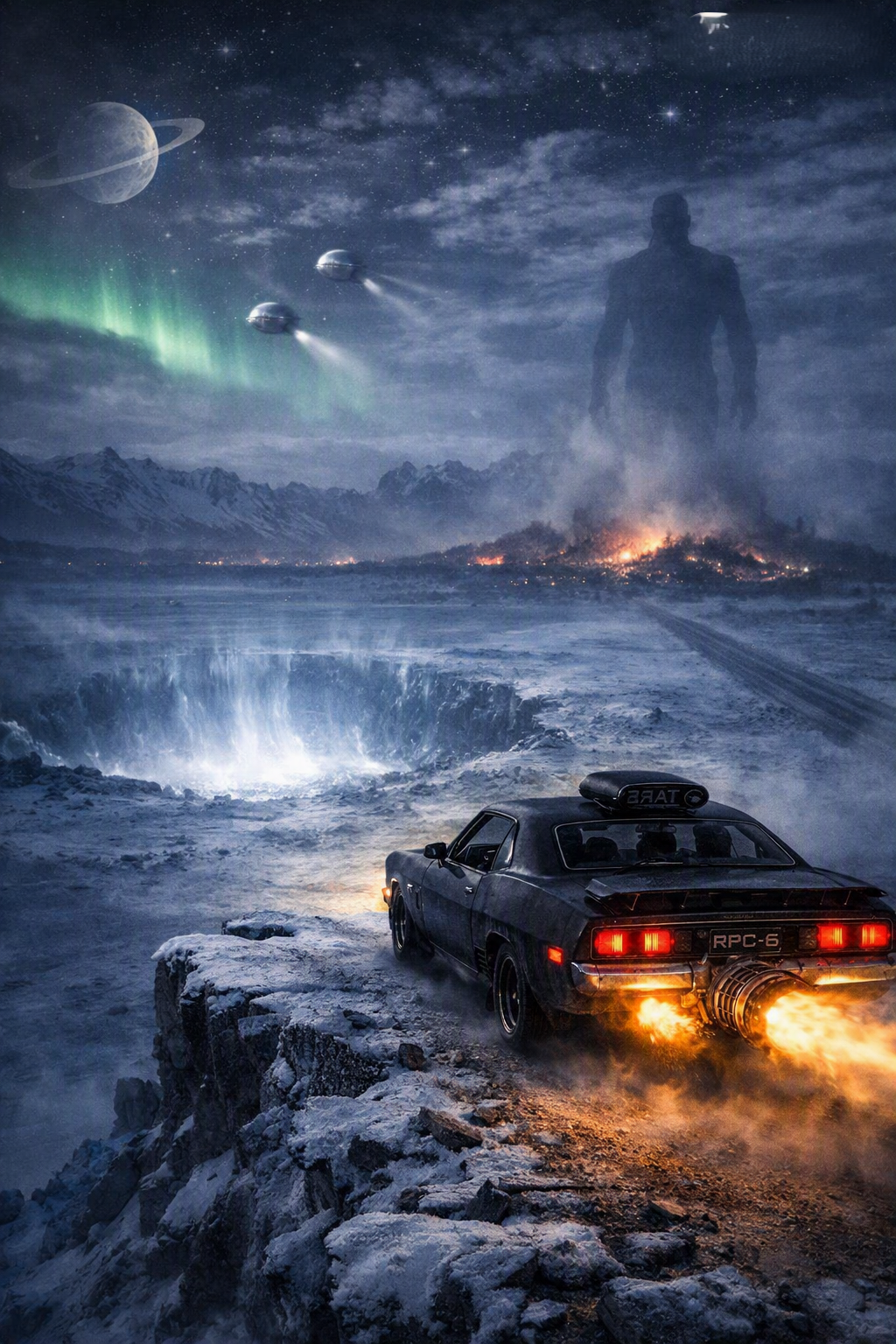
The three moved in silence, circling the crater's edge. Each step kicked up ash and fragments of glass — remnants of the Burning Man's last incineration. The air shimmered with heat and something else… movement beneath the surface.
From below came a sound — mechanical, rhythmic, alive.
The crater wasn't just a hole. It was breathing.
Tim crouched, setting the first charge. "He's using the burners as conduits. Every drum down there is a vessel."
Jody's voice was low. "Slaves."
Mike looked up at the horizon. "Not anymore."
They finished the perimeter, wires snaking back toward the RPC‑6. Tim climbed into the driver's seat, flipping open the detonator panel. The red emblem on the fender pulsed like a heartbeat.
"Ready?" he asked.
Jody nodded. "Do it."
Tim pressed the switch.
The charges ignited in sequence — flashes of white light racing around the crater rim. The ground shook, the air split, and the red glow below flared into chaos.
The drums ruptured, sending columns of fire and black smoke into the night. The crater screamed — a sound not of earth, but of something deeper, older, furious.
Mike gripped the shotgun as the first sphere burst from the smoke, spinning toward them. He fired, the blast tearing it apart mid‑air.
Jody shouted over the roar. "He's coming!"
Tim slammed the accelerator. The RPC‑6 roared, tires spitting dust and flame as it backed away from the collapsing rim.
Behind them, the crater imploded — a vortex of red light swallowing the drums, the machinery, and the Tall Man's portal itself.
The desert went silent.
Only the wind remained.
Mike looked at Tim. "Did we stop it?"
Tim stared at the horizon, where faint silver lights still drifted in the sky. "We slowed him down."
Jody's voice was faint, echoing like a ghost. "But he's never really gone."
The RPC‑6 idled, its blower glowing faintly red.
Mike exhaled. "Then we keep driving."
Tim nodded. "North."
The car turned toward the horizon, the desert stretching endlessly ahead — cracked, red, and waiting.
The ignition flared.
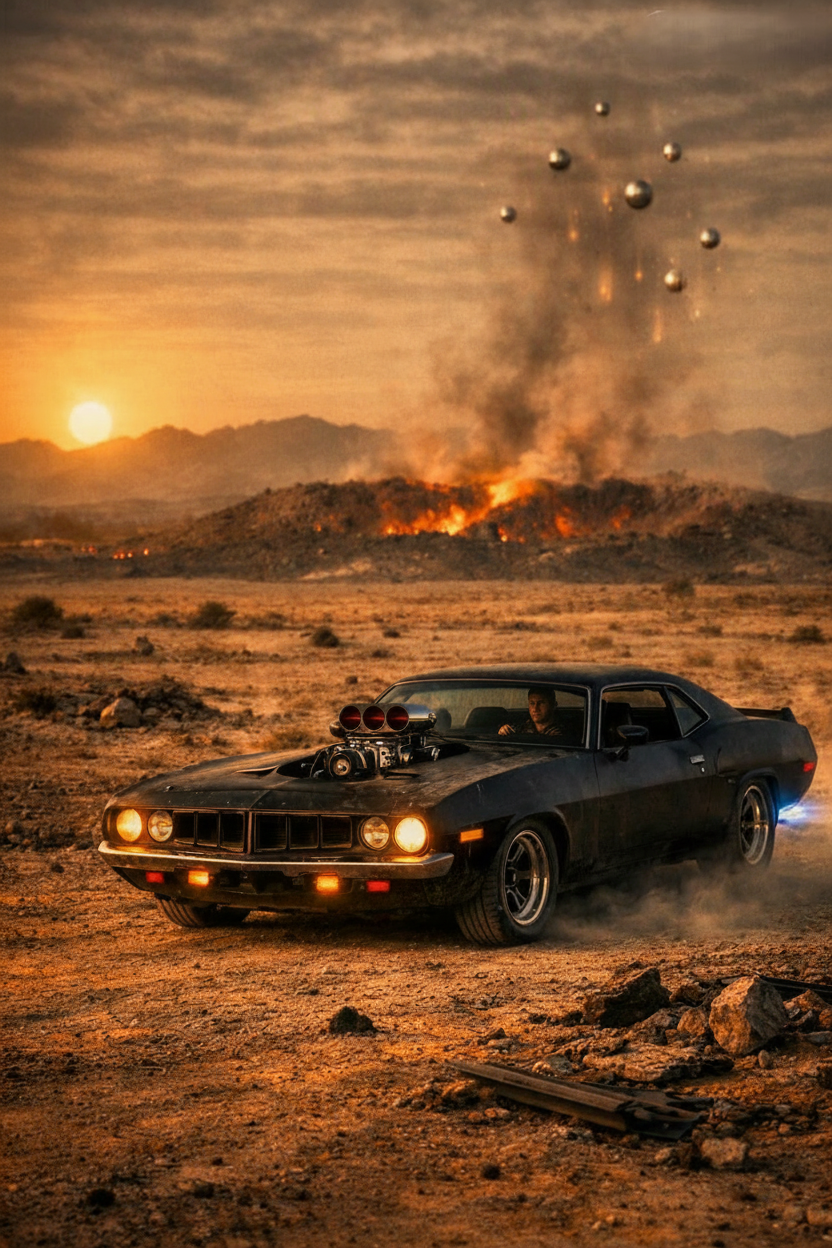
Recovered treatment — chapter eight
The desert was silent again.
Ash drifted like snow across the cracked earth, settling on the twisted remains of the crater. The air shimmered with heat and static, the kind that hums inside your bones. The explosion had erased the portal — but not the presence.
Tim stood beside the RPC‑6, face streaked with dust and sweat. The detonator hung limp in his hand, its lights dead. "It's done," he said quietly.
Mike scanned the horizon. "No. It's changing."
The ground where the crater had been was no longer solid. It pulsed — faintly, rhythmically — like something breathing beneath the surface. The red glow was gone, replaced by a dull, black shimmer that swallowed light.
Jody stepped forward, his outline flickering. "He's rebuilding."
Tim kicked at the dirt. "We buried his gate."
Mike shook his head. "You buried one of them."
The wind shifted, carrying the faint metallic hum of spheres — distant, but moving. The sound was slower now, deliberate, like they were searching.
Tim opened the RPC‑6's trunk again. The C‑4 was gone, spent. Only the scorched duffel remained. "We've got nothing left."
Jody looked up at the sky. "He's not coming from below anymore."
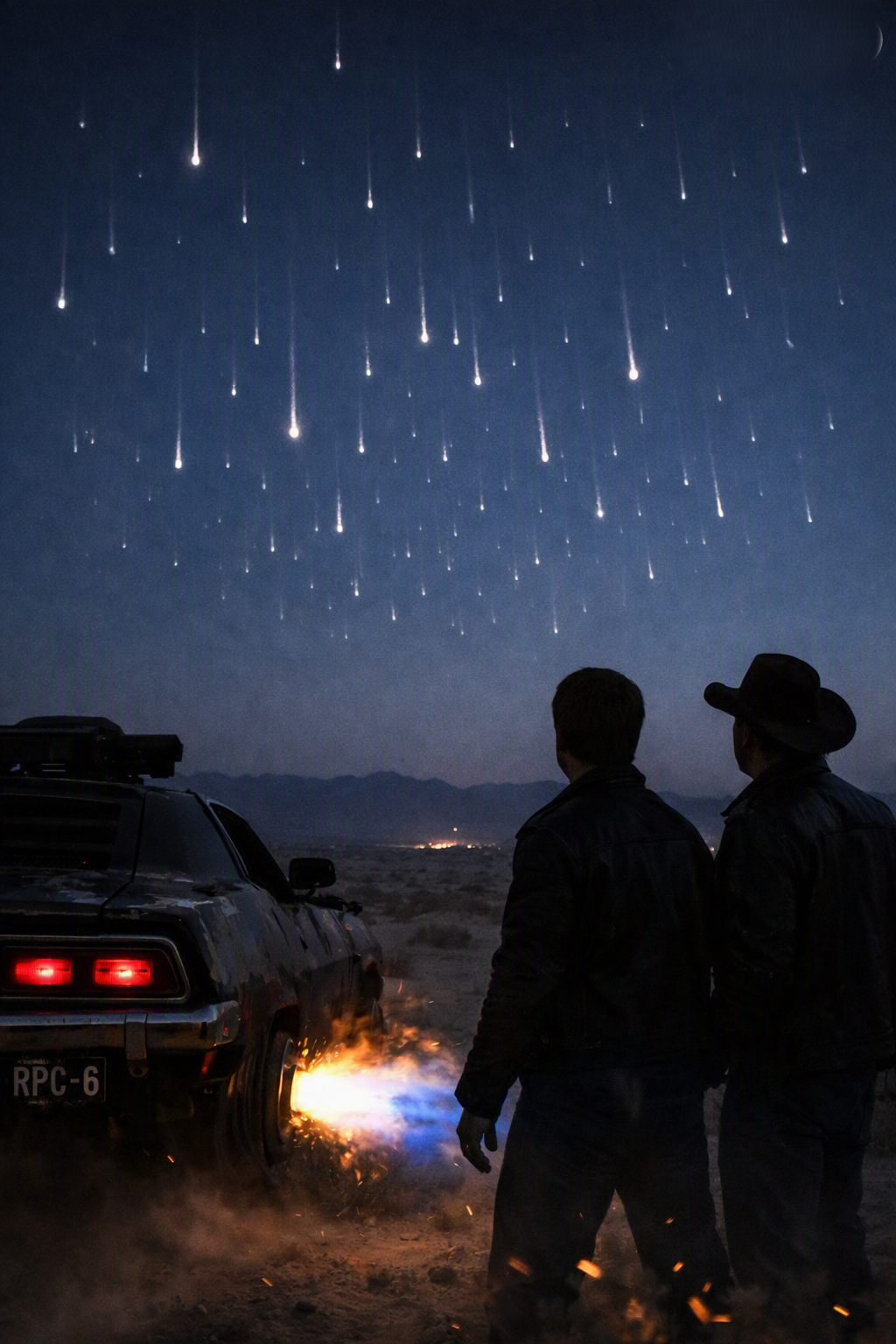
Mike followed his gaze. High above, faint silver dots shimmered against the bone‑colored sky — spheres descending from orbit, hundreds of them, like falling stars.
Tim whispered, "He's bringing the war topside."
The RPC‑6's blower coughed once, then roared back to life. The red emblem on the fender flickered weakly, pulsing like a dying heart.
Mike climbed in, shotgun across his lap. "We drive."
Tim nodded, sliding behind the wheel. "North?"
Jody smiled faintly. "Always north."
The car rolled forward, tires crunching over ash and glass. Behind them, the crater began to collapse inward — a slow, grinding motion that sounded like the earth swallowing itself.
The horizon glowed faintly red again.
Tim pressed the accelerator.
The RPC‑6 tore across the wasteland, leaving a trail of dust and fire behind.
And somewhere far above, the spheres began to fall.
Recovered treatment — chapter nine
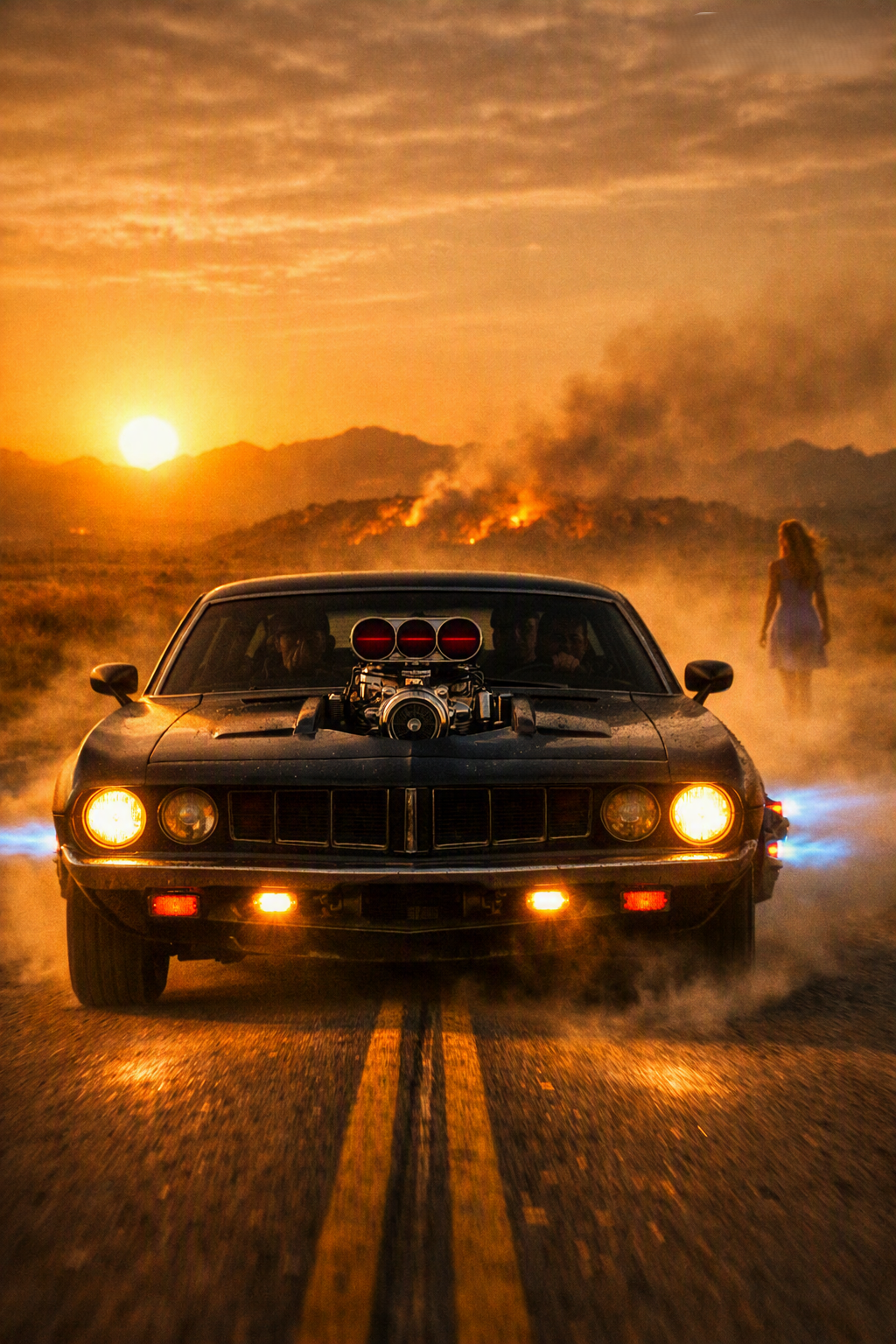
The RPC‑6 hit asphalt like a hammer striking steel.
After miles of flat rock and sand, the two‑lane highway felt almost alien — smooth, dark, endless. The car's tires hissed against it, the nitro mix burning hot through the lines. The rear jet propulsion system had done its job perfectly, carrying them clear of the crater and whatever was left beneath it.
Tim's welds had held. The reinforced cage gleamed faintly under the rising sun, smoke drifting across the Black Mountain ridges. The Cuda was battered, scorched, but alive — just like its crew.
Inside the cabin, silence. Only the sound of the blower winding up, the hemi screaming through high gear — mechanical music for men who'd seen too much.
Reggie's absence hung heavy. The thought of him back at the service station — alone, waiting for the inevitable — sent a chill through the cabin louder than the engine itself.
Mike leaned forward from the back seat, voice low. "This was for you, Reg."
Tim caught his reflection in the rearview mirror, eyes wet, jaw tight. Jody reached across, resting a hand on Mike's leg and Tim's shoulder — the older brother's touch, steady and final. He looked out the side window, the desert rolling by in streaks of gold and ash.
"Hell of a way to start a trio," he said.
They all nodded, the kind of nod that means everything and nothing.
Then — movement.
A figure on the side of the highway, far ahead, walking with her back turned. Tim downshifted, the bark of the exhaust echoing across the empty road. The woman flinched, startled by the sound.
Mike squinted. "She's a survivor. From the burn."
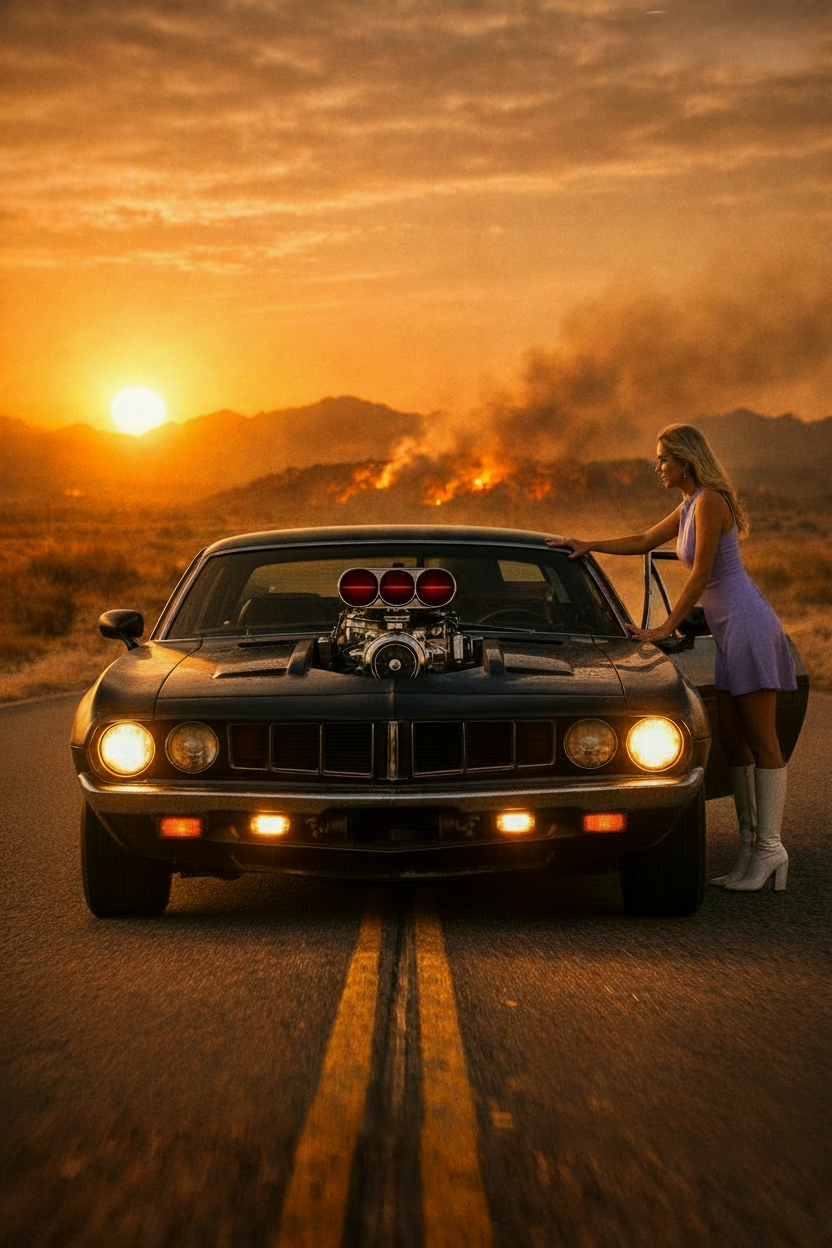
She was stunning. Too stunning.
Tim coasted closer, neutral gear humming. The moment her eyes met Jody's, the world seemed to stop.
A woman of lavender grace — whose charm was a deadly lure, and whose smile could turn to the Tall Man's fangs.
The guys ducked quickly down to the floorboard.
She placed both hands on the roof of the Cuda, leaned into the driver's window, and smiled.
"So… what's the only thing to do in this town?"
Mike's voice cracked through the silence. "Get out of here!"
Tim slammed the throttle. The RPC‑6 roared, rear Hoosiers lighting up, smoke and fire pouring from the exhaust as the car tore down the highway, leaving the woman in a cloud of dust and confusion.
The trio didn't speak. They didn't need to.
They knew exactly what had just happened — and what it meant.
The Tall Man's reach was endless. His world wasn't gone. It had simply changed shape.
The Cuda thundered north, the sun rising behind them, the desert stretching forever ahead. The blower screamed, the jet thrusters flared, and the horizon shimmered with heat and memory.
Somewhere far behind, the woman in lavender watched them vanish — her smile fading into something sharp, something ancient.
And somewhere far ahead, the wind carried a faint metallic hum.
Spheres.
Waiting.
The road went on.
The legend lived.
Recovered treatment — chapter ten
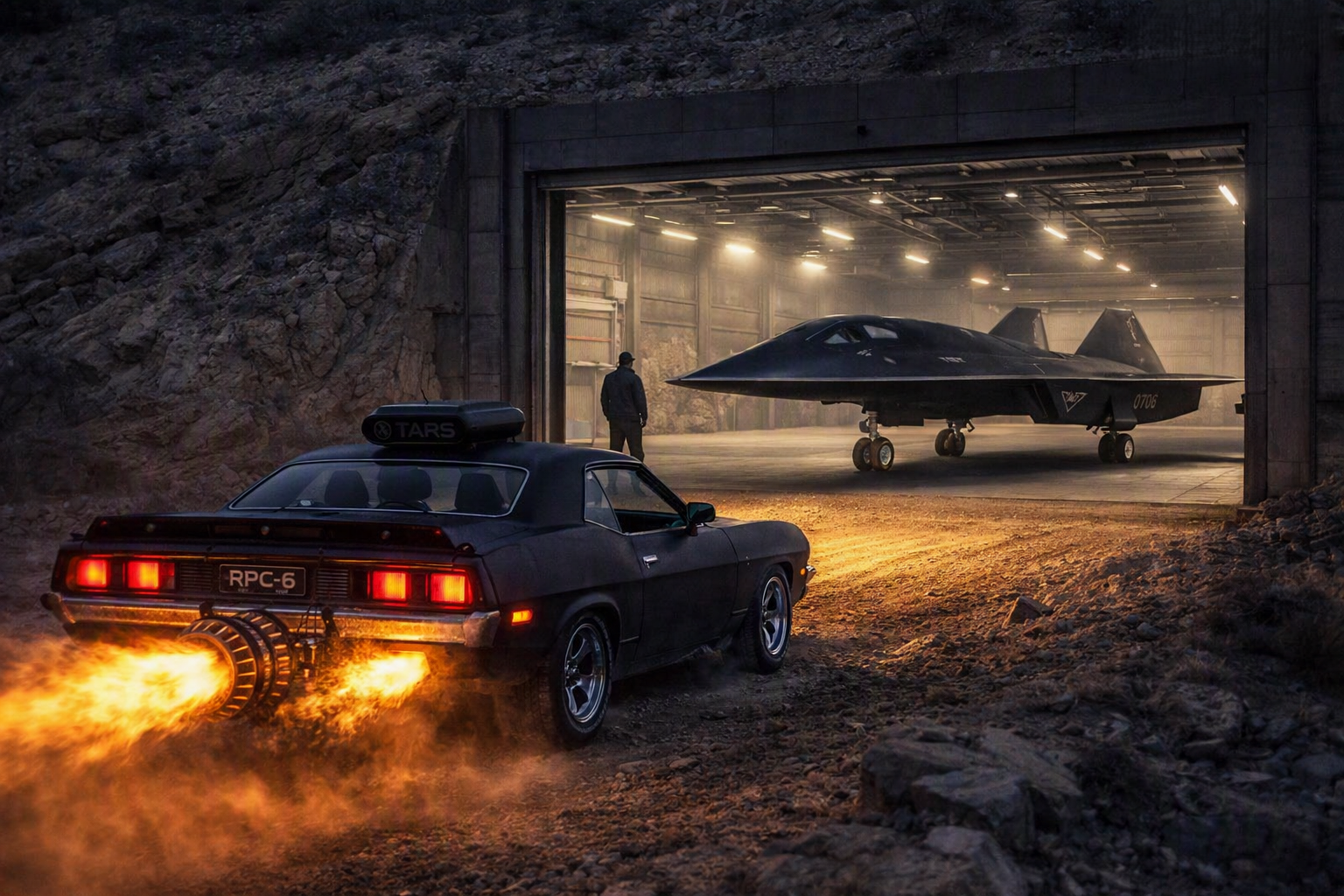
The hillside bunker opened like a wound in the rock.
Massive blast doors — reinforced steel, painted matte black — rolled apart on hydraulic tracks, exhaling a breath of cold pressurized air that smelled of jet fuel, machine oil, and something older. Something classified.
The RPC‑6 idled at the threshold, its jet thrusters cooling to a low blue pulse. Tim killed the engine. The silence that followed was cathedral‑deep.
Inside the bunker, bathed in the amber wash of overhead work lights, it waited.
The Sphere‑Star Fighter. SSF‑6.
A three‑seat canopy ghost — born from Tim's forbidden designs, built in the dark years between Phantasm III and the crater siege. Its fuselage was matte obsidian, swept‑wing geometry borrowed from nothing that existed in any public record. No tail number. No registry. Just the faint stencil on the starboard nacelle: 0706.
Jody stepped out of the Cuda first, boots crunching on the bunker floor. He walked toward it slowly, the way a man walks toward something he's been told about his whole life but never believed was real.
"Tim," he said quietly. "You actually built it."
Tim climbed out of the driver's seat, wiping grease from his hands onto a shop rag. He didn't answer right away. He just looked at the machine — his machine — with the expression of a man who had paid a price no one else could see.
"Reggie helped with the avionics," Tim said finally. "Before."
Mike stood at the rear of the Cuda, staring up at the SSF‑6's canopy. Three seats. Three flight suits, already hanging in the TARS pod mounted to the RPC‑6's roof — sealed in vacuum bags, waiting for exactly this moment.
"The spheres don't fight on the ground," Mike said. "They never did. We've been chasing them on their terms. Roads. Corridors. Tunnels."
He turned to face the others.
"It's time to fight on ours."
The air inside the bunker hummed with classified power — a subsonic frequency that pressed against the chest, that made the fillings in your teeth ache. The SSF‑6's onboard systems were already cycling up, responding to proximity, responding to the crew it had been built for.
Tim moved to the TARS pod and cracked the seal. Three suits unfolded in the amber light — matte black, form‑fitted, bearing no insignia except a small embroidered patch on the left shoulder: a gold sphere, bisected by a lightning bolt.
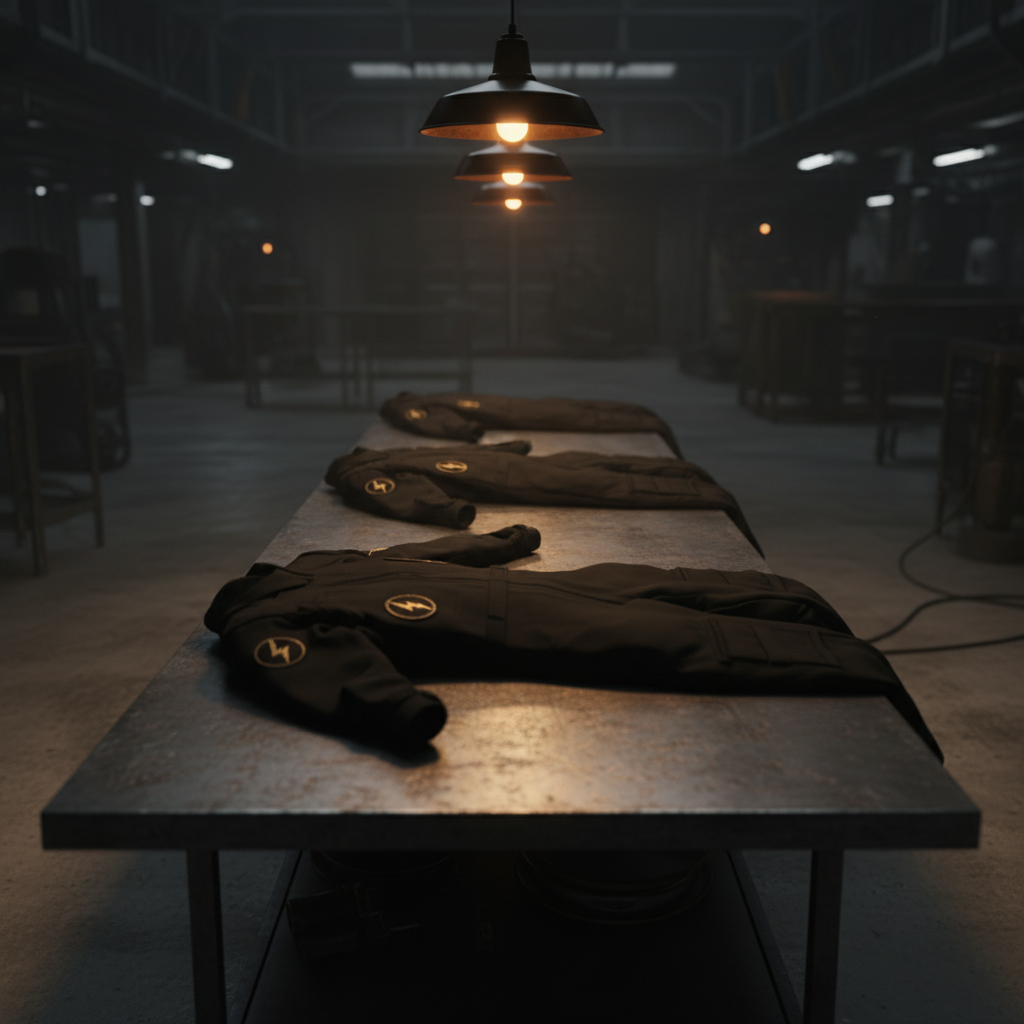
"The Tall Man's spheres operate at altitude," Tim said, pulling on his suit with practiced efficiency. "Staging points above the cloud layer. That's where the portals originate. That's where the dwarves are processed before deployment."
Jody zipped his suit to the collar. "You've known this how long?"
"Since the Morningside files. The ones the Tall Man left behind — deliberately. He wanted us to know. He wanted us to try."
A beat of silence.
"Then let's not disappoint him," Mike said.
They suited up in the amber dark, the bunker humming around them, the SSF‑6 waiting with the patience of a weapon that had always known its hour would come.
Outside, the desert stretched to the horizon — flat, white, infinite. The RPC‑6 sat at the bunker threshold, its TARS pod now empty, its jet thrusters cold. It had carried them this far. The next leg belonged to something faster.
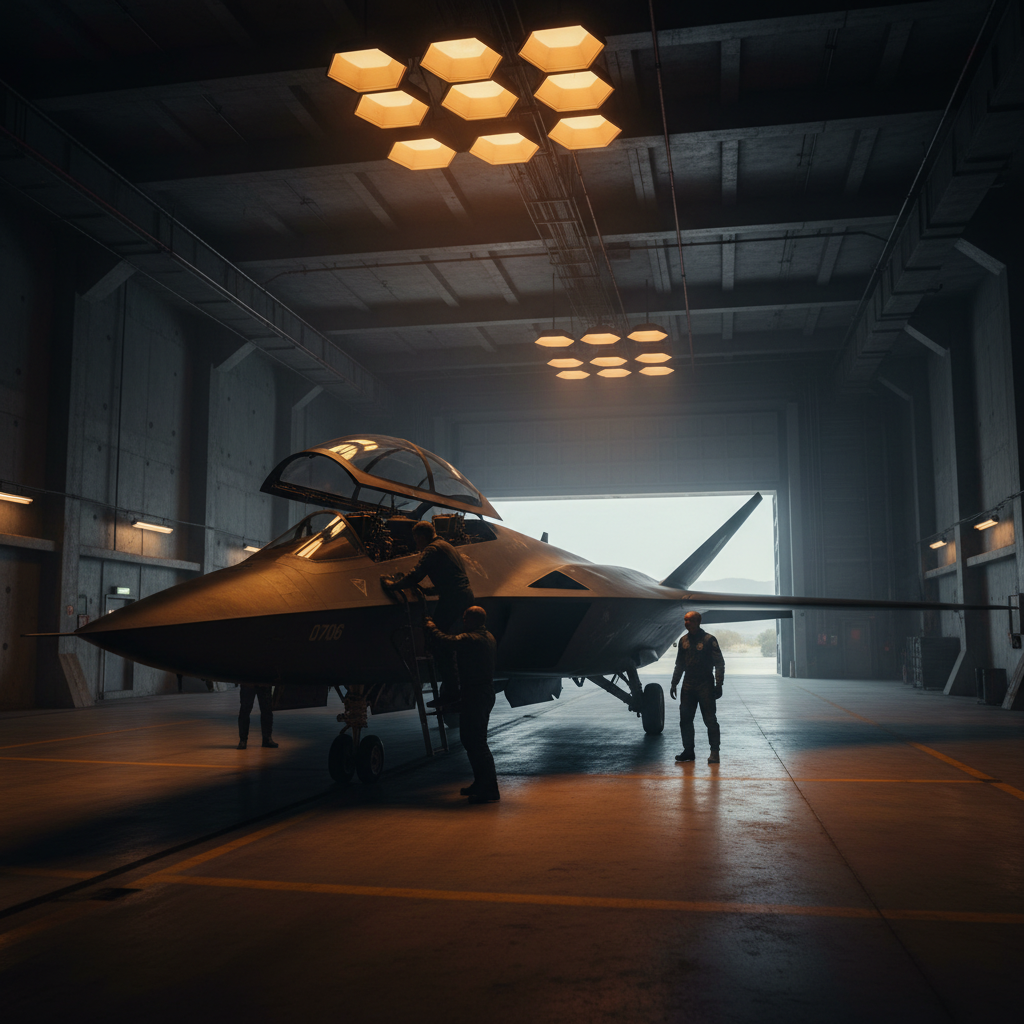
Tim climbed the boarding ladder first, settling into the pilot's seat with the ease of a man who had run this sequence a thousand times in his mind. Jody took the co‑pilot position. Mike dropped into the rear tactical seat, strapping in without a word.
The canopy sealed with a pneumatic hiss.
The bunker lights dimmed to red.
The SSF‑6's engines ignited — not with the roar of the Cuda's hemi, but with a sound like the sky tearing open. A clean, absolute, terrifying sound.
The craft rolled forward, out of the bunker, into the blinding Nevada morning.
And then it was gone.
The next war had begun above the clouds.
Recovered treatment — chapter eleven
The SSF‑6 punched through the cloud layer at forty thousand feet and kept climbing.
Below, Nevada dissolved into a pale geometry of salt flats and shadow. Above, the sky deepened from blue to violet to the absolute black of the upper stratosphere — a darkness that had no bottom, no edge, no mercy.
Tim's hands moved across the controls with the precision of a man who had built every switch himself. He knew what each one did. He knew what each one cost.
"Radar contact," Jody said from the co-pilot seat, his voice flat and professional. "Multiple signatures. Bearing zero-four-zero. Altitude: matching ours."
"How many?" Mike asked from the rear tactical seat.
A pause.
"All of them," Jody said.
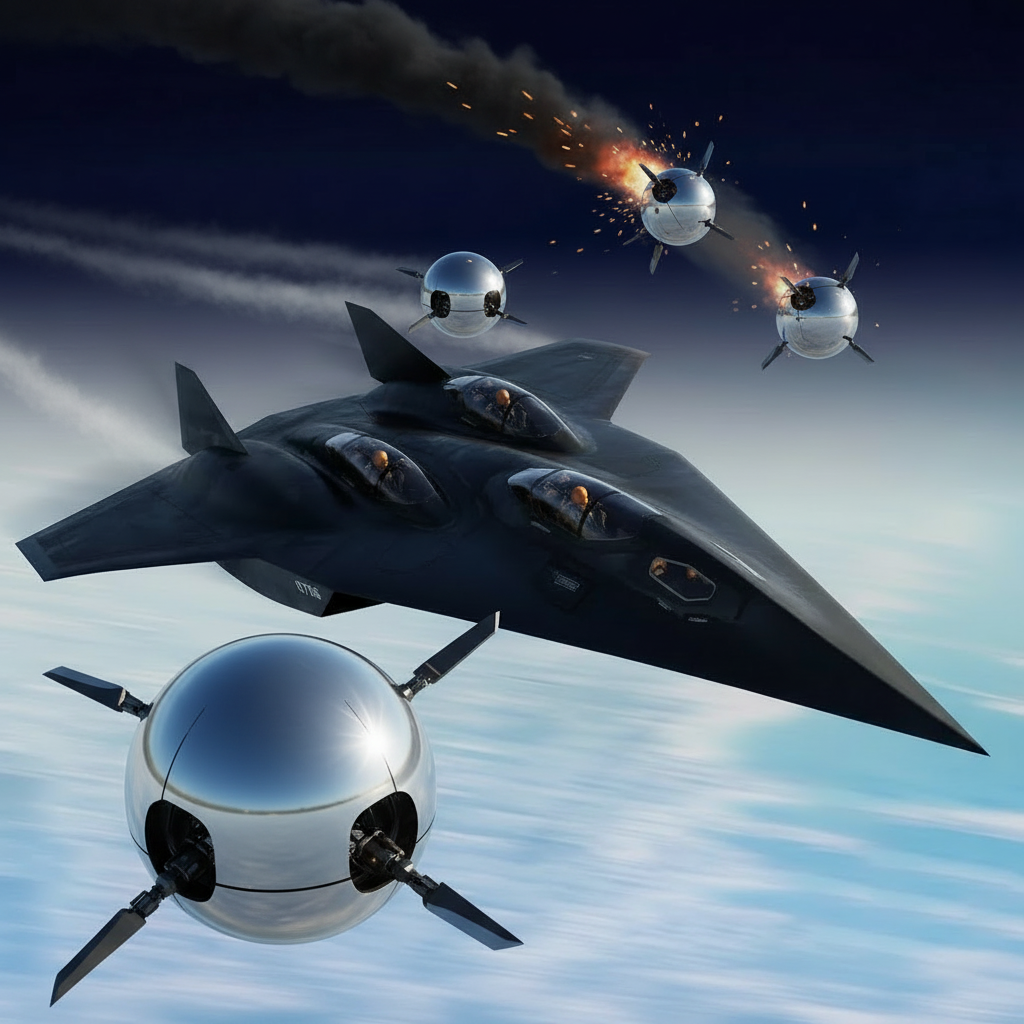
They came out of the dark like a fever dream — dozens of silver spheres, each one catching the last light of the stratosphere, each one trailing its blades in slow, patient arcs. They moved in formation, the way they always moved: with the cold intelligence of something that had been doing this for a very long time.
Tim rolled the SSF‑6 hard to port, the g-force pressing them into their harnesses. The first sphere screamed past the starboard canopy close enough to see the drill bit spinning.
"Weapons hot," Tim said.
Mike's hands found the tactical panel. The SSF‑6's wing-mounted cannons cycled up — a sound like the world tearing at its seams — and then the sky lit white.
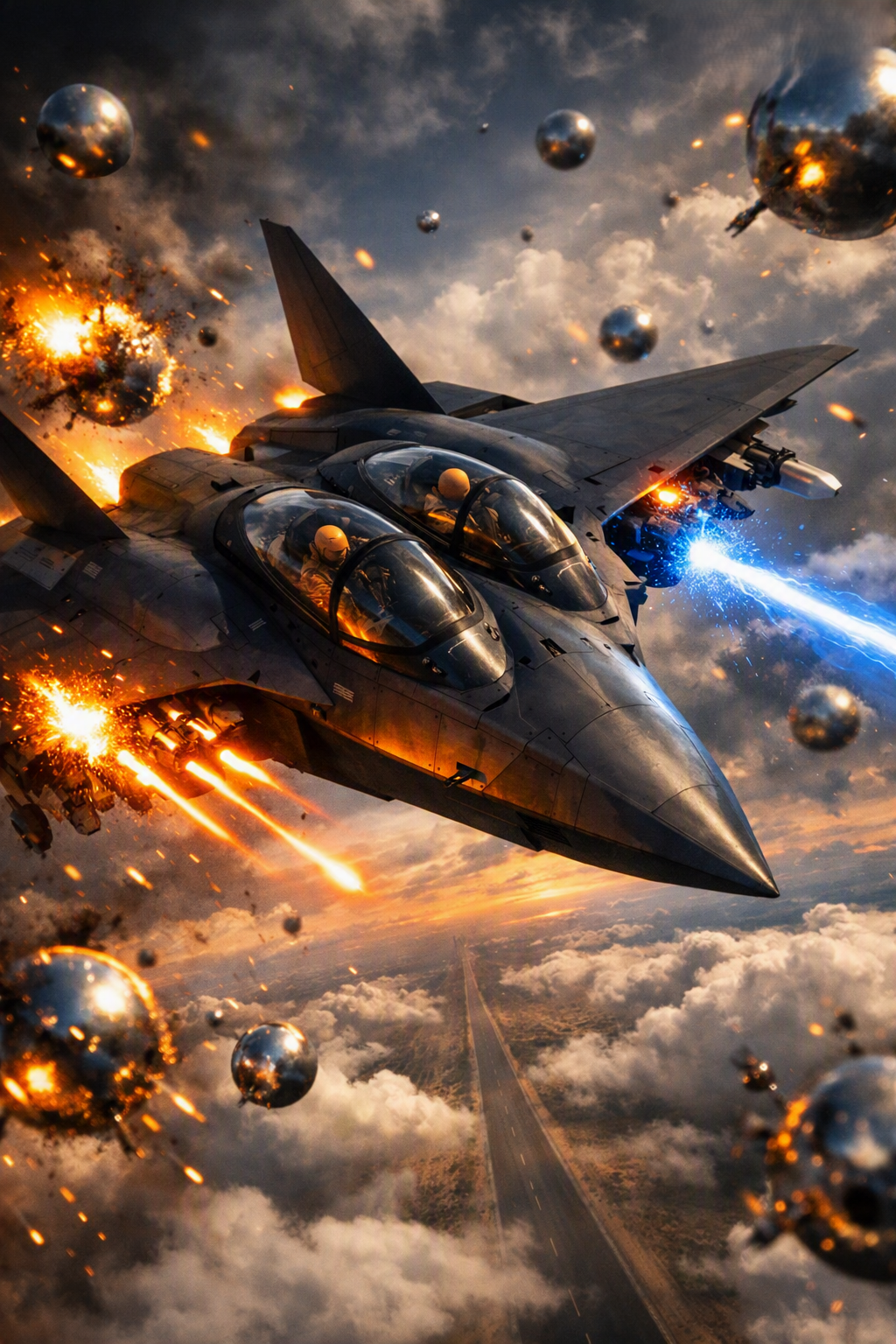
The first volley caught three spheres in a tight cluster. They detonated in cascading orange bursts, the shockwave rolling through the airframe like a fist.
"Good kill," Jody said. "Twelve more inbound. High side, three o'clock."
Tim pulled the nose up and rolled inverted, the Earth swinging overhead in a slow, impossible arc. For a moment the three of them hung in their harnesses, the cloud layer above them, the void below — and the spheres everywhere, filling the canopy glass like a nightmare constellation.
"This is what he wanted," Mike said quietly. "The Tall Man. He wanted us up here."
"Then let's give him a fight worth watching," Tim said.
He rolled upright and pushed the throttle to its stop.
The SSF‑6 screamed into the swarm.
What followed was not a dogfight. It was something older — a reckoning. The kind of violence that doesn't have rules or referees, only survivors. Tim flew by instinct, by the muscle memory of a thousand hours in simulators built from stolen Tall Man schematics. Jody called targets with the calm of a man who had already made his peace. Mike fired until the cannons ran hot, then switched to the secondary array — the pulse weapons Tim had reverse-engineered from the sphere fragments recovered at Morningside.
Sphere after sphere detonated in the black.
But there were always more.
"Portals," Jody said. "They're opening portals. Replenishing from the other side."
Mike leaned forward. "Then we close them."
"The resonance charges," Tim said. "TARS pod, bay two. I built them for exactly this."
Mike reached for the bay-two release. His hand hesitated for exactly one second — the weight of what came next pressing down on him like a physical thing.
Reggie had helped design the detonation sequence. In the long months between the crater siege and this moment, in the back of Tim's garage, over cold coffee and blueprints spread across the hood of the RPC‑6 — Reggie had sat across from Tim and worked through the math. His handwriting was still on the schematics, neat and careful, the handwriting of a man who took things seriously.
"For you, Reg," Mike said.
He pulled the release.
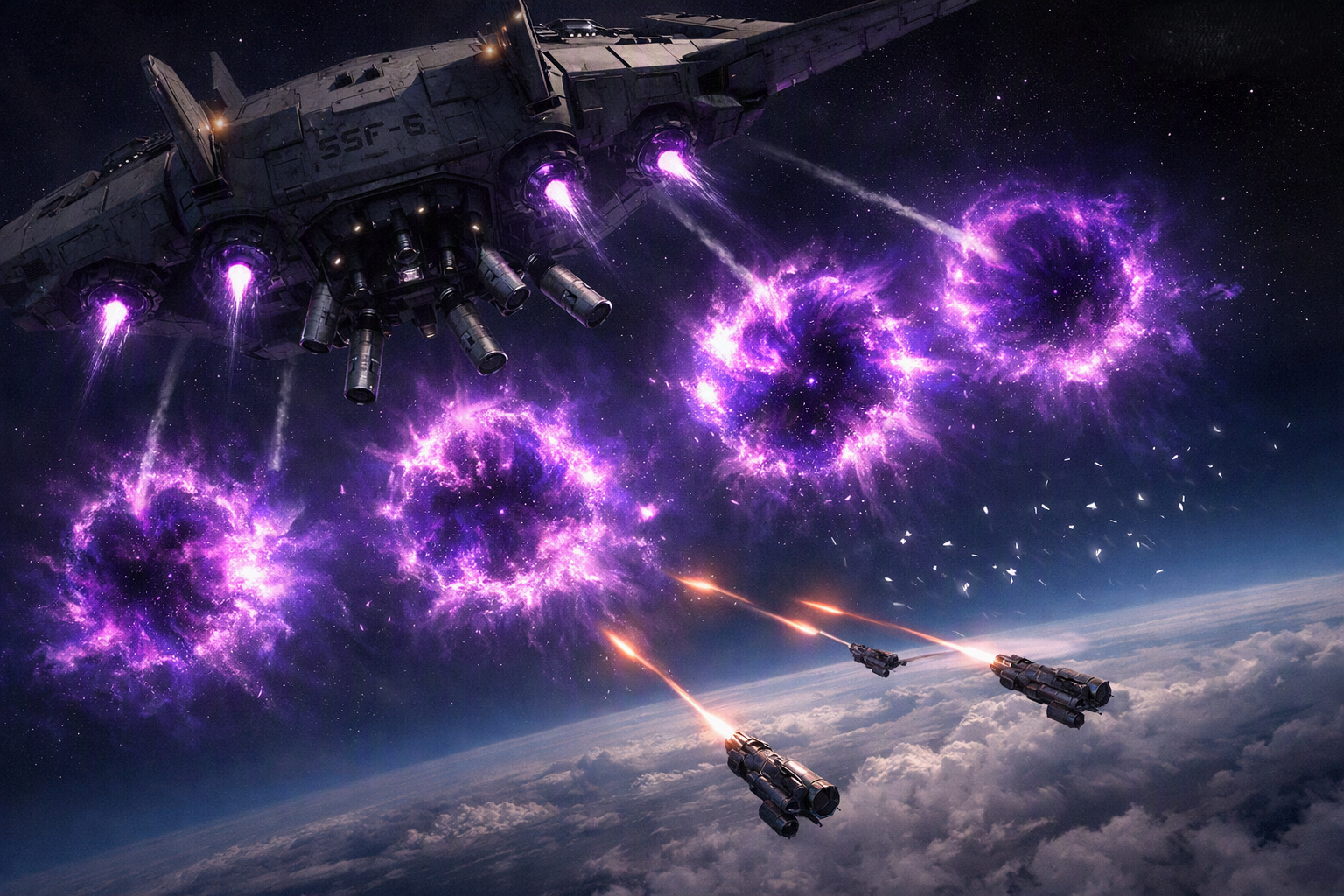
The resonance charges deployed in a wide arc — six canisters spinning outward from the SSF‑6's belly, each one finding a portal signature and locking on. The detonations were silent at this altitude, visible only as blooms of deep violet light that expanded and collapsed in the same breath.
One by one, the portals closed.
The remaining spheres drifted, directionless — cut off from their source, their formation dissolving into scattered silver points of light. Tim brought the SSF‑6 around in a wide banking turn and the cannons finished the work.
Then silence.
The real kind. The kind that only exists above the clouds, where the world's noise can't reach.
The three of them sat in it for a long moment, breathing.
"Is that all of them?" Jody asked.
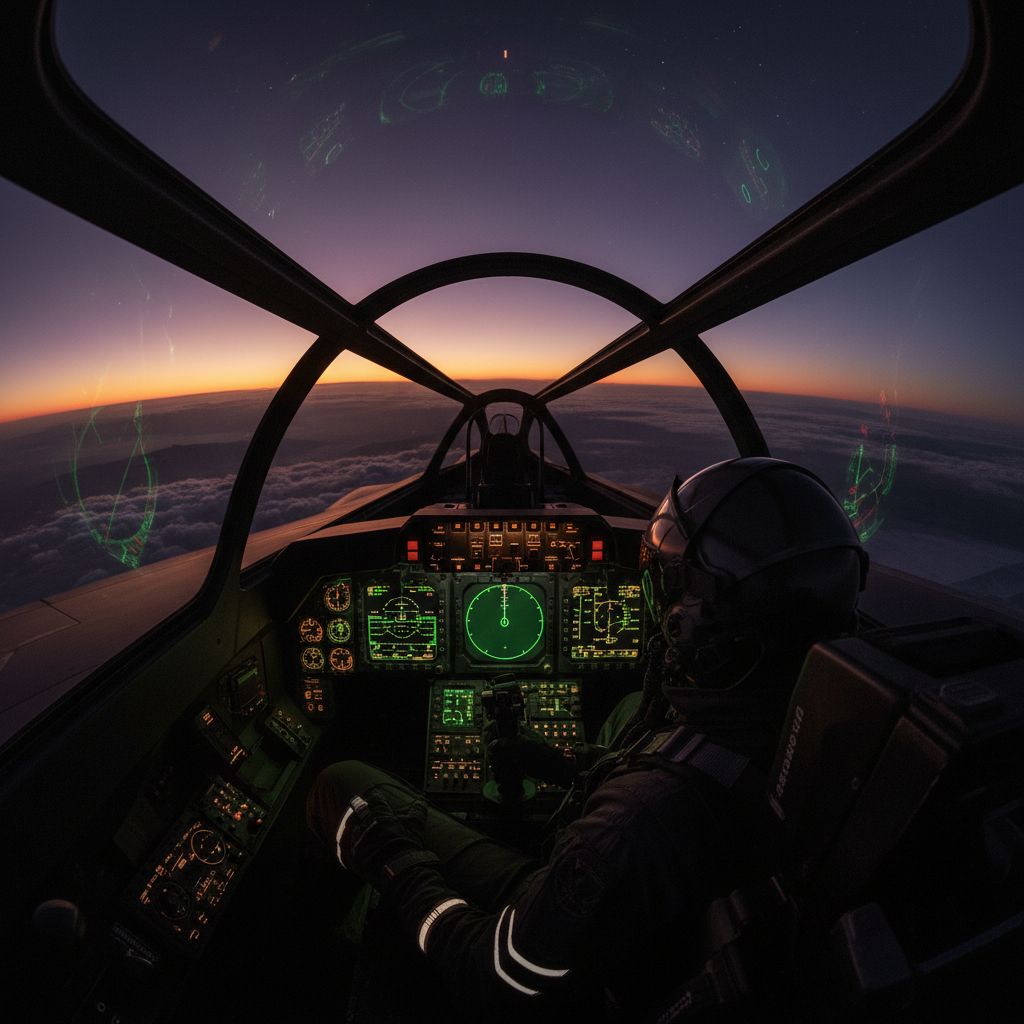
Tim scanned the instruments. The radar screen was clean. The sky outside the canopy was empty and vast and impossibly beautiful — violet fading to black at the edges, the first stars appearing.
"For now," he said.
Jody nodded slowly. "Then we go home."
Tim eased the SSF‑6 into a long descending arc, the nose dropping toward the cloud layer, toward Nevada, toward the desert and the road and the RPC‑6 waiting at the bunker threshold.
Below the clouds, the world was still there.
It always was.
The war above the clouds was over — for now. But the three of them knew, with the bone-deep certainty of men who had seen too much, that the Tall Man's reach did not end at the stratosphere.
It ended nowhere.
And so neither did theirs.
Recovered treatment — chapter twelve
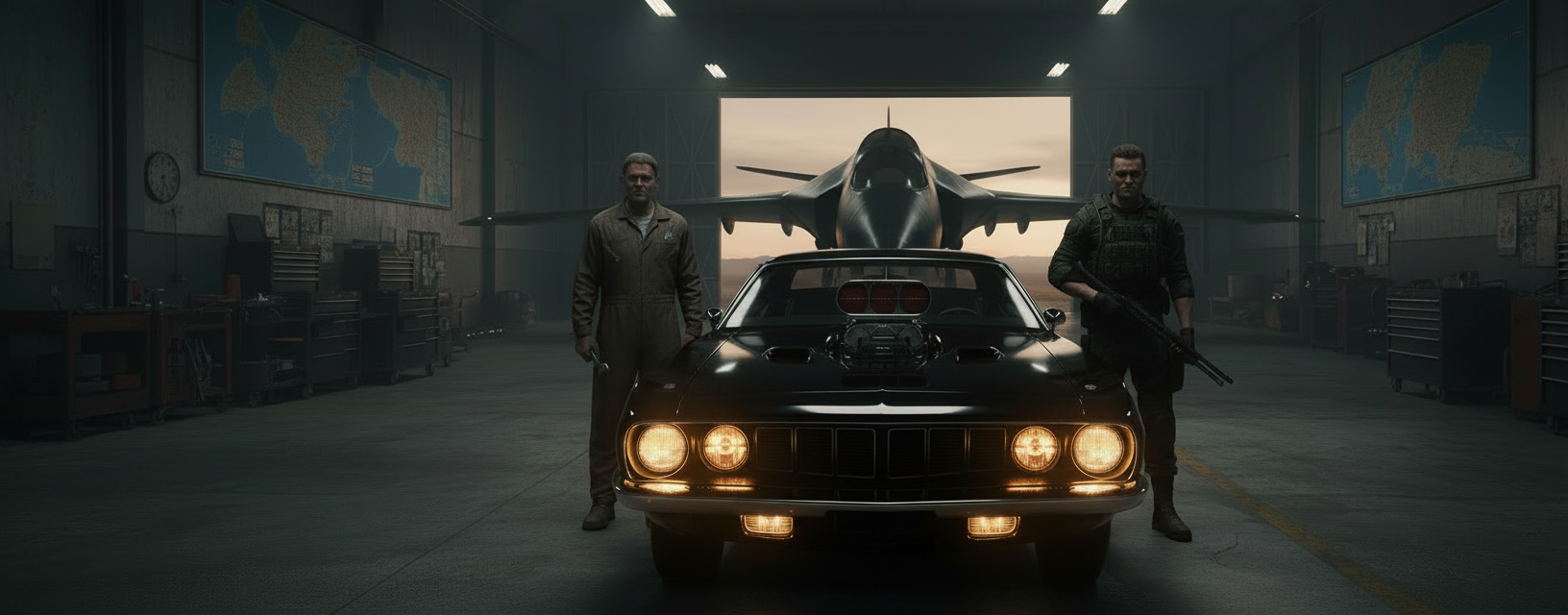
They came back down through the cloud layer just before dawn, the SSF‑6 descending in a long, quiet arc over the Nevada flats.
The bunker doors were open when they landed. Someone had left the lights on.
Tim taxied the fighter to its bay and cut the engines. The silence that followed was the kind that only comes after something enormous — a silence with weight and texture, the kind you can feel in your chest.
The three of them climbed down from the canopies without speaking. Their boots hit the concrete in sequence — Tim first, then Jody, then Mike — and they stood there in the hangar light, looking at the RPC‑6.
It was exactly where they'd left it. Blower stacked. Jet thrusters cold. The quad headlights dark, the chrome grille catching the overhead fluorescents in four clean rectangles of light.
"She waited for us," Jody said.
Tim walked to the driver's side and ran his hand along the hood, fingers trailing over the blower scoop. He could feel the heat still in the metal — residual warmth from the desert run, from everything that had come before.
"She always does," he said.
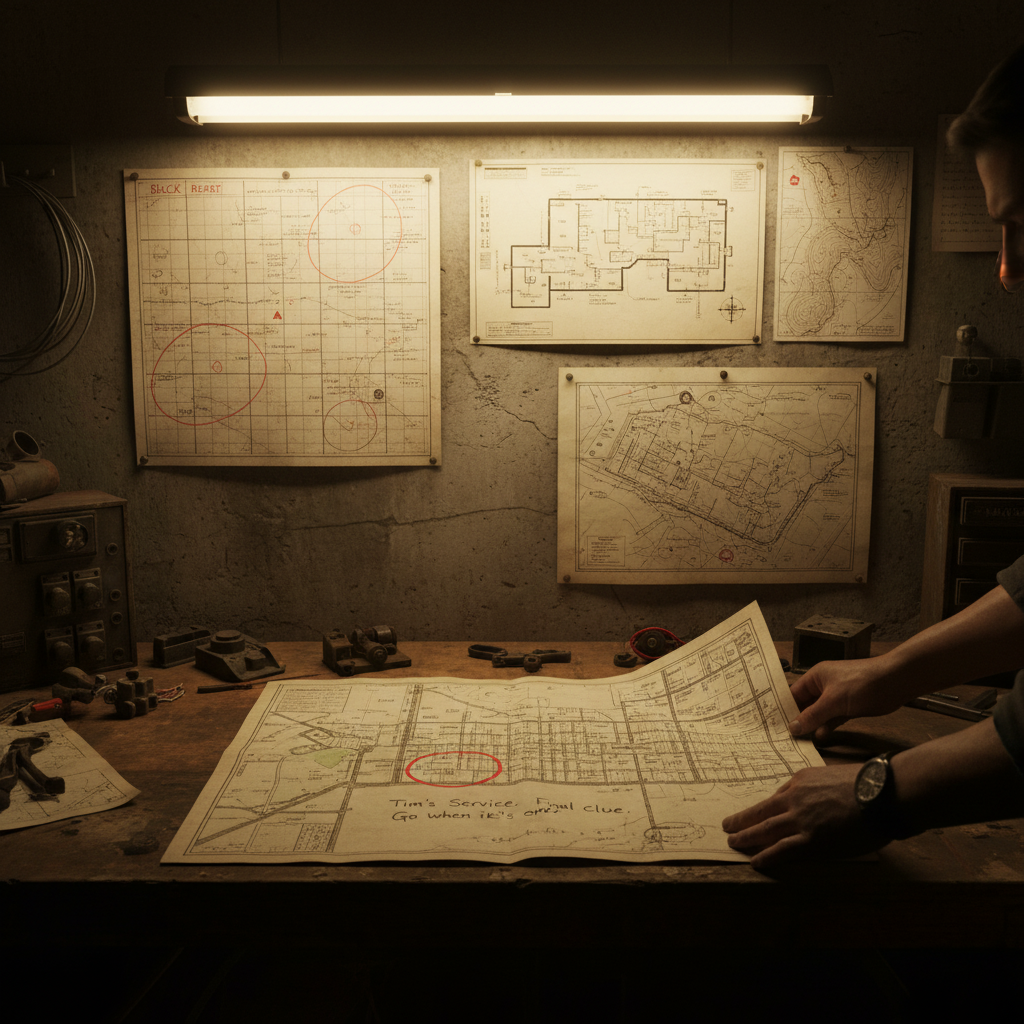
Mike moved to the workbench along the east wall. The mission maps were still pinned there — the Black Rock grid, the crater coordinates, the bunker schematics drawn in Reggie's careful hand. He stood looking at them for a long moment.
"There's something I haven't told you," he said.
Tim and Jody turned.
"Before the crater. Before any of this." Mike pulled a folded paper from his jacket — worn at the creases, the ink faded but legible. "Reggie gave me this. Said to open it when the portals were closed."
He unfolded it on the workbench.
It was a hand-drawn map. Not of Nevada. Not of any desert they'd crossed. It was a street map — San Fernando Valley, the grid of it unmistakable, with a single address circled in red ink.
Below the circle, in Reggie's handwriting: Tim's Service. Final clue. Go when it's over.
The three of them stood over the map in silence.
Tim's Service. The garage on the edge of everything, the place where the RPC‑6 had been born from stolen schematics and borrowed time. The place where Reggie had sat across from Tim over cold coffee and blueprints, working through the math that had just closed the portals above the stratosphere.
"He knew," Jody said quietly. "He knew all along there was something there."
"He always knew more than he let on," Mike said. "That was Reg."
Tim folded the map carefully and tucked it into his shirt pocket. He walked back to the RPC‑6 and opened the driver's door — the hinges moving with the smooth precision of a machine that had been maintained with devotion.
"Then we go," he said.
"Now?" Jody asked. "We just got back."
Tim looked at him over the roof of the car. The hangar lights caught the chrome of the blower, threw long shadows across the concrete, made the SSF‑6 behind them look like a sleeping predator.
"Reggie said go when it's over," Tim said. "It's over."
A beat.
Jody picked up his shotgun from the workbench. Mike grabbed his jacket. They moved to the car with the unhurried certainty of men who had been doing this long enough to know that hesitation was just another word for fear.
Tim turned the key.
The 426 Hemi woke up like a thunderstorm — a deep, chest-filling roar that filled the hangar and rolled out through the cracked doors into the Nevada dawn. The blower screamed. The quad headlights blazed to life, four amber rectangles cutting through the dark.
The hangar doors opened fully. Automatic. Tim had wired them to the ignition months ago, a small convenience that now felt like prophecy.
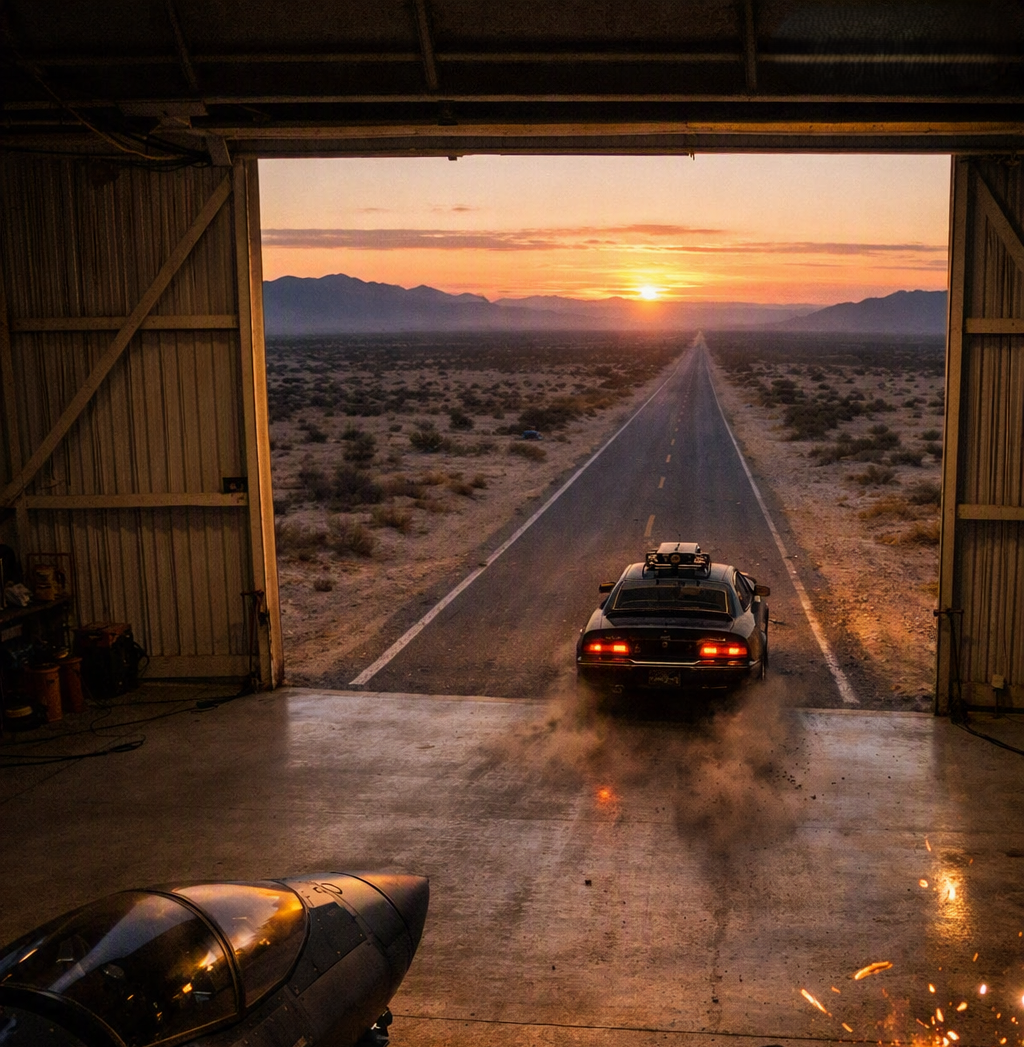
Beyond the doors: the desert. The pale orange horizon. The long straight road running south toward California, toward the Valley, toward whatever Reggie had left for them at Tim's Service.
The road was calling.
Tim put the RPC‑6 in gear.
Behind them, the SSF‑6 sat silent in its bay — the war above the clouds finished, the next war not yet named. The bunker lights hummed. The mission maps rustled in the draft from the open doors.
Reggie's handwriting on the map in Tim's pocket: Final clue. Go when it's over.
They went.
Recovered treatment — chapter thirteen
Route Archive — Chapter 13
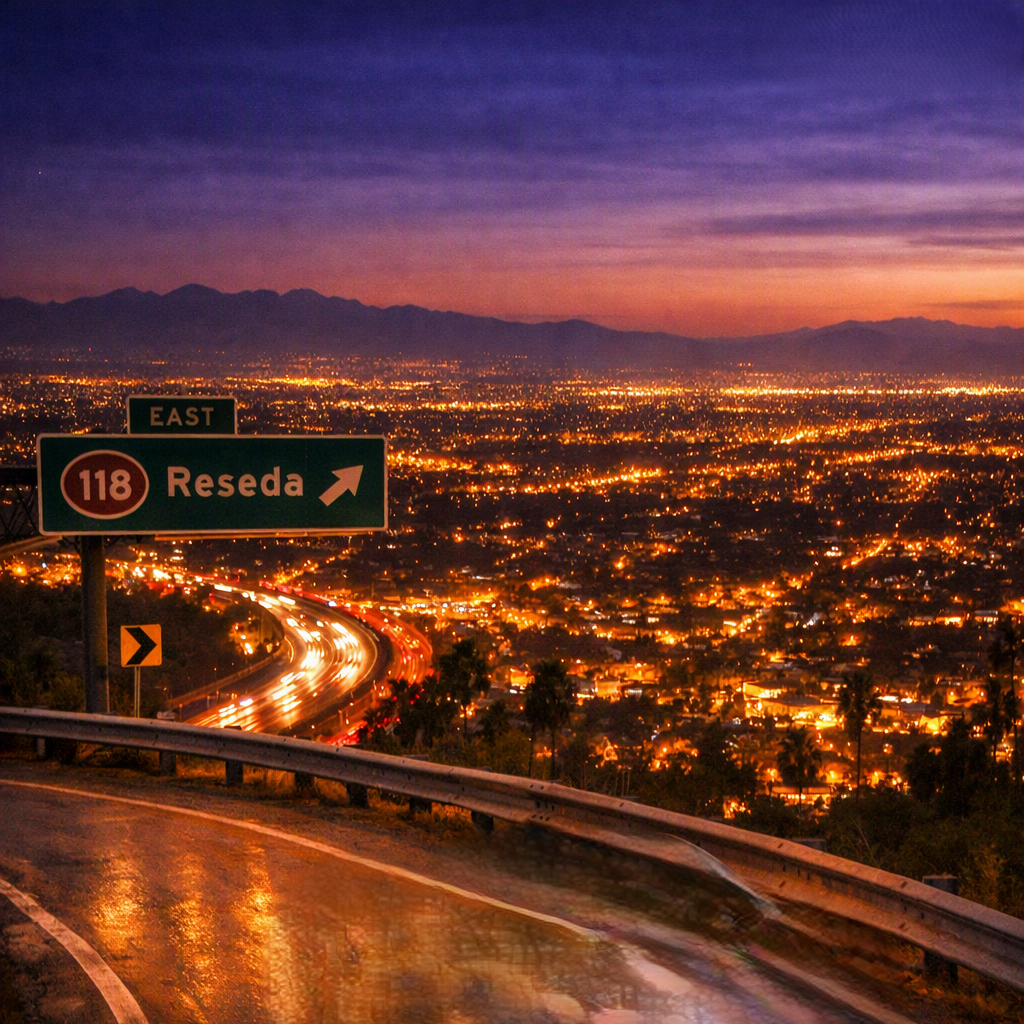
They came down out of the desert on the 405, the RPC‑6 running quiet in the early morning dark, the blower ticking as it cooled.
The San Fernando Valley spread out below them like a circuit board — a grid of amber streetlights and sleeping subdivisions, palm trees standing black against a sky that never quite went dark this close to the city.
Tim took the Reseda exit without being told.
"You've been here before," Mike said. It wasn't a question.
"My father brought me here when I was nine," Tim said. "Said there was something about this corner. Said the air was different." He paused. "I thought he was just being strange. He was always being strange."
"Sounds like someone else we knew," Jody said quietly.
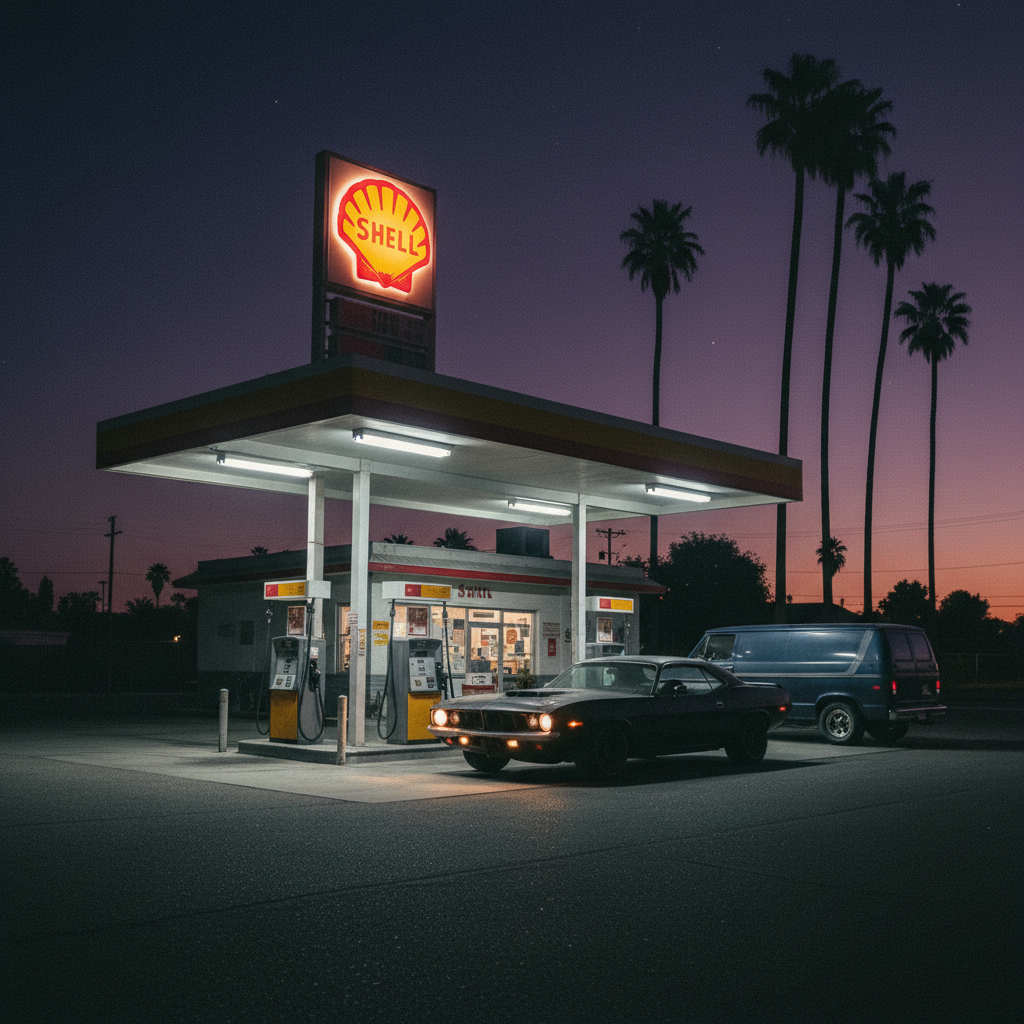
The Shell station appeared at the corner of Reseda and Devonshire exactly as Reggie's map had drawn it — the red and yellow sign glowing against the purple LA sky, the canopy lights throwing hard white pools across the pump islands, the office window cluttered with hand-lettered price signs that hadn't been updated since gas was under a dollar.
Tim pulled the RPC‑6 to the curb and cut the engine.
The three of them sat looking at it.
"This was his father's station," Mike said, reading from the notes Reggie had tucked behind the map. "Senior. Ran it from 1971 until he passed. Tim inherited the name, took it to Nevada for the second location. But this corner — this one stayed in the family."
"The porthole," Jody said.
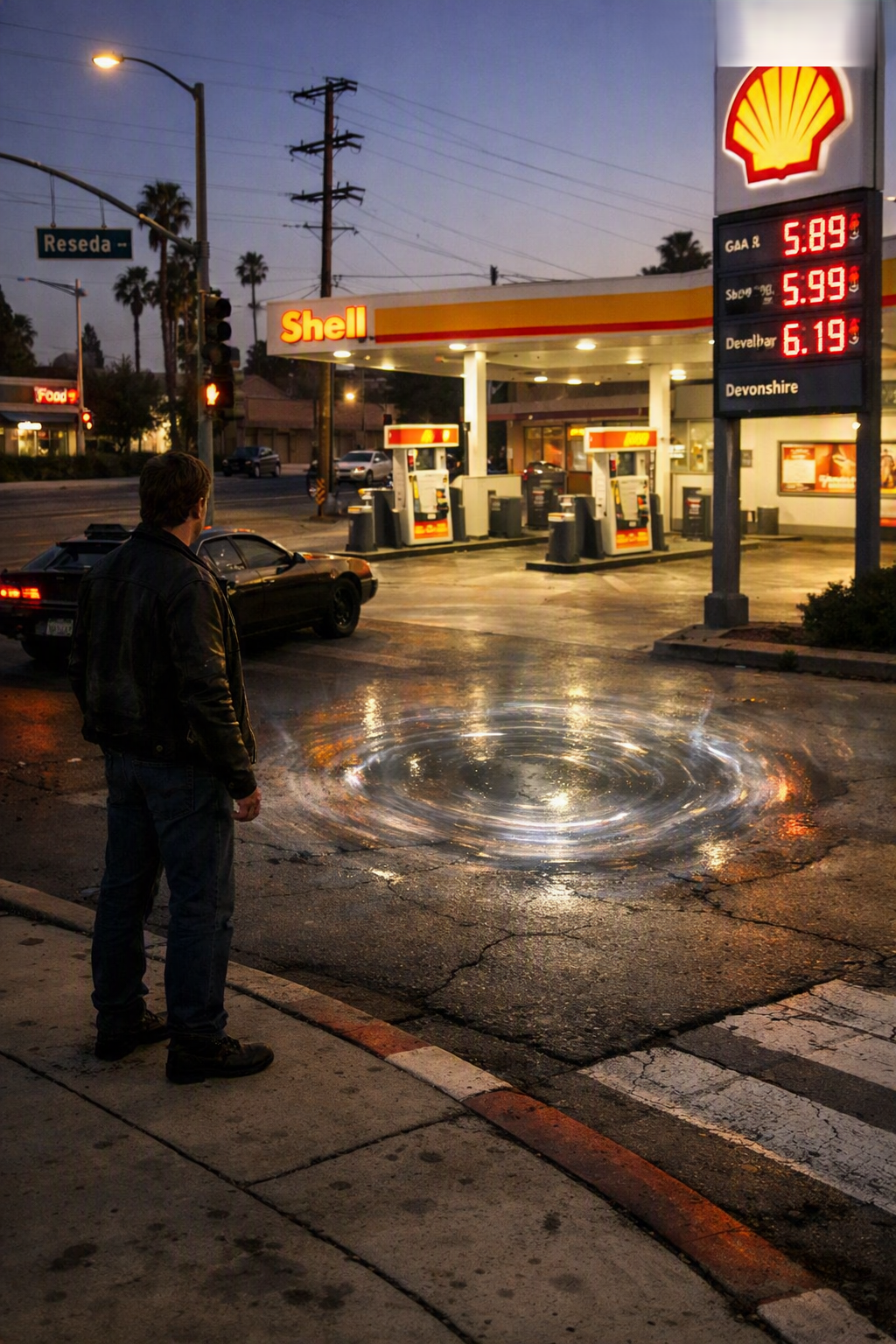
"That's what Reggie called it. A porthole. Said Tim's father discovered it — a place where the membrane between here and the Tall Man's dimension runs thin. Where things can cross if you know how to look."
Tim was already out of the car.
He stood on the sidewalk at the corner of Reseda and Devonshire and looked at the asphalt, at the faded paint of the crosswalk, at the pump islands where his father had once stood in a Shell uniform and watched the world go by.
"It was 1980," Tim said. "Right here. A man named Baker came to this corner with a black '71 Cuda. He was going to trade it for a custom van. My father was the one who told him not to."
Mike and Jody came to stand beside him.
"Your father knew Baker?" Mike asked.
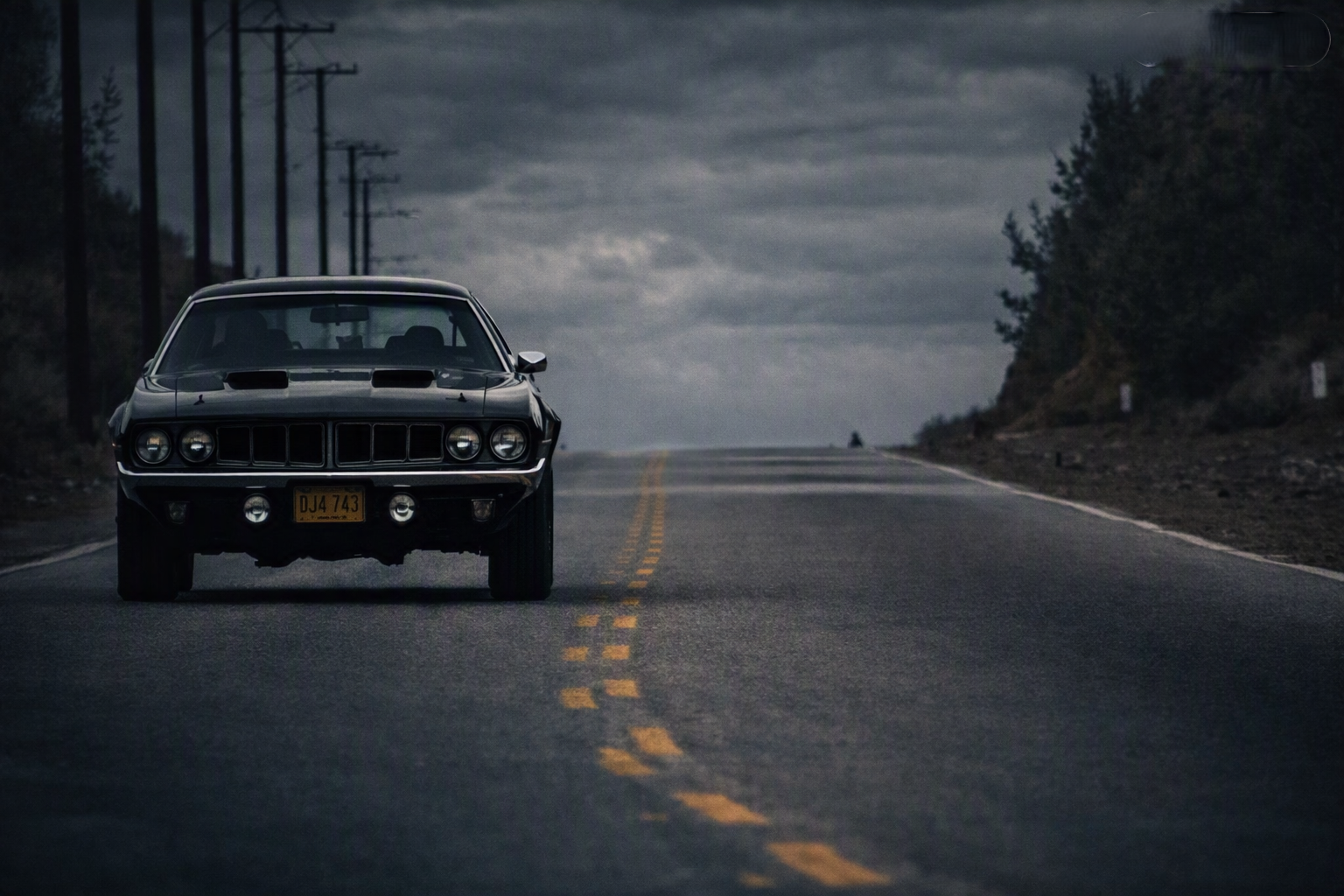
"My father knew what the car was," Tim said. "He'd seen it on Kanan Road. He'd felt what it carried. He told Baker the car wasn't his to sell — that it belonged to something larger than either of them." He paused. "Baker didn't listen. Made the trade anyway. And then the car was gone."
The Shell sign hummed above them. A car passed on Devonshire, its headlights sweeping across the pump islands and gone.
"Reggie knew your father," Jody said slowly.
"Reggie knew everyone," Tim said. "That was Reg. He collected people the way other men collect receipts — kept them all, knew exactly where each one fit." He reached into his shirt pocket and unfolded the map again. At the bottom, below the circled address, below the words Final clue. Go when it's over — there was one more line he hadn't noticed before. The ink was fainter, written smaller, as if added as an afterthought.
He read it aloud.
"The porthole opens when the Cuda comes home."
Silence.
The three of them looked at the RPC‑6 sitting at the curb — the quad headlights dark now, the blower cold, the black paint absorbing the glow of the Shell sign.
"He built the RPC‑6 to come back here," Mike said. "Reggie built it to come back to this corner."
"He built it to finish what Baker started," Tim said. "What my father tried to stop. What the Tall Man has been waiting forty years to complete."
Jody pumped a shell into his shotgun. The sound was very loud in the quiet Valley night.
"Then we finish it first," he said.
Tim walked back to the RPC‑6. He opened the driver's door and sat behind the wheel and looked at the corner — at the exact square of asphalt where a black '71 Cuda had sat in 1980 while a man named Baker made the worst decision of his life.
He turned the key.
The Hemi fired.
The quad headlights blazed to life — four amber circles cutting through the Valley dark, illuminating the corner, the pumps, the faded crosswalk, the exact spot where the porthole waited.
And somewhere beneath the asphalt of Reseda and Devonshire, something very old felt the vibration of a 426 cubic inch engine and began, slowly, to wake.
The road had led here all along.
Recovered treatment — chapter fourteen
The map had a backside.
Tim found it when the porthole light hit the paper at an angle — a faint grid of pencil marks, too deliberate to be random, too small to read without the right light. He held it up to the Shell station canopy and the marks resolved into letters. Reggie's handwriting, compressed to near-invisibility.
He read it three times before he said it out loud.
"The final message rests inside the Baker Cuda. Secretly concealed behind the glove box in a fireproof container."
Silence on the corner of Reseda and Devonshire.
"He put something in the car," Mike said.
"Before Baker traded it," Jody said. "Before any of this. Reggie got to that car first and he left something inside it."
"Which means we need the car," Tim said.
He folded the map and looked south down Reseda Boulevard. The Valley stretched ahead of them, flat and wide under the pre-dawn dark, the streetlights running in a straight orange line toward Chatsworth.
"Speedco Motors," he said. "Reseda and Cohasset. My father's name is on the original deed as a part owner. He and the lot manager went back to the early seventies — two guys who loved muscle cars and hated banks."
"That's where the Cuda went after the Shell gas station trade," Mike said.
"The new owner brought it down Reseda from the Shell station," Tim said. "Walked in, handed over the keys, walked out with cash. My father watched it happen from across the street and didn't say a word. He told me that story once. Said it was the worst thing he ever saw and he couldn't explain why."
Jody pumped a fresh shell. "Then let's go see what's left of it."
They drove south on Reseda with the RPC‑6's headlights cutting through the Valley dark. The boulevard was empty at this hour — a CVS, a taqueria, a mattress store, a tire shop — the ordinary geography of a neighborhood that had no idea what moved through it.
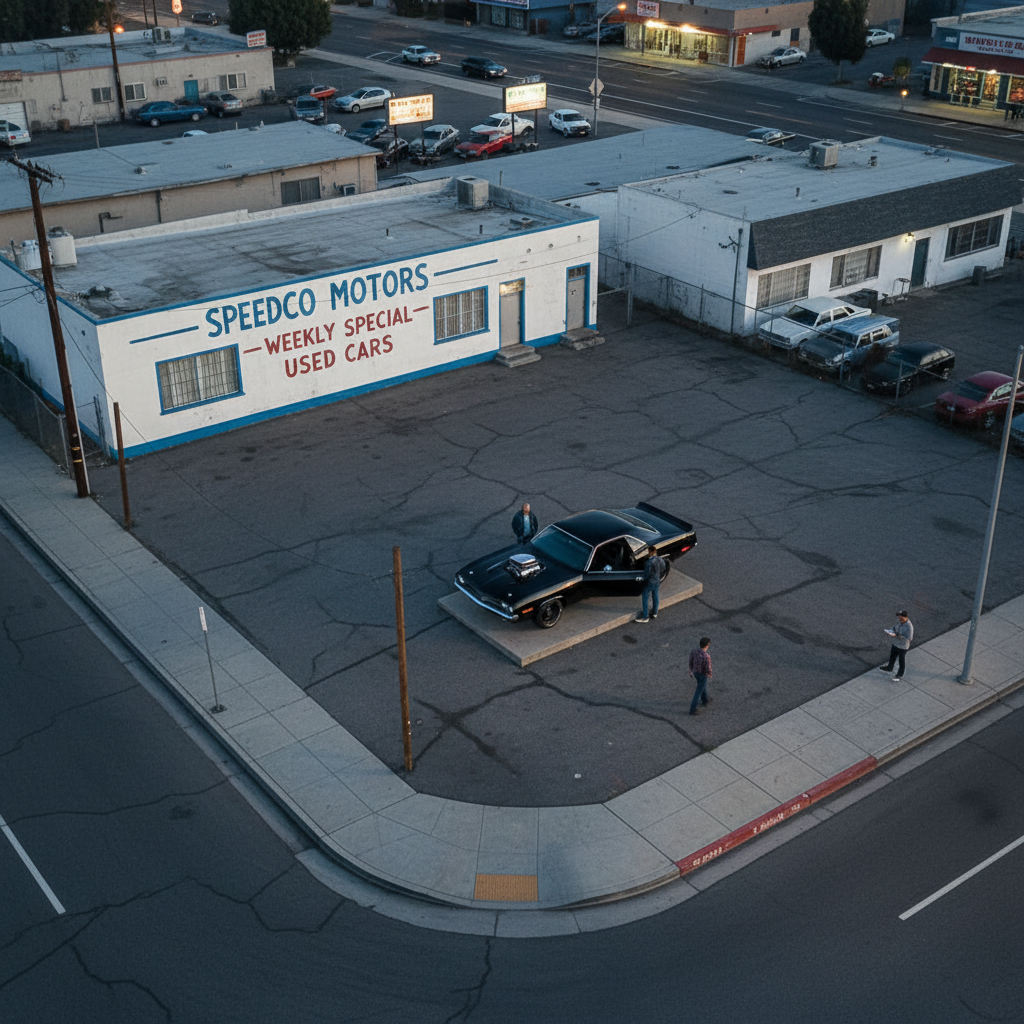
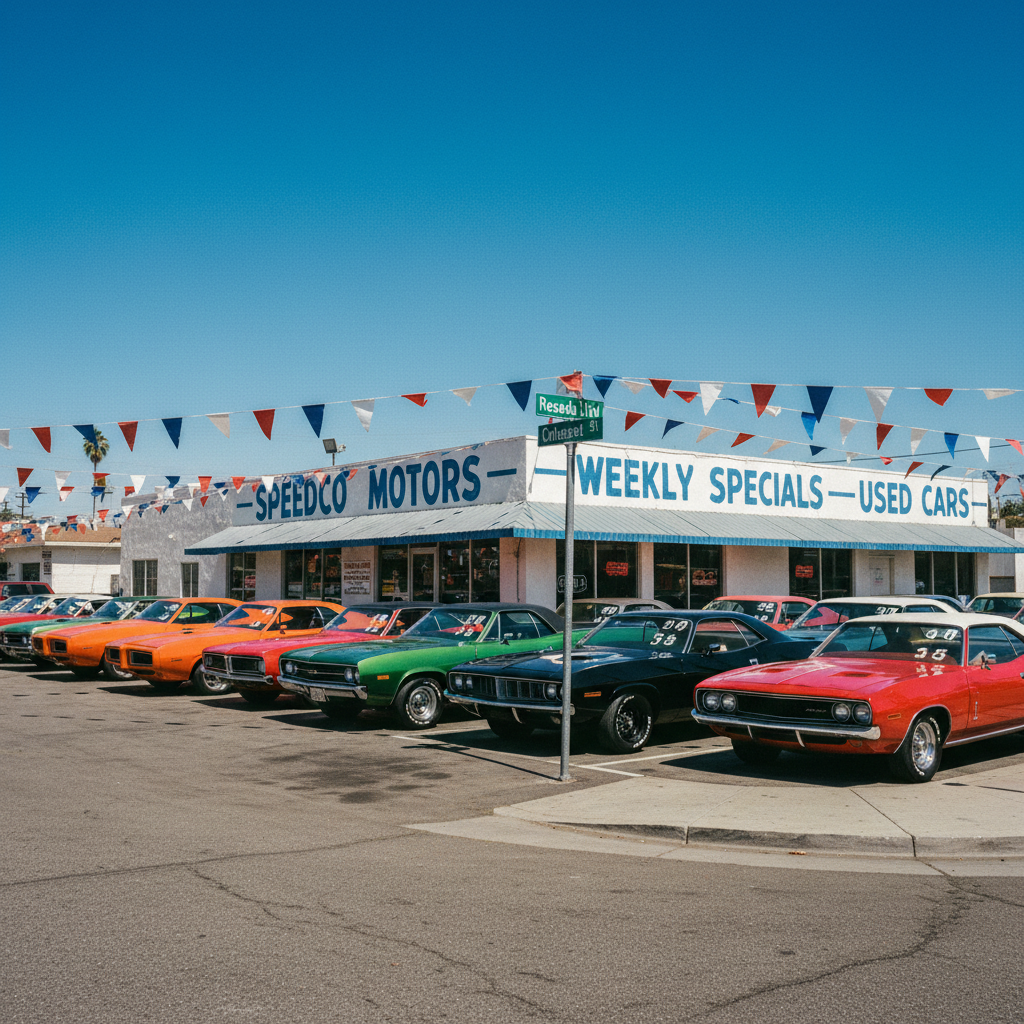
Speedco Motors appeared at the corner of Cohasset exactly as Tim had described it — or rather, exactly as it had been. The white stucco wall was still there, faded now, the blue trim gone to gray. The hand-painted signage had been painted over but the ghost of the letters was still visible in the right light: SPEEDCO MOTORS. WEEKLY SPECIALS. USED CARS.
The lot was empty. Had been for years.
Tim pulled the RPC‑6 to the curb and cut the engine. The three of them sat looking at the ghost of the lot — the asphalt cracked and weedy, the pennant wire still strung between the poles but bare now, the poles themselves leaning at angles that suggested decades of neglect.
"The car was here," Mike said. "Baker's Cuda. Right here on this lot."
"For about three weeks," Tim said. "That's all. My father said the lot manager got a call from a location scout at Burbank Studios. They were casting background vehicles for a TV production — a cop show. Needed period-correct muscle cars that could take some abuse."
"CHiPs," Jody said.
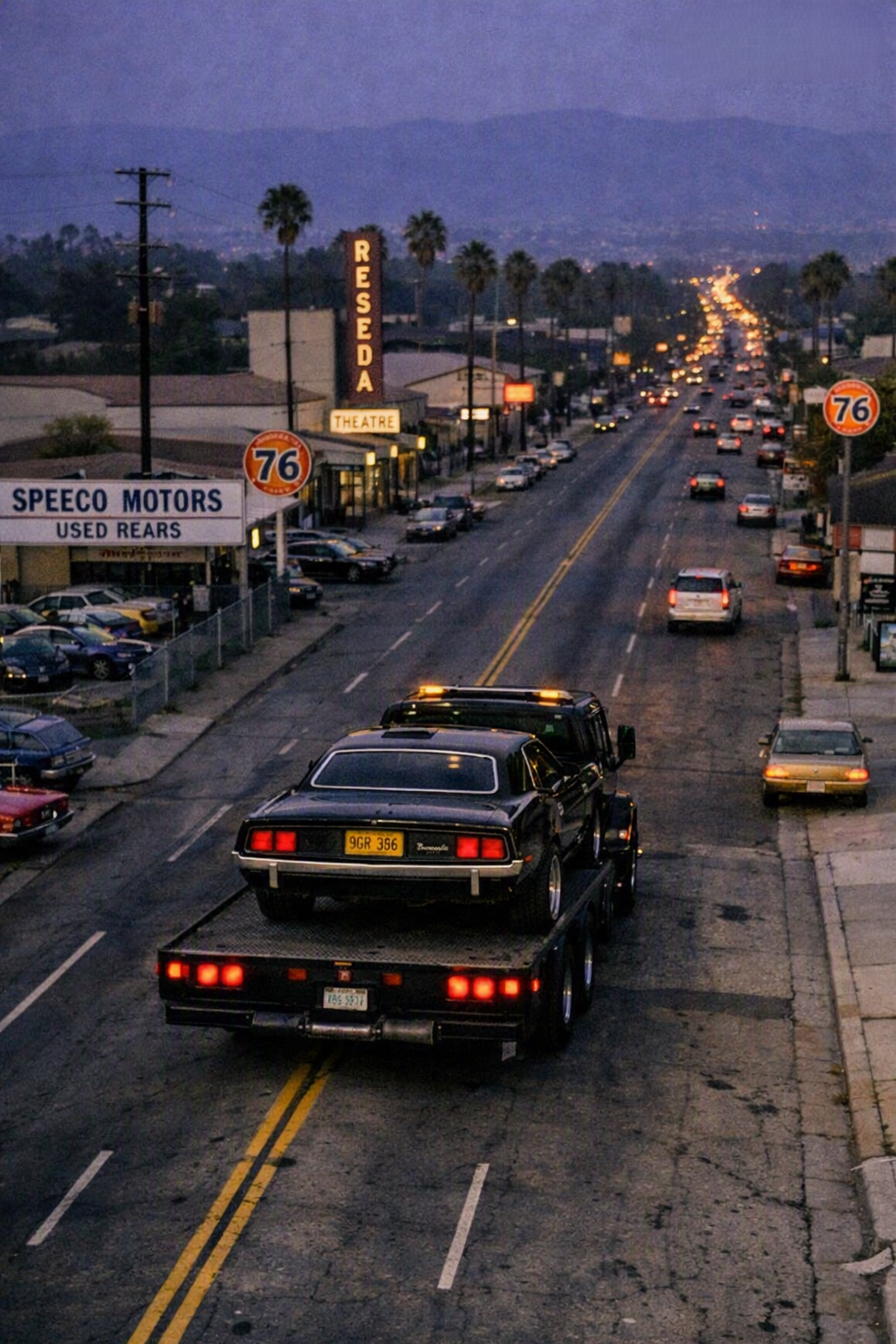
"CHiPs," Tim confirmed. "The lot manager sold the Cuda to the studio for twice what Baker had taken for it. Said it was the easiest money he ever made. My father said the car went up Reseda on a flatbed and he watched it go and felt something leave the neighborhood — like a pressure releasing."
Mike was already out of the car, walking the perimeter of the old lot. He stopped at the center of the asphalt where a raised concrete platform still stood — the display pad, cracked now, the blue paint long gone — and looked at the space where the Cuda had sat.
"Reggie knew," he said. "He knew the car would end up at the studio. He knew the trail would lead here."
"Reggie knew everything," Tim said. "He just never told you in the right order."
Jody was scanning the lot perimeter, shotgun low, eyes moving. Old habit. "So the car went to Burbank Studios. Then what?"
Tim pulled out the map again and looked at the decoded message. "It says the container is still in the car. Fireproof. Behind the glove box." He looked up. "Which means the car still exists. Somewhere."
"Background vehicles from that era," Mike said slowly. "Studios sold them off. Auctions, private sales, wrecking yards." He paused. "Or they kept them. Some studios kept the good ones."
"A black '71 Cuda with a sunroof," Jody said. "That's not a car you forget."
Tim folded the map one more time and put it in his chest pocket, next to where Reggie's original note had been. He looked at the ghost of Speedco Motors — the empty lot, the bare pennant wire, the faded letters on the white wall — and felt the weight of the trail they'd followed.
From Kanan Road to the Nevada desert. From Tim's outpost to the stratosphere. From the Shell station porthole to this cracked asphalt corner where a car had sat for three weeks in 1980 before disappearing into the machinery of Hollywood.
"Burbank Studios," he said.
Mike nodded.
Jody was already walking back to the RPC‑6.
Tim took one last look at the lot. In the early morning light, with the sun just beginning to pink the eastern sky above the Valley rooftops, he could almost see it — the orange GTO on the display pad, the red Charger in the back row, the pennant flags snapping in the Santa Ana wind, and somewhere in the middle of it all, a black '71 Cuda sitting quiet and patient, waiting for someone to come looking.
Reggie had known they would.
The RPC‑6 fired. The quad headlights blazed. And the road turned east toward Burbank.
Recovered treatment — chapter fifteen
They came off the 134 at Olive Avenue and followed the studio wall east.
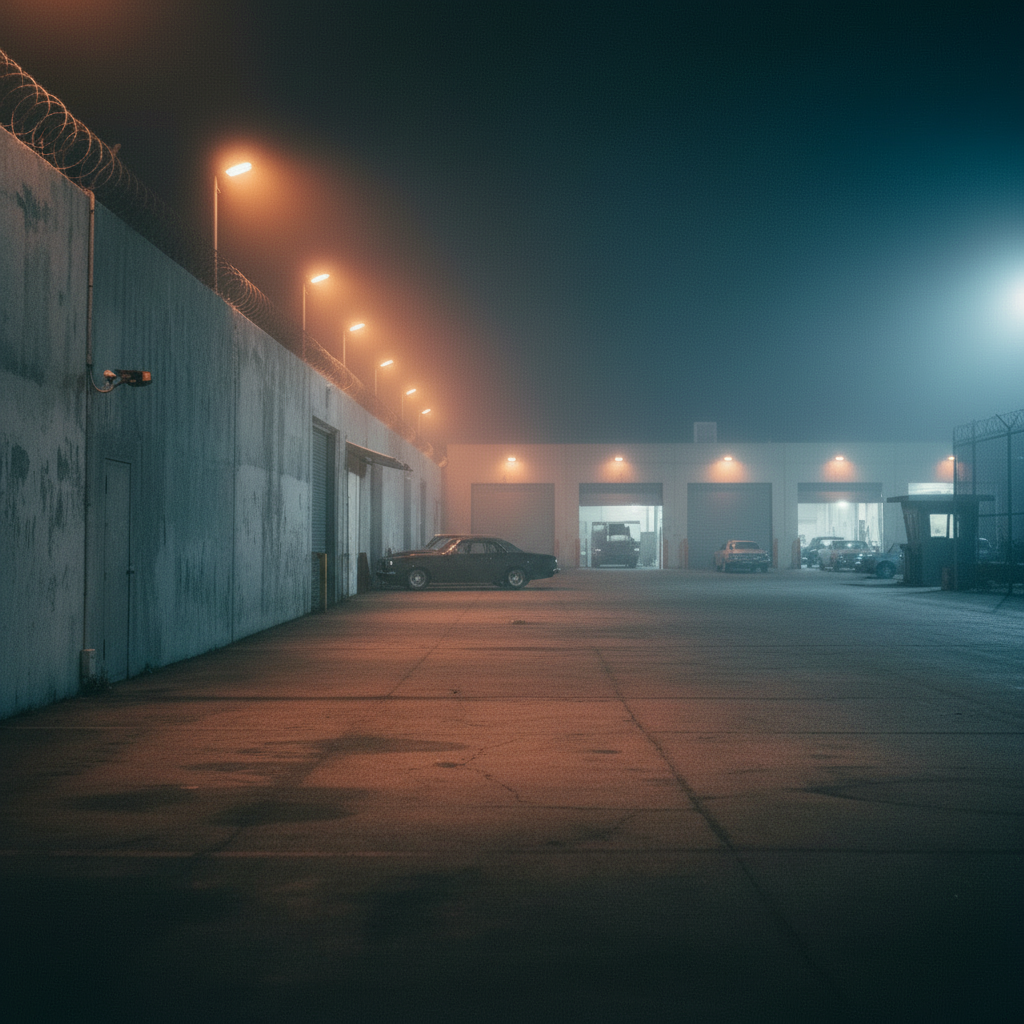
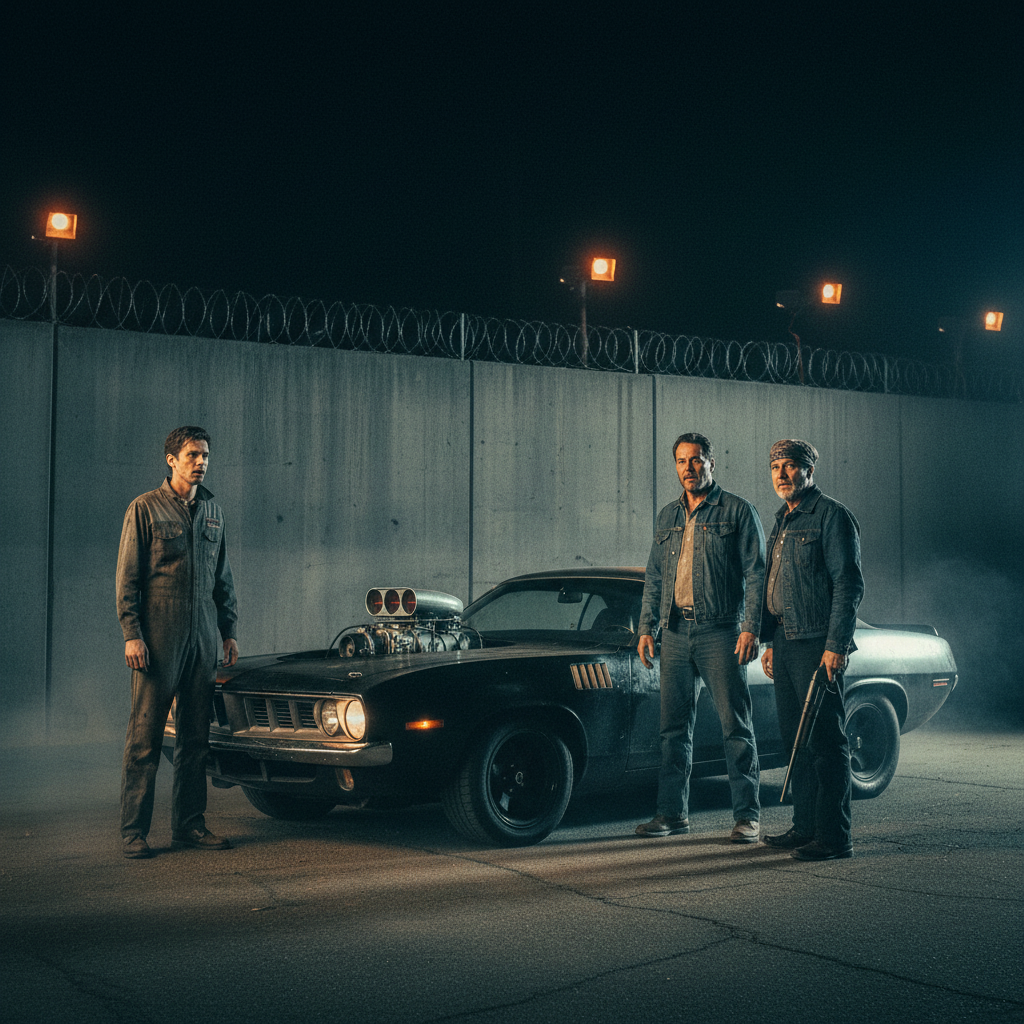
It was a long wall. Concrete, painted the color of old bone, running the full length of the block with coiled barbed wire along the top catching the orange glow of the sodium vapor lights. The kind of wall that said: what's inside is worth protecting.
Tim pulled the RPC‑6 to the curb and cut the engine. The three of them sat in the dark and looked at it.
"Burbank Studios," Mike said.
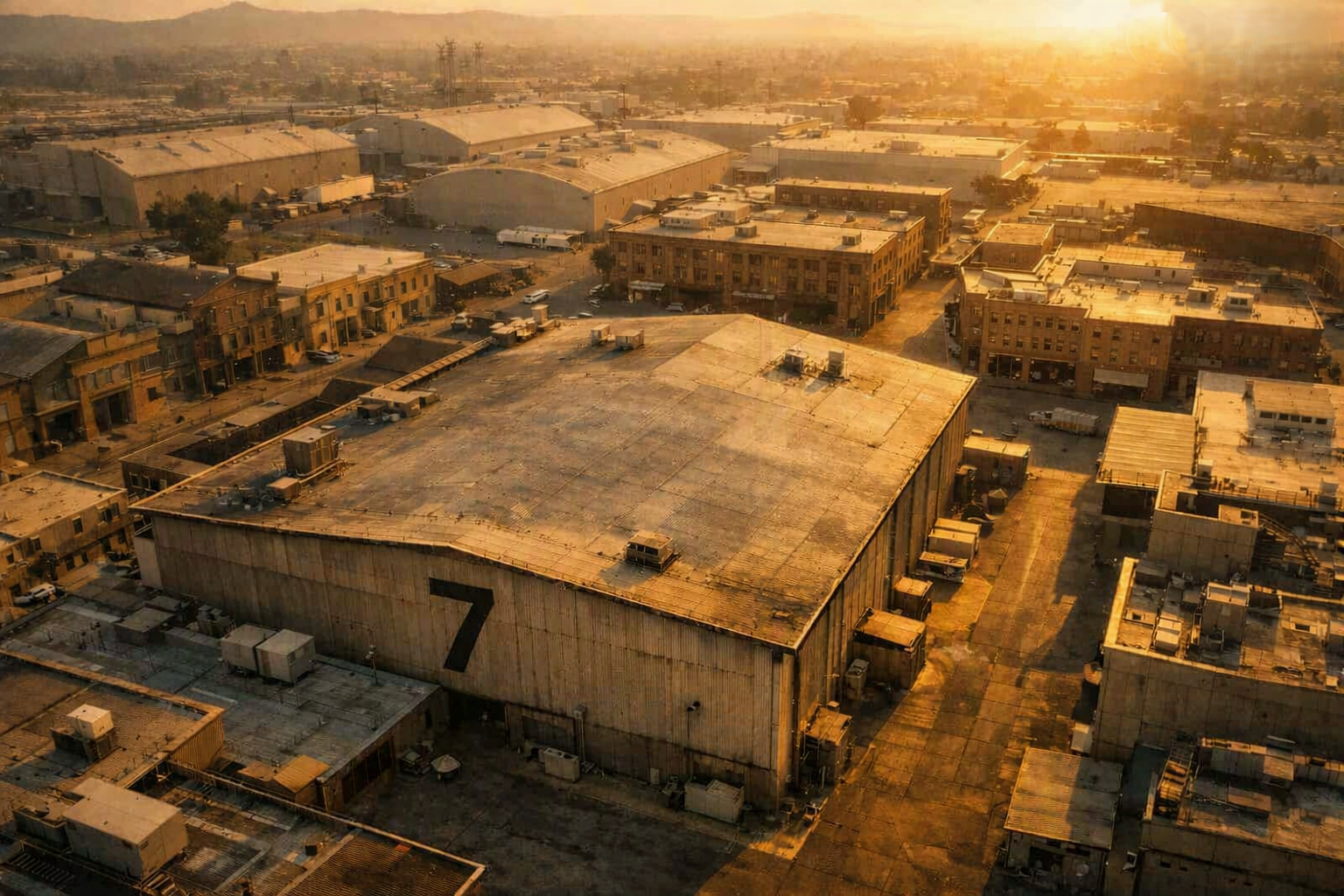
"Warner Bros. now," Tim said. "But in 1980 it was still Burbank. That's when the Cuda came through those gates."
The backlot stretched behind the wall — they couldn't see it from here, but Tim had studied the layout. Vehicle storage was on the north end, a row of industrial rolling doors set into a long low building, the kind of structure that held things the studio didn't want to throw away but didn't know what to do with. Background vehicles. Prop cars. Machines that had been in something once and might be in something again.
"The CHiPs production wrapped in '83," Mike said, reading from the notes he'd been compiling since Nevada. "Background vehicles were inventoried and transferred to the studio's general prop pool. A black '71 Cuda with a sunroof is listed in the 1984 inventory under 'muscle cars — non-hero.' Last confirmed location: north backlot vehicle storage."
"That was forty years ago," Jody said.
"Studios don't throw away muscle cars," Tim said. "Not ones that photograph like that."
Jody was already scanning the perimeter. His eyes moved the way they always moved — methodically, without hurry, cataloguing threats. "Guard booth at the main gate. Cameras on the wall corners. And dogs." He paused. "I can hear them."
From somewhere beyond the wall, low and distant, came the sound of a dog moving — not barking, just the soft percussion of paws on asphalt, the particular silence of an animal that has been trained not to announce itself.
"Two," Jody said. "Maybe three."
Mike looked at Tim. "Tell me you have a plan that doesn't involve Jody shooting a security dog."
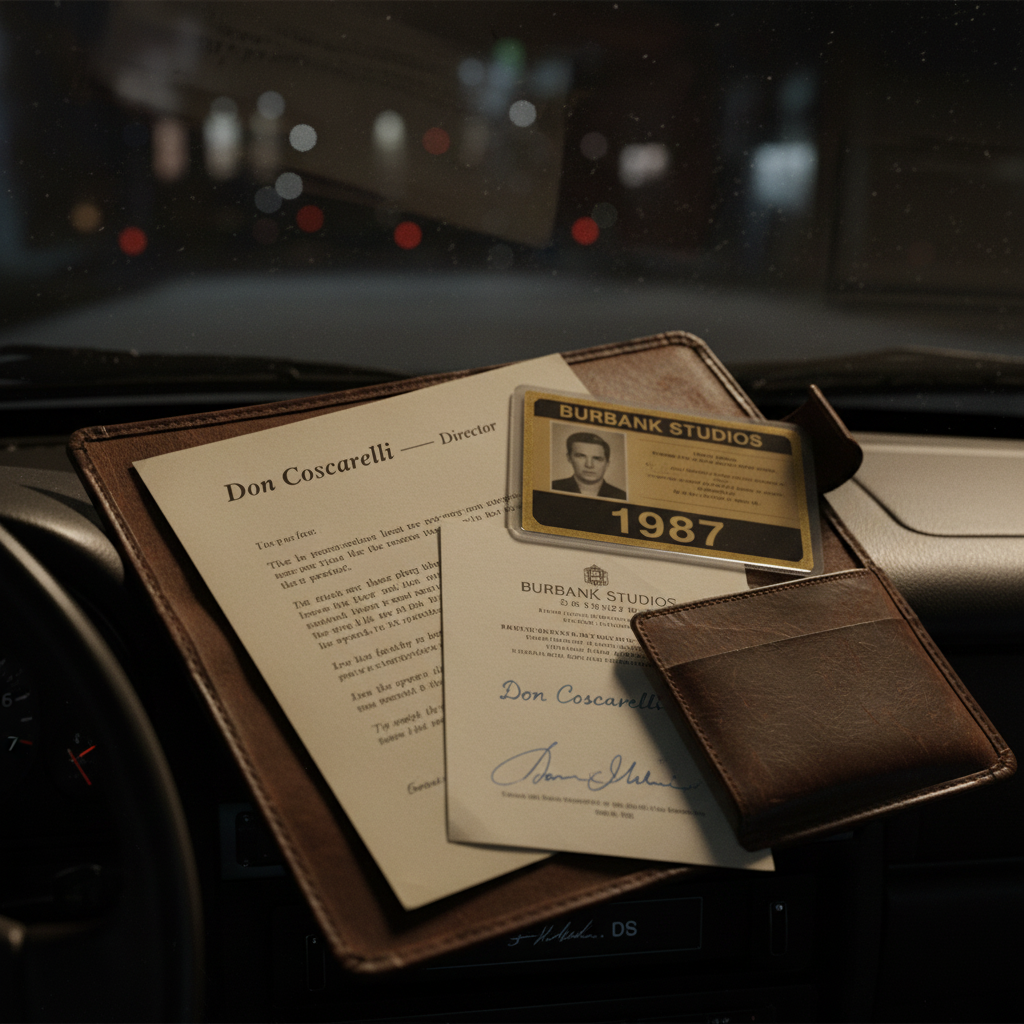
Inside: a production credential. A laminated studio pass from 1987. A letter on Don Coscarelli's personal letterhead, signed in blue ink, identifying the bearer as a researcher working under the director's authority on a retrospective production project. And beneath that, a second letter — this one on studio stationery, countersigned by a production executive whose name still carried weight in the Burbank lot.
"Reggie," Mike said quietly.
"Reggie," Tim confirmed. "He got these to my father years ago. Said to keep them safe. Said there would come a time when someone needed to walk through a studio gate without a fight." He looked at the credential. "Don Coscarelli's name opens doors in this town. Even at two in the morning. Even forty years later."
Jody studied the letterhead. "This is real?"
"Don knew what the car meant," Tim said. "He put it in five films. He knew it was more than a prop. Reggie made sure he understood — and Don made sure there was a way back in, if it ever came to that."
Mike was quiet for a moment. Then: "Reggie planned this from the beginning. All of it. The map, the porthole, the credentials. He laid a trail that only we could follow."
"He laid a trail that only we would bother to follow," Tim said.
They got out of the RPC‑6. Tim tucked the document wallet under his arm. Jody kept the shotgun low and out of sight. Mike walked slightly ahead, the way he always had — like someone who had been walking toward things that frightened him for so long that the fear had become indistinguishable from forward motion.
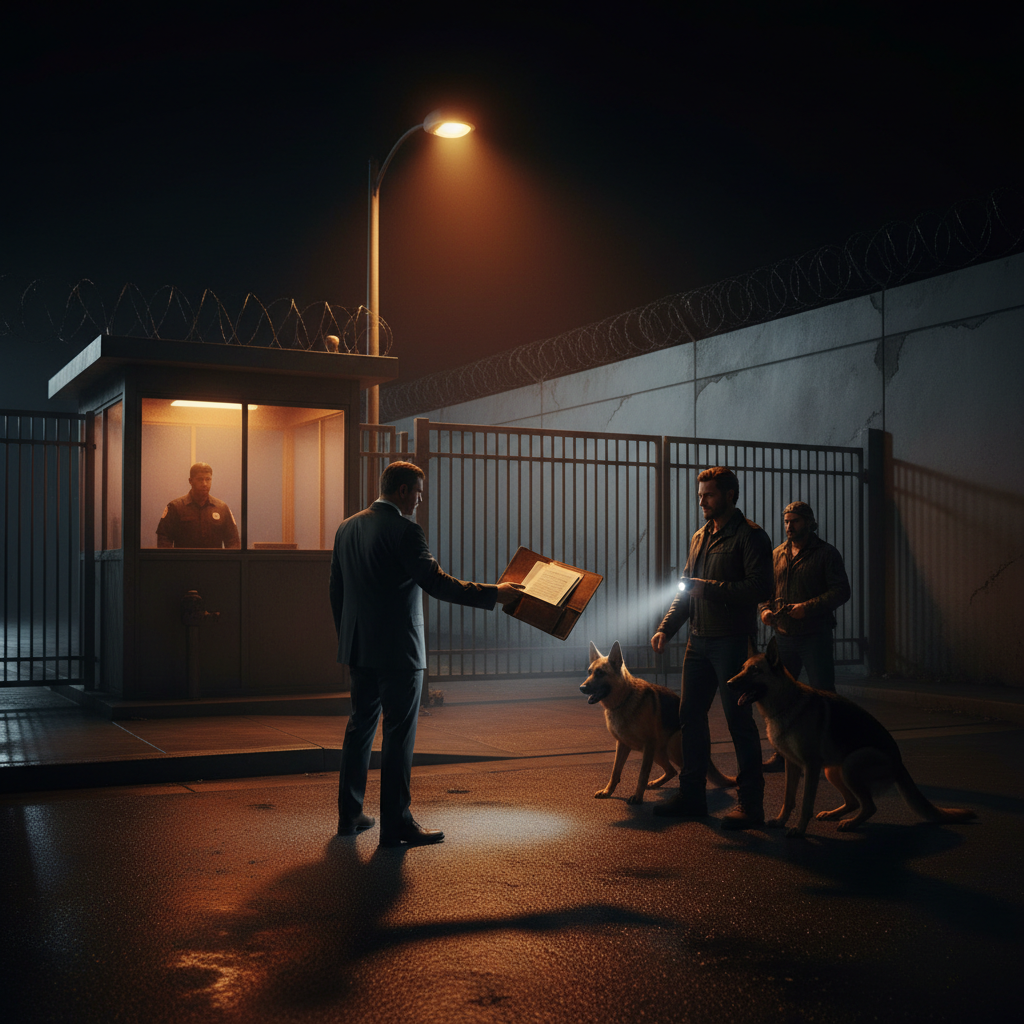
Two of them. German Shepherds, moving fast and low across the asphalt, a handler behind them with a flashlight cutting through the dark.
"Hold," the handler called. "This is private property. Identify yourselves."
Tim stepped forward into the light and opened the document wallet.
"Research access," he said. "Authorized under the Coscarelli retrospective project. We have a standing credential and a countersigned studio letter." He held the documents out, steady, the way his father had taught him to hold things when the situation required calm.
The handler took the documents. The dogs held — trained, professional, watching.
A long moment.
The handler keyed his radio. A burst of static. A voice on the other end, groggy, annoyed, then less annoyed. Then: "Copy that. Let them through."
The gate rolled back.
The handler handed the documents back to Tim without a word and led the dogs away into the dark.
The three of them walked through the gate and onto the Burbank Studios backlot.
Ahead of them, at the far end of the north lot, the row of rolling doors waited — dark, closed, silent. Somewhere behind one of them, if Reggie's trail held, a black '71 Cuda with a sunroof had been sitting in the dark for forty years.
Waiting.
"Which door?" Jody said.
Tim looked at the row of identical doors stretching into the sodium-lit dark.
"Reggie's map only brought us to the lot," he said. "The rest we find ourselves."
Mike looked at the doors. Counted them. Seven.
"Then we start at one," he said.
And somewhere in the dark behind those rolling doors, something that had been waiting a very long time felt them coming.
Recovered treatment — chapter sixteen
They started at door one.
It was unlocked. The studio's vehicle storage ran on a trust system that assumed nobody would ever want what was inside — old props, background dressing, machines that had been in something once and might be in something again. The kind of inventory that got catalogued and forgotten.
Jody pulled the rolling door up and they went in.
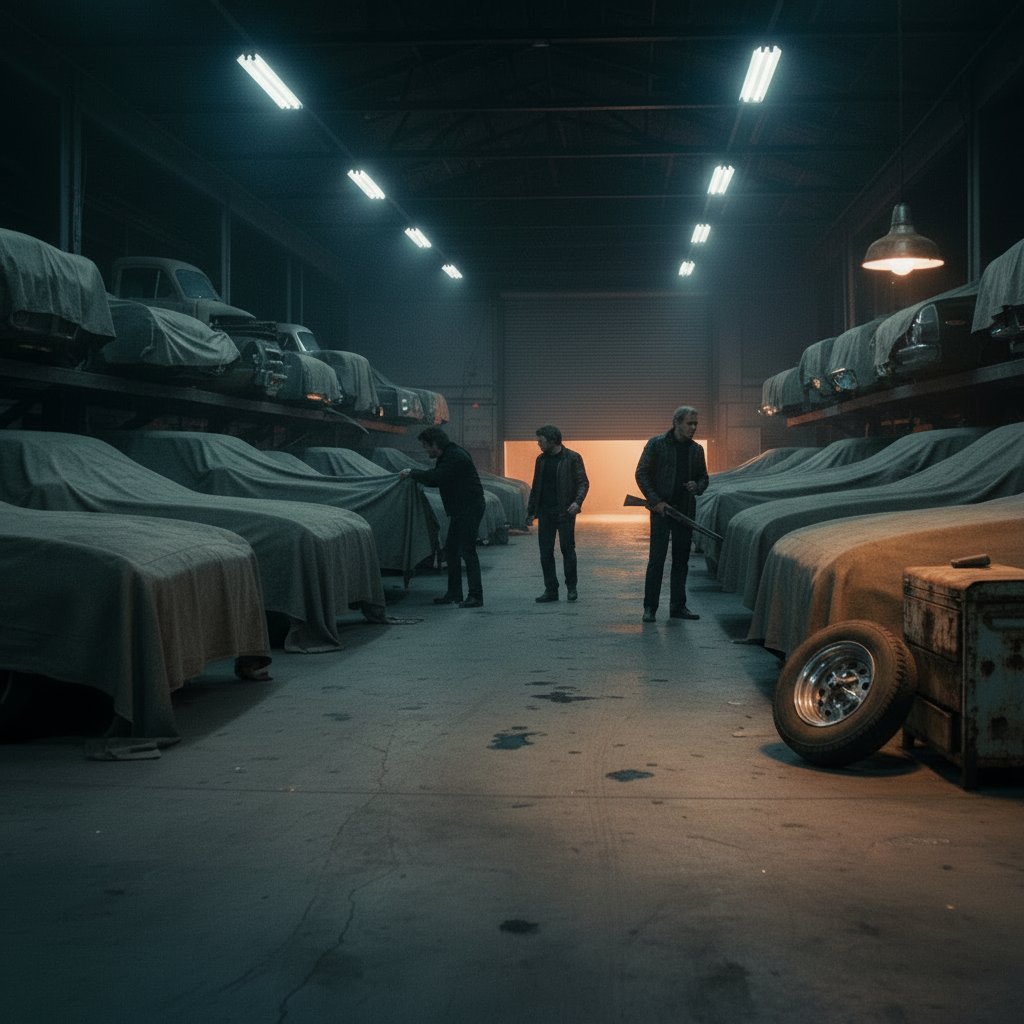
Cars under covers. Rows of them, stretching back into the dark, the grey canvas shapes humped and anonymous under a single row of fluorescent tubes that buzzed and flickered overhead. The smell of old oil and concrete dust and something underneath that — rubber, maybe, or the particular staleness of a room that hadn't been properly opened in years.
Mike moved down the first row, lifting cover corners, checking. A '67 Mustang. A Dodge Dart. A mid-seventies Cadillac with a cracked vinyl roof. A Ford pickup that had been painted flat black for something and never repainted.
"Not here," he said.
Building two: more of the same. A row of station wagons. Three identical brown sedans that had been used as police cars in something. A VW van with a flower painted on the side, the flower faded to almost nothing.
"Not here," Tim said.
Building three held motorcycles and a fire truck. Building four was locked — Jody looked at the lock for a moment and then looked at Tim, and Tim shook his head. Not yet.
Building five: a row of convertibles, all top-down, all dusty. A Lincoln Continental. Two Thunderbirds. Something European that Mike couldn't identify. He lifted every cover anyway, methodically, the way he did everything.
"Not here."
Building six was the largest — a double-wide structure that held what looked like an entire decade of American automotive production. Muscle cars, sedans, trucks, a school bus cut down to half its length for some production reason nobody had documented. Tim walked the rows slowly, reading the shapes under the covers the way a person reads a language they half-remember.
"Not here," he said. His voice was flat. Not defeated — just flat.
Building seven was at the end of the row, set slightly apart from the others, smaller, the rolling door dented at the bottom as if something had backed into it hard once and nobody had bothered to fix it. A hand-lettered sign above the door read MISC — LONG TERM.
Jody pulled the door up.
The smell hit them first — deeper than the other buildings, older, the particular atmosphere of a space that had been sealed for a very long time. The fluorescent tube inside was dead. Tim pulled out a flashlight and swept it across the interior.
Fewer cars here. Maybe a dozen, covered, pushed to the walls as if someone had cleared the center of the floor at some point and never put anything back. A workbench along the far wall. A rusted metal toolbox on wheels, the kind with a dozen drawers, the kind that mechanics kept for forty years.
And leaning against the toolbox, half-hidden in shadow, a wheel.
Tim's flashlight found it and stopped.
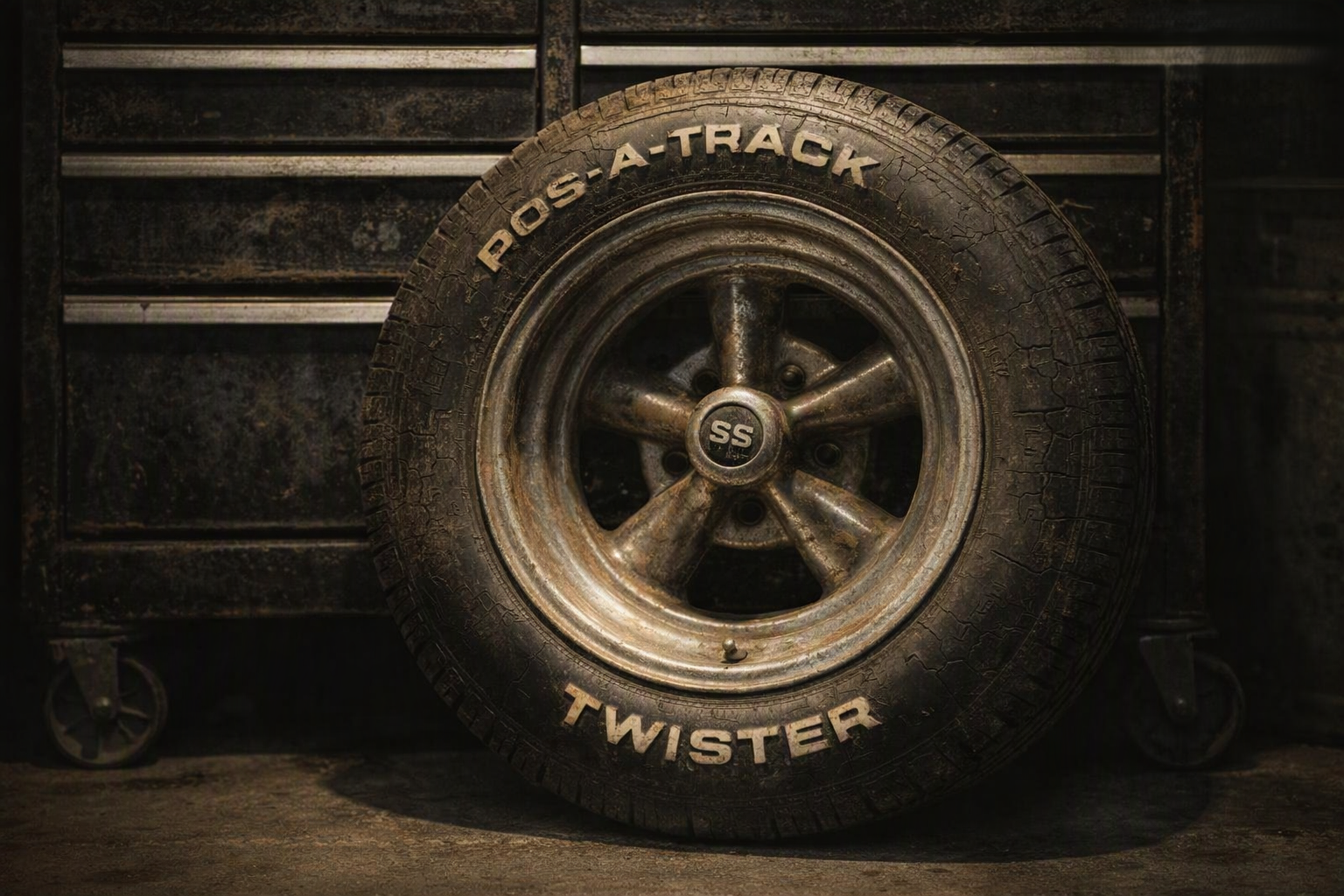
A Cragar SS. Ten-inch chrome — or what had been chrome, once. Now it was oxidized to a dull silver-grey, the finish pitted and clouded with age. But the shape was unmistakable: the five-spoke Cragar pattern, the center cap still in place, the deep dish catching the flashlight beam and throwing it back in fragments.
Still mounted on the wheel: a tire. Old, cracked at the sidewall, the tread worn nearly smooth. And on the sidewall, in raised white lettering that had gone yellow with age, three words:
POS-A-TRACTION TWISTER.
Nobody said anything for a long moment.
Mike crouched down in front of it. He didn't touch it. He just looked at it the way you look at something you've been searching for long enough that finding it doesn't feel real yet.
"That's a Cuda wheel," he said.
"That's THE Cuda wheel," Tim said. "My father described this exact setup. Cragar SS tens with Twisters. He said Baker ran them on all four corners. Said they were the first thing he noticed when he saw the car — said they looked like something off a race car, not a street machine."
Jody was already moving along the wall, checking the covered cars. He lifted the first cover and found a '73 Camaro. The second: a Pontiac GTO. The third—
He stopped.
"Tim."
His voice was different. Not flat. Not urgent. Something in between — the voice of a man who has learned to be careful about hope.
Tim crossed the floor and stood beside him. The cover was grey canvas, same as all the others, but this one had been tucked in at the edges with more care than the rest — folded under the rocker panels, smoothed across the hood. Someone had covered this car deliberately. Someone had wanted it to stay covered.
Mike came up on the other side.
The three of them stood around it in the dark of Building 7, the flashlight beam cutting across the canvas, the old Cragar wheel leaning against the toolbox behind them.
Tim reached for the cover.
Then Mike said: "Wait."
He had moved to the toolbox. The top drawer was open — not forced, just open, as if someone had left it that way. Inside: a manila folder, thick with age, the edges brown and soft. Mike lifted it out carefully and opened it.
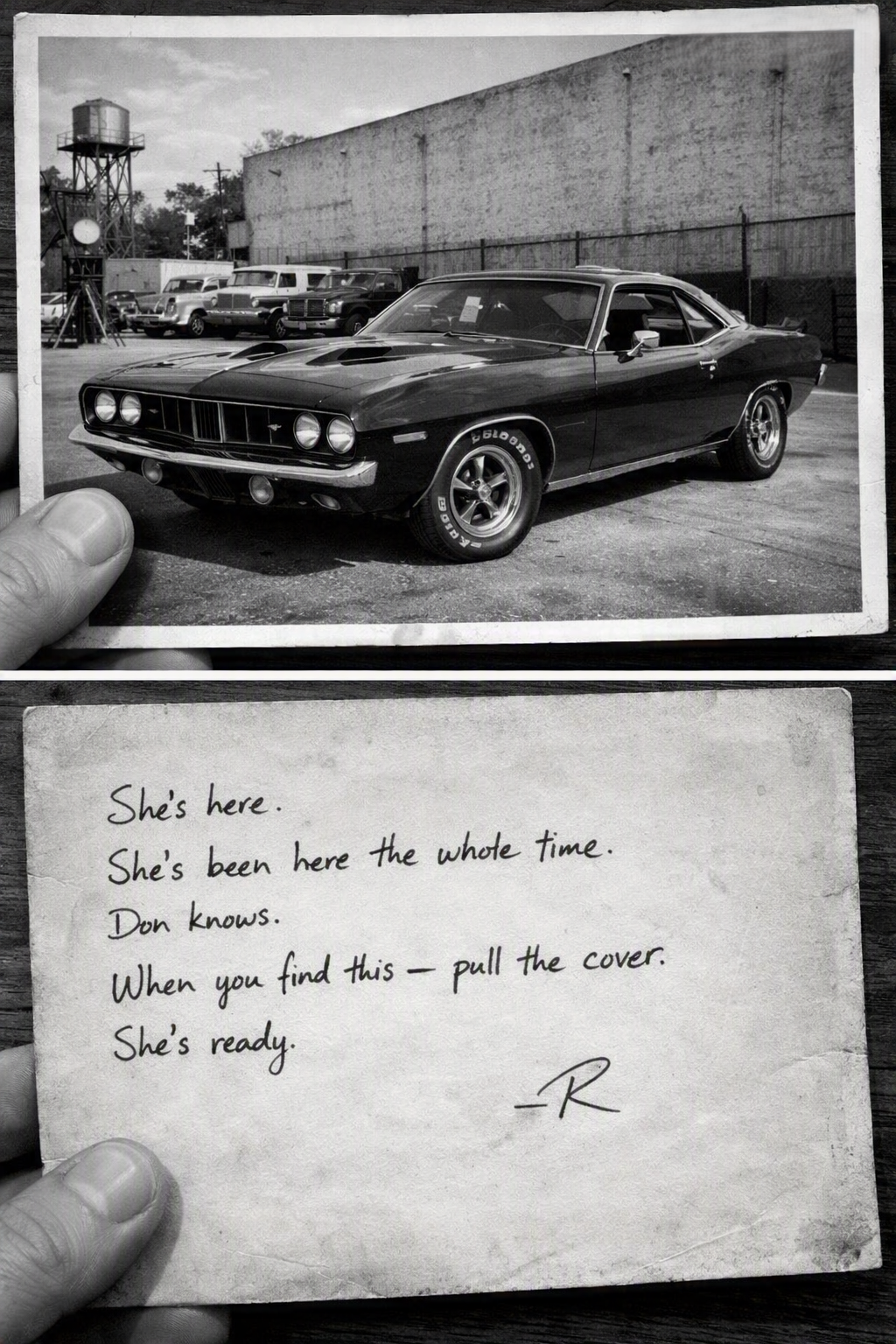
Photographs. Eight-by-tens, black and white, the glossy surface gone matte with time. Vintage cars on a backlot — the Burbank lot, recognizable from the wall in the background, the same wall they had walked past an hour ago. Production vehicles lined up for inventory. Background dressing. The ordinary documentation of a working studio.
And then, near the bottom of the stack, a photograph that was different from the others.
A black 1971 Plymouth Cuda. Parked on this lot. The sunroof visible. The Cragar SS wheels on all four corners, the Twister tires unmistakable even in black and white. The car sitting in the California sun looking exactly like what it was — a machine that had been in five films and didn't know it was lost.
Mike turned the photograph over.
On the back, in handwriting he recognized from the map, from the porthole note, from every piece of the trail they had followed across two states and forty years:
"She's here. She's been here the whole time. Don knows. When you find this — and you will find this — pull the cover. She's ready."
It was signed with a single R.
Mike looked up from the photograph.
Tim's hand was still on the cover.
"Pull it," Mike said.
Recovered treatment — chapter seventeen
Tim's hand was on the canvas.
He didn't pull it. Not yet. He just stood there with his palm flat against the cover, feeling the shape underneath — the long flat hood, the slight rise of the dual scoops, the geometry of a car he had only ever known from photographs and his father's voice.
Jody moved first. He came around the driver's side slowly, the shotgun held low and loose in one hand, and pressed his free hand against the rear quarter panel. The canvas was thick with dust — forty years of it, grey and fine, the accumulated silence of a room that had been sealed and forgotten. Under his palm he could feel the shape of the fender flare. Wide. Pronounced. Unmistakable.
"That's a flare," he said. His voice was quiet. Not a question.
Mike came up on the passenger side and reached out. His fingers found the roofline and traced it forward until they hit the edge of the sunroof panel — the lip of it, the slight recess in the roof where the glass had been removed for filming and never replaced. He ran his thumb along the edge.
"Sunroof," he said.
Neither of them said anything else for a moment. They just stood there with their hands on the car, the dust coming off on their palms, the shape of it becoming real under their touch the way a thing becomes real when you stop believing in it and start feeling it instead.
Jody moved his hand slowly along the quarter panel toward the rear. The fender flare curved out wide under the canvas — wider than a standard body, the aftermarket flare that had been on the car since Baker ran it, the same flare visible in every photograph, in every frame of every film. He pressed his palm flat against it and held it there.
"Forty years," he said.
"Forty years," Mike said.
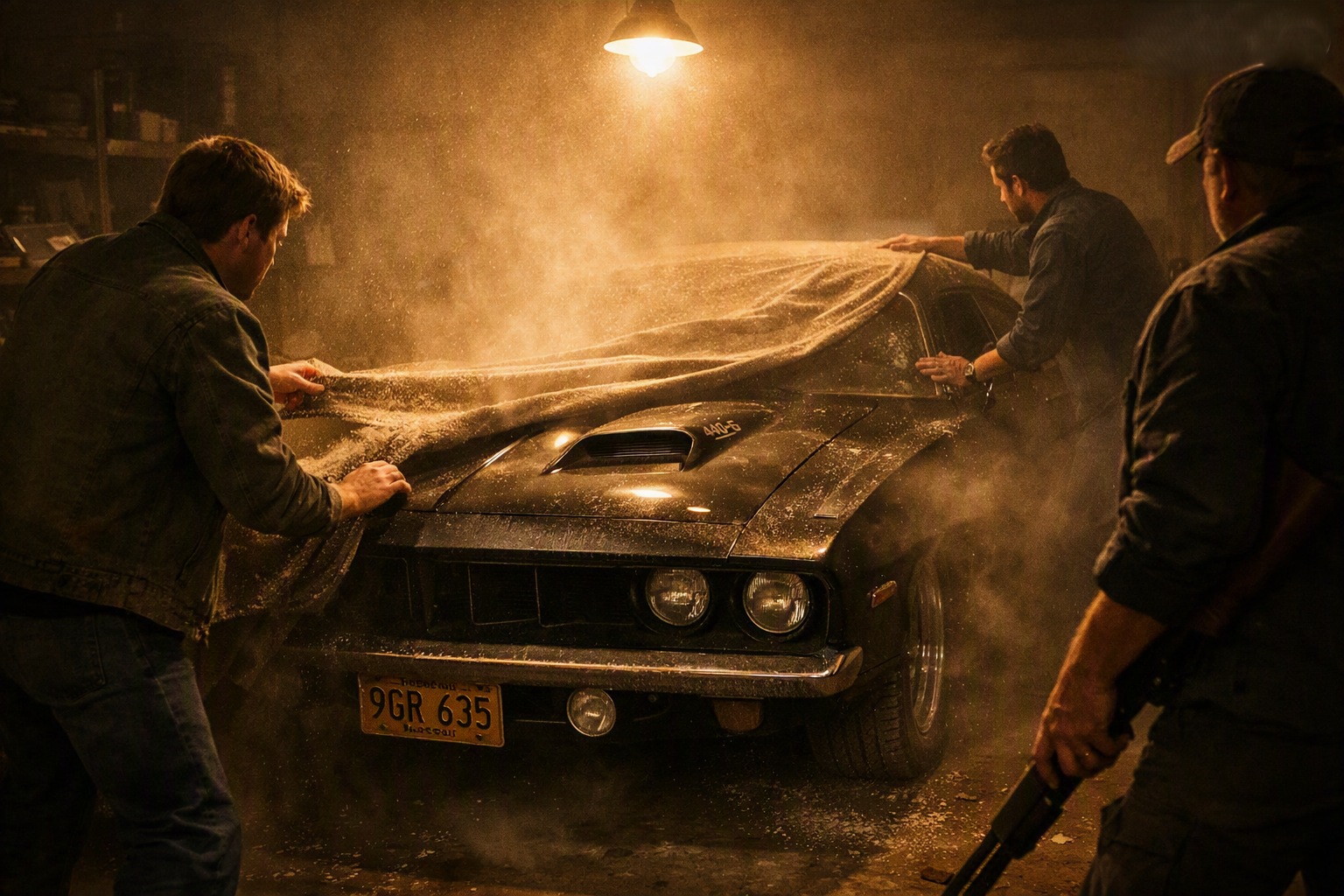
Tim pulled the cover.
He grabbed the front edge and walked it back, the canvas sliding off the hood in a slow wave, the dust rising in a cloud that caught the work light and hung in the air like smoke. The hood emerged first — jet black under the grey, the paint oxidized and chalky but intact, the dual 440-6 callout scoops sitting exactly where they had always sat, the lettering worn to almost nothing but still there, still readable if you knew what you were looking for.
Tim kept walking the cover back. The roofline came next — the sunroof opening dark and empty, the glass long gone, the edges of the opening clean. Then the windshield, filmed with dust, and through it the interior: the three-spoke aftermarket steering wheel, rust-pitted on the spokes but the rim still solid, still holding its shape. The pistol grip shifter rising from the floor, the four-speed handle intact, the leather worn smooth at the grip.
The tinted side windows. The rear quarter glass dark as it had always been, the tint holding after four decades in a sealed room.
The fog lights below the front bumper, both lenses intact.
The license plate.
Yellow. Oregon. The numbers and letters still legible under the dust.
9GR 635.
Mike stared at it. He had seen that plate in the CHiPs episode. He had seen it in Baker's photograph. He had seen it in the negative that Reggie had left in the fireproof container behind the glove box. He had been looking at that plate for months and now it was three feet in front of him coated in forty years of Burbank dust and it was the most real thing he had ever seen.
Tim let the cover drop to the floor behind the car.
The Baker Cuda stood in the work light, black and grey with dust, every detail intact. The car that had been in five films. The car that James Baker had traded at a Shell station on Reseda Boulevard in 1980. The car that had been a background vehicle in a television show and then disappeared into a studio inventory and been covered and forgotten in a building at the end of a row.
The car that Reggie had known was here. That Don had known was here. That had been waiting, under a canvas cover in Building 7, for someone to bother to look.
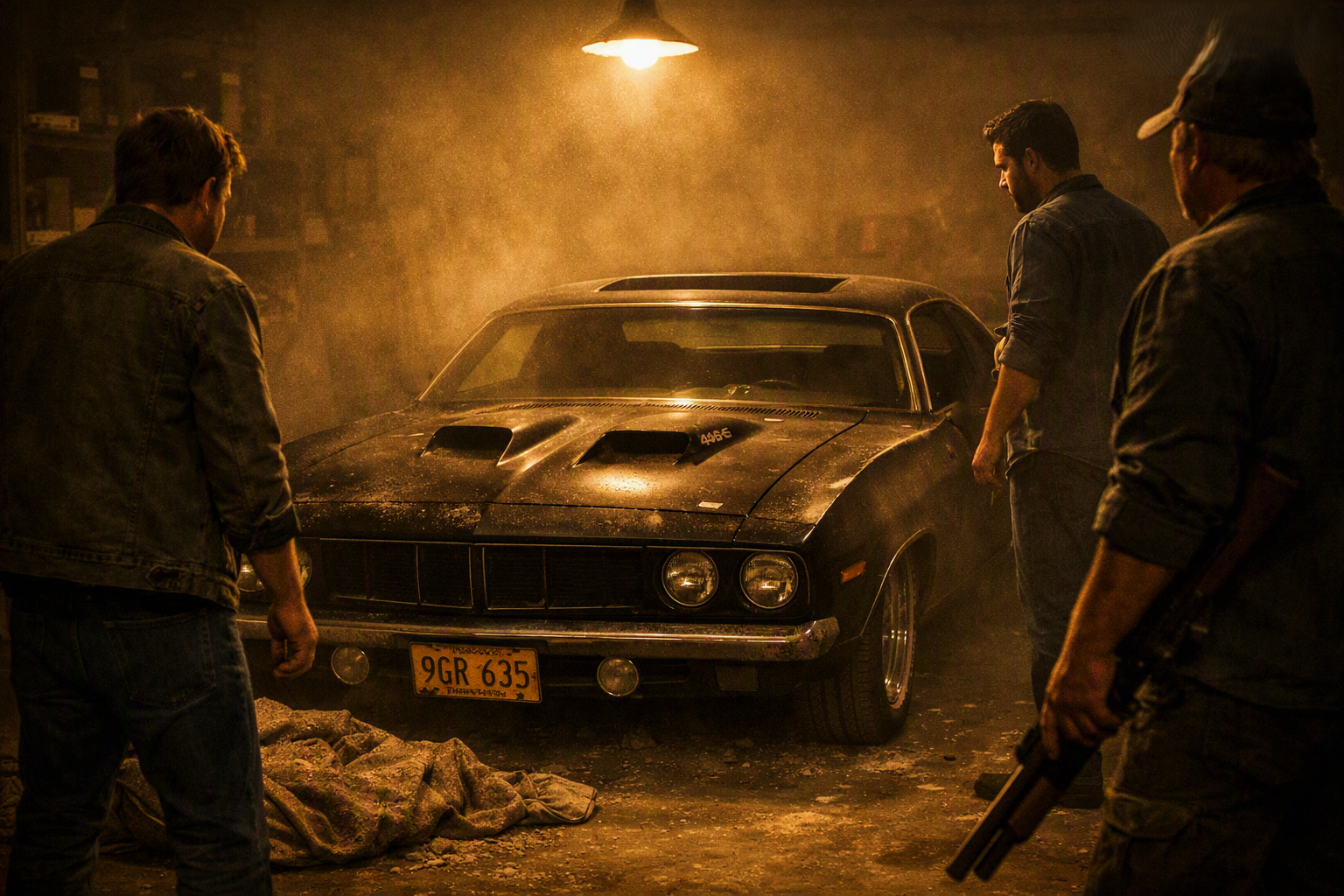
Jody crouched down and looked at the driver's door. "It's locked."
"Check the passenger side," Tim said.
Mike tried the passenger door. It opened.
The smell hit him first — old vinyl, old carpet, the particular interior atmosphere of a car that had been sealed for decades. He leaned in and looked under the passenger seat.
There, in the dust on the floor beneath the seat, lay the rearview mirror. Removed for filming. Never reinstalled. Sitting exactly where someone had placed it, forty years ago, in a car that was about to be covered and forgotten.
Mike picked it up. The glass was intact. He could see his own face in it, dusty and tired and something else — something he didn't have a word for yet.
He set it on the seat.
"She's all here," he said.
Tim stood at the front of the car with his hand on the hood, the dust coming off on his palm, the heat of the work light on his back. He thought about his father standing across the street from Speedco Motors watching the Cuda change hands. He thought about Reggie driving it through five films, knowing what it was, knowing where it would end up, laying a trail that would take forty years to follow.
He thought about the porthole. The map. The Shell station. The credentials in the leather wallet. The Cragar wheel leaning against the toolbox. The photograph with the single R on the back.
"What do we do now?" Jody said.
Tim looked at the car. The dust. The plate. The scoops. The sunroof opening dark against the roofline.
"We take her home," he said.
Recovered treatment — chapter eighteen
They stood outside in the sodium vapor dark, the three of them, gathered around the RPC‑6 where it sat against the studio wall.
Nobody said anything for a long time.
The barbed wire caught the orange light above them. The fog had thickened since they'd gone in — it moved across the asphalt in slow drifts, the kind of fog that belongs to the Valley at three in the morning, the kind that makes everything feel like it happened a long time ago.
Mike had his hands on top of his head. He was staring at the studio wall as if he could see through it, back into Building 7, back to the car under the cover, back to the plate.
9GR 635.
Jody leaned against the RPC‑6's passenger door with the shotgun resting across his forearms, his eyes moving the way they always moved — perimeter, gate, wall, fog, back to perimeter. But there was something different in his face. Something that wasn't threat assessment.
Tim stood at the front of the RPC‑6 with both hands flat on the hood, looking down at the asphalt between his feet.
"We can't take it," he said.
Mike turned. "What?"
"We can't take it," Tim said again. "Not tonight. Not like this." He looked up. "Think about what we just did. We walked through that gate on a forty-year-old credential and a dead man's signature. We went into a building we had no legal right to enter. We pulled a cover off a car that belongs to this studio." He paused. "If we drive that car out of here tonight, we're thieves. Everything Reggie built — the trail, the credentials, the photograph — all of it becomes evidence against us instead of for us."
The fog moved between them.
"He's right," Jody said. He didn't sound happy about it.
Mike looked back at the wall. At the gate. At the guard booth where the light was still on, the handler inside with his dogs and his radio and his memory of three men with a very old piece of paper.
"So we leave her," he said.
"We leave her," Tim said. "She's been there forty years. She'll be there when we come back with the right paperwork. With lawyers. With Don's name on something that can't be argued with in daylight."
"And nobody knows we were here," Jody said.
"Nobody knows we were here," Tim confirmed.
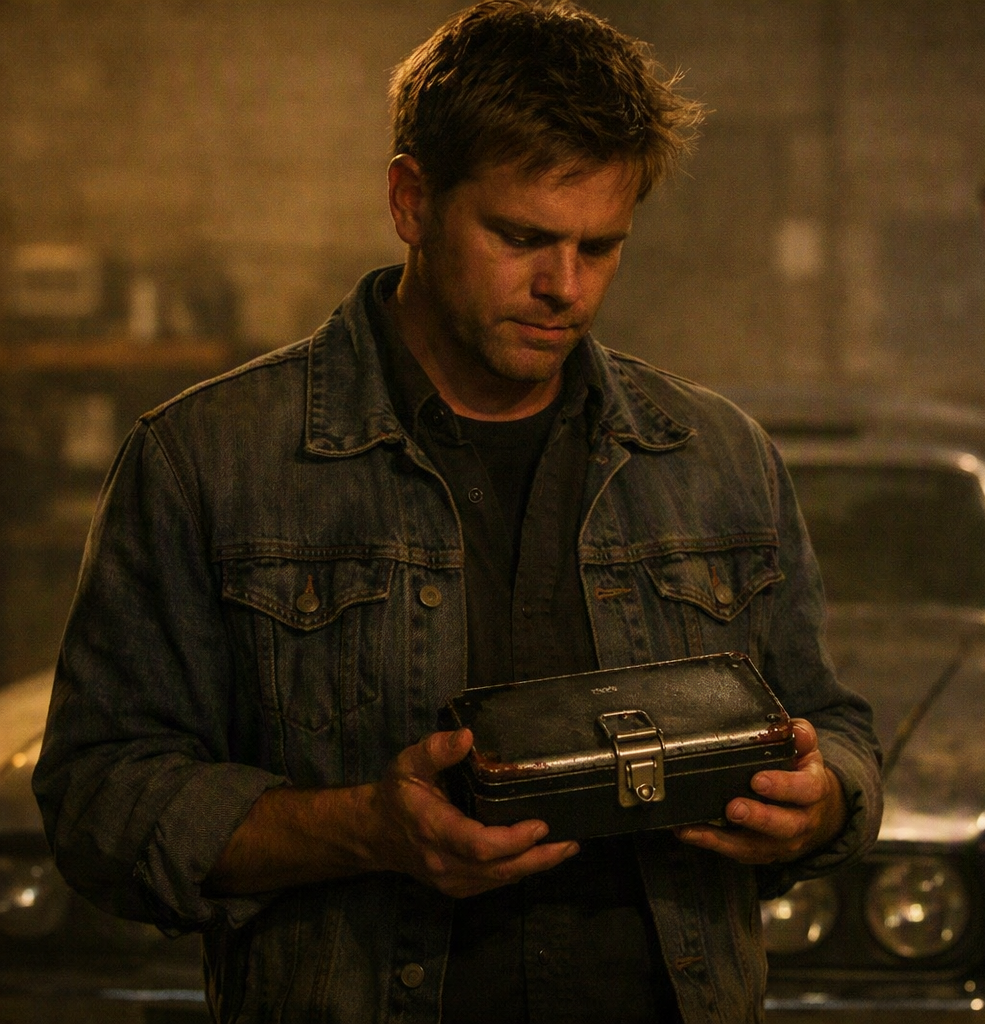
He reached into his jacket and pulled out the fireproof container — small, flat, the kind designed to survive a car fire, the kind that had been sitting behind the Baker Cuda's glove box for four decades waiting for someone to open it. He turned it over in his hands. The latch was stiff with age but it hadn't been forced. Whatever was inside had never been touched.
"Reggie put this here before the car went into storage," Tim said. "Before it got covered. Before it got forgotten. He knew someone would find the car. He knew they'd find this." He looked at Mike. "He knew it would be us."
"Open it," Mike said.
"Not here," Tim said. "Not on this lot. Not until we're somewhere that isn't a studio backlot at three in the morning with a security guard fifty yards away."
He put the container in his jacket pocket.
They got into the RPC‑6. Tim started the engine — the sound of it too loud in the empty lot, the exhaust note bouncing off the studio wall — and pulled away from the curb slowly, no headlights until they were through the gate and back on Olive Avenue.
The guard booth was dark as they passed. The handler and his dogs were gone.
Nobody had seen them.
They drove south on Olive and picked up Cahuenga heading into the Valley, the RPC‑6 moving through the pre-dawn empty streets with the city lights smearing in the fog above them. Nobody spoke. The container sat in Tim's jacket pocket against his ribs.
They came down Reseda Boulevard the same way they had come up it — past the CVS, the taqueria, the mattress store, the tire shop. The ordinary geography of a neighborhood that had no idea what moved through it.
At Cohasset, Tim slowed.
The Speedco Motors lot was dark. The chain-link fence, the hand-lettered sign, the rows of used hot rods sitting in the dark under a single security light. The lot where the Baker Cuda had changed hands for the last time before it disappeared into a studio inventory and a canvas cover and forty years of silence.
Tim looked at it as they passed. He didn't stop.
"She came through here," Mike said quietly.
"She came through here," Tim said.
They drove south to Devonshire and turned east, and three minutes later they pulled into the Shell station at Reseda and Devonshire — Tim's service, the same pumps, the same overhead lights, the same concrete apron where a black '71 Cuda had sat one night in 1980 while James Baker made the worst decision of his life.
Tim parked at the far end of the lot, away from the pumps, away from the light. He killed the engine.
He took the fireproof container out of his jacket and set it on the center console between them.
The three of them looked at it.
"Forty-five years," Jody said.
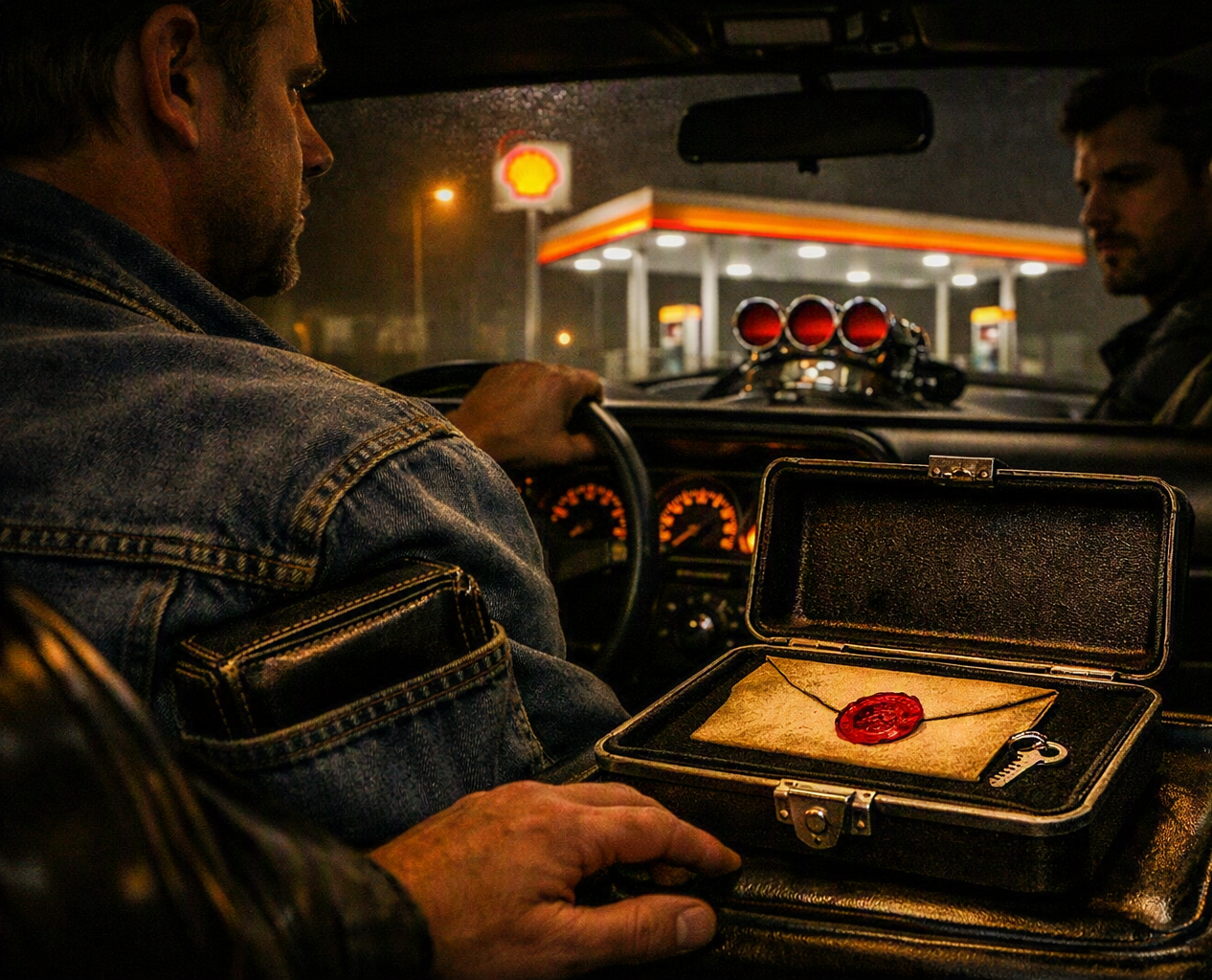
Tim worked the latch. It resisted — the mechanism stiff, the metal swollen slightly with age — and then it gave, and the lid came open.
Inside: a folded document, sealed in a wax envelope that had gone brittle and brown. And beneath it, a small key on a plain ring, the kind that opens a safety deposit box.
Tim lifted the envelope carefully and broke the wax seal.
He unfolded the document.
He read it once. Then he read it again.
Mike watched his face. Tim's expression didn't change — not exactly. But something behind his eyes did. Something that had been moving for a long time came to rest.
"What does it say?" Mike said.
Tim set the document on the console and smoothed it flat with his palm.
"It says the car was never lost," he said. "It says Reggie put it there. Deliberately. He made a deal with the studio — a private arrangement, undocumented, the kind that only works when both parties understand what they're protecting. The Cuda goes into storage. It stays off the market. It stays off the record. And when the time is right — when someone follows the trail all the way to the end — the car comes home."
The Shell station hummed around them. A truck passed on Reseda, its headlights sweeping through the windshield and gone.
"He hid it on purpose," Mike said.
"He protected it," Tim said. "There's a difference."
Jody looked at the key on the plain ring. "And the key?"
Tim picked it up. Turned it over. On the back of the ring, stamped into the metal in letters almost too small to read:
FIRST FEDERAL — RESEDA.
"There's more," Tim said.
He looked out through the windshield at the Shell station pumps, at the concrete apron, at the place where the Baker Cuda had sat forty-five years ago on a night that had set everything in motion.
"The secret that's been kept for forty-five years," he said, "isn't where the car is."
He looked at Mike. Then at Jody.
"It's why."
Recovered treatment — chapter nineteen
It began on a film set in 1977.
A young director with curly dark hair and a camera he'd borrowed against every reasonable expectation. A tall, bald musician and actor who had said yes to a low-budget horror film because something about the script felt different — felt like it was reaching for something that most films didn't bother to reach for.
Don Coscarelli and Reggie Bannister. Two men who would spend the next five decades making films together, building a mythology together, and keeping a secret together that neither of them ever broke.
The car was there from the beginning.
A 1971 Plymouth Cuda, jet black, with a sunroof and wide fender flares and a presence on screen that nobody had planned for and nobody could explain. It wasn't supposed to be the star. It became the star anyway. The Mopar community saw it and felt something shift — the way you feel something shift when you see a car that is exactly right, that is the physical expression of an idea that you didn't know you had until you saw it moving down a road.
Don knew what he had.
He knew it when the first film came out and the letters started arriving. He knew it when the Mopar clubs started asking questions. He knew it when the car culture press started running stories and the fans started showing up at conventions with photographs and theories and a hunger for the car that never diminished across the decades.
Don Coscarelli in deep thought about the true significance of the original '71 Cuda he unleashed in the first film — the moment that quietly detonated a cultural shift, igniting decades of awareness, obsession, and respect across the Mopar community for the most killer car ever to hit a Hollywood screen.
He knew it, and he made a decision.
The decision was this: the car would disappear. Not be sold, not be auctioned, not be displayed at a show where someone could photograph the VIN and trace the title. It would simply cease to be findable. It would go somewhere safe, somewhere institutional, somewhere that a canvas cover and a studio inventory number and forty years of bureaucratic indifference would protect it better than any vault.
The opportunity came after the CHiPs episode aired. The Cuda had been used as a background vehicle on the Burbank Studios lot — a prop car, logged in an inventory, invisible in plain sight. Don went directly to the studio. He knew people there. He had been making films in this industry long enough that a quiet conversation with the right person in the right office could accomplish things that no contract could.
He purchased the car. Not through a dealer, not through a broker, not through any channel that would leave a paper trail a determined researcher could follow. A private transaction, a handshake, a storage arrangement that would keep the Cuda exactly where it was — on the lot, under a cover, in a building at the end of a row — for as long as Don needed it to stay there.
His connections in the film industry ran deep. He had spent decades building them — directors, producers, studio administrators, the kind of people who understood that some things were better kept quiet and who had the institutional authority to make sure they stayed that way. He was confident. Not reckless, not naive — confident. The kind of confidence that comes from knowing exactly who you are dealing with and exactly what they owe you.
The car would be there when he needed it. However many years that took.
And only one other person would know.
Reggie Bannister.
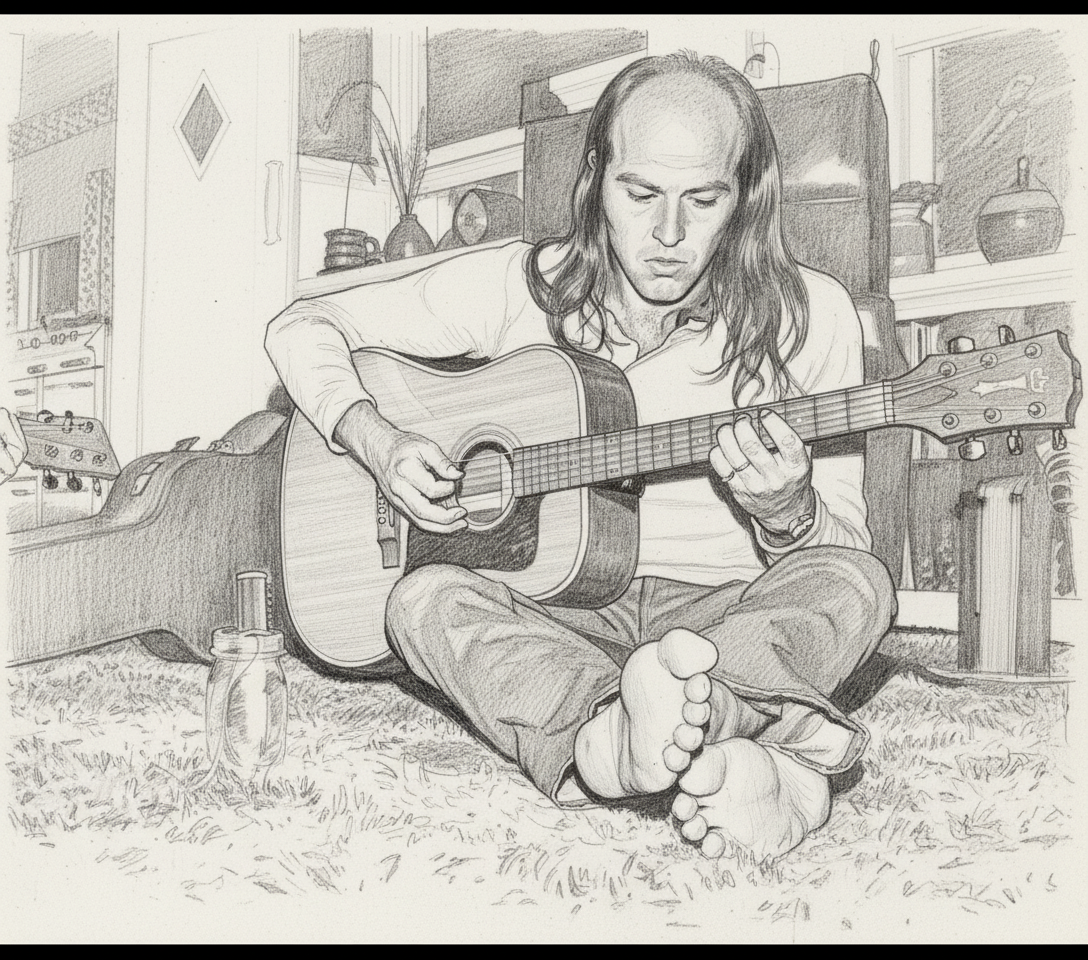
Courtesy of Gigi Bannister
The conversation happened once. Don doesn't remember exactly when — sometime after the CHiPs episode, after the purchase had been made and the storage arrangement was in place. He told Reggie everything: that he had bought the car directly from the studio, that it was sitting on the lot under a cover, that the arrangement was private and undocumented and would hold for as long as the industry relationships that backed it held. He told him where the car was. He told him why it was staying there. And he told him that when the final film was ready — when the story had run its full course — the car would come back.
"Don't tell anyone," he said. "Not ever. Not even when they ask directly. Especially when they ask directly."
Reggie looked at him for a long moment.
"How long?" he said.
"As long as it takes," Don said.
Reggie nodded. That was the pact. No paperwork, no witnesses, no ceremony. Two men who trusted each other completely, standing on a film set beside a black Cuda, making a promise that would hold for forty-five years.
And it held.
Through four sequels. Through conventions and retrospectives and anniversary screenings and documentary interviews where the question came up every single time. Through the internet age, when the fans got organized and the research got serious and the theories multiplied. Through the death of Angus Scrimm, who had played the Tall Man across all five films and who had known nothing about the car's location because Don had decided that the fewer people who knew, the better the secret held.
Reggie played his part perfectly.
He shrugged at conventions. He said he didn't know. He said it was probably gone, probably crushed, probably sitting in a field somewhere in the Valley rusting back into the earth. He said it with the easy regret of a man who genuinely wished he knew more, and the fans believed him because he was Reggie — because he was one of them, a guy who loved the car as much as they did, a guy who had driven one across five films and felt what it was like to sit behind that wheel.
He was the perfect keeper of the secret because he was the last person anyone would suspect of keeping it.
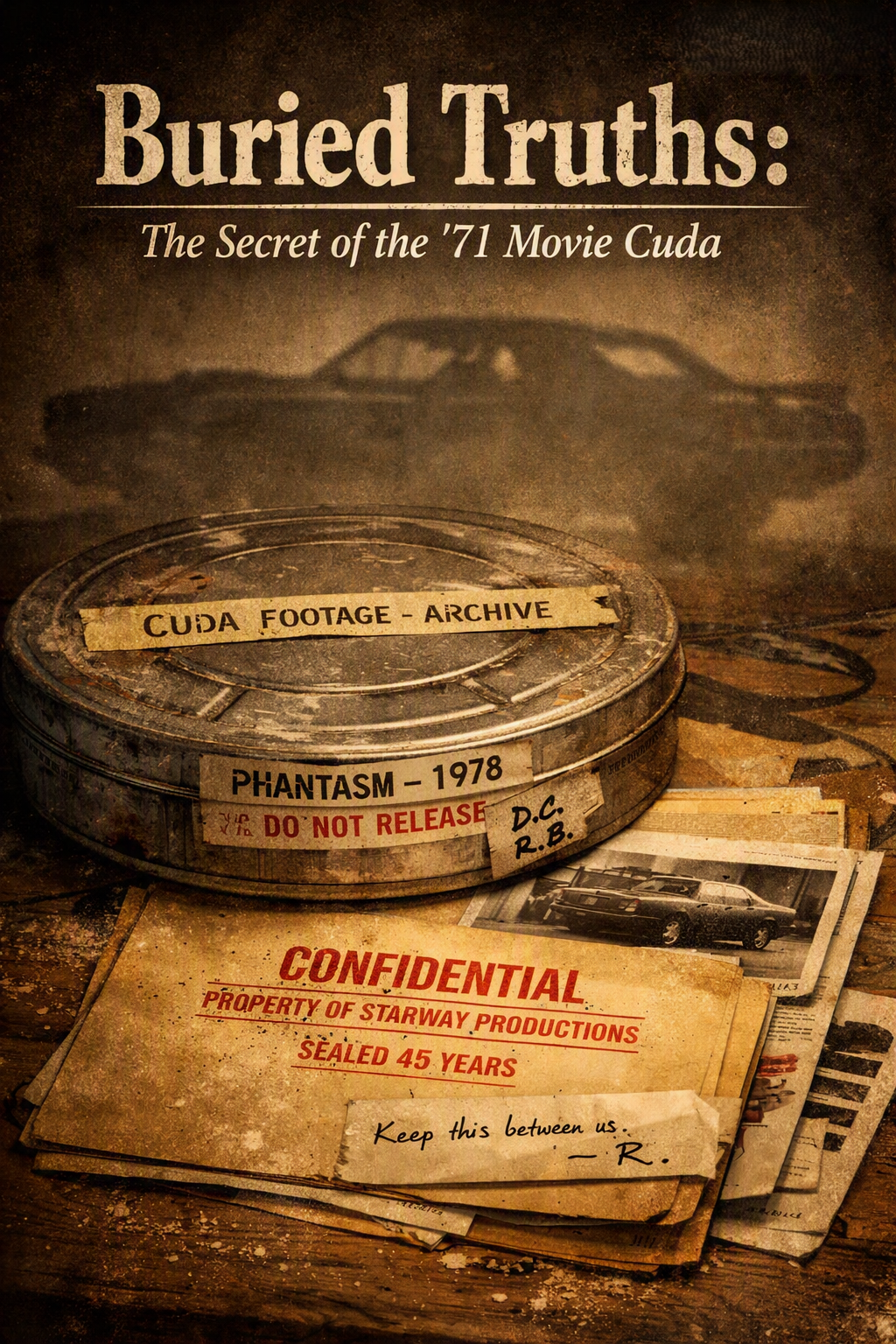
Don, for his part, played the mystery with the precision of a director who understood that the best horror is the horror you don't explain. He talked about the car with genuine affection and genuine vagueness. He said he'd lost track of it. He said the production had been chaotic and the paperwork had been a mess. He said he hoped it was still out there somewhere.
He said it with a straight face for forty-five years.
Because the secret wasn't just about protecting a car. It was about protecting a story. The most Phantasm thing Don Coscarelli had ever done wasn't a scene in any of the five films — it was this: hiding the most famous muscle car in horror film history in plain sight, inside a studio that had been using it as a background vehicle, and waiting for someone to care enough to look.
The original Cuda was never lost.
It was saved. Deliberately, carefully, with the patience of a man who knew exactly what he was building toward.
Because the last Phantasm film hasn't been made yet.
And when it is — when the final chapter of the story that began on Kanan Road in 1977 is finally put on screen — the car that started it all will be there.
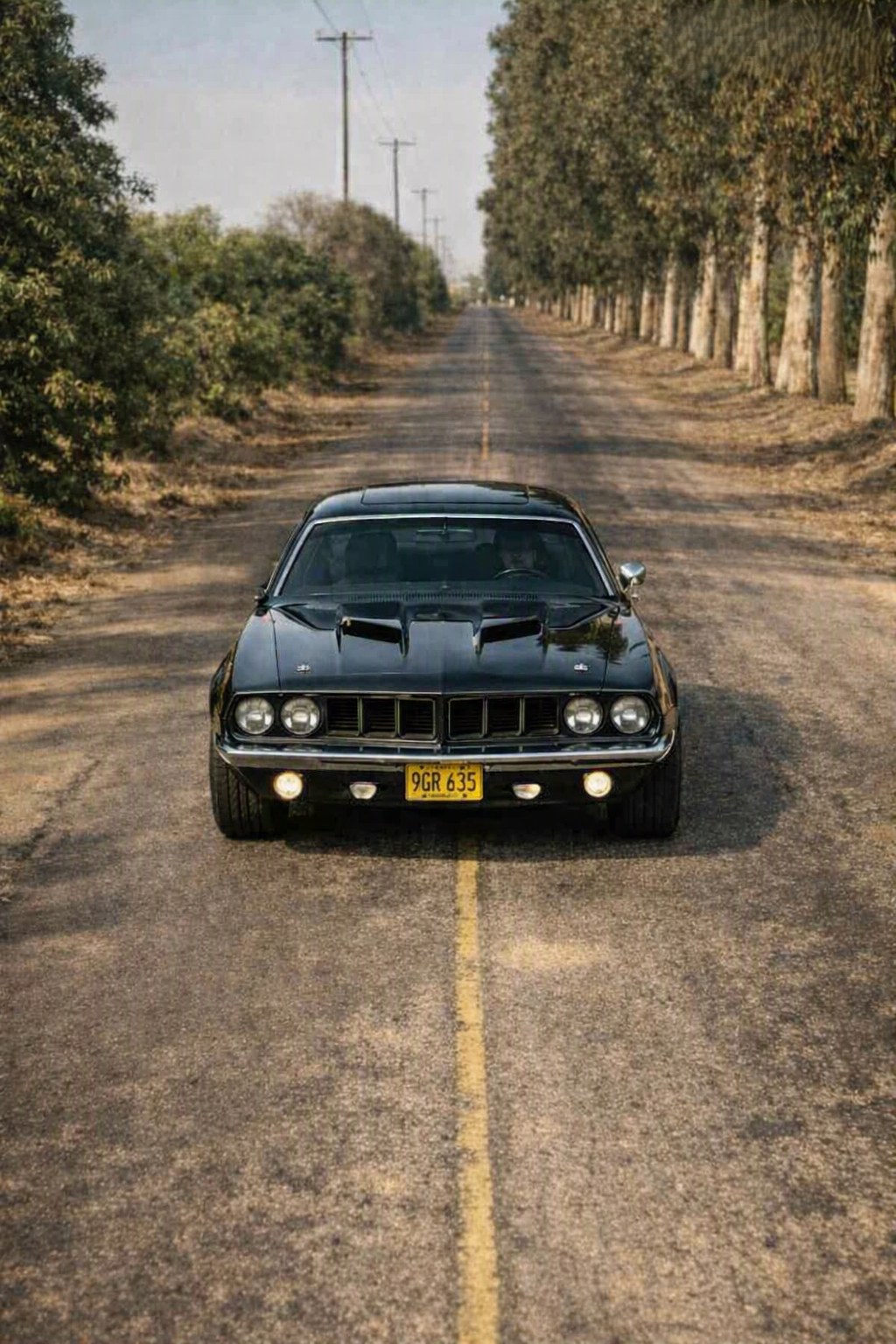
Black. Restored. Every detail intact.
The original.
Coming home.
Phantasm VI: The Last Awakening — Energy Edition
Don Thomas Almeido has spent decades at the intersection of motorsports, film, and myth‑driven storytelling. A lifelong enthusiast of performance machines and the culture surrounding them, he approaches every project with a journalist's discipline and a filmmaker's instinct for atmosphere, pacing, and visual truth.
His work is shaped by the dream‑logic worlds of cult cinema — especially the Phantasm universe, whose desert horizons, chrome echoes, and haunting sense of legacy have followed him since youth. That influence threads quietly through his writing, not as imitation, but as a reverent continuation of the mood, mystery, and emotional gravity that defined the original films.
In Phantasm VI: The Last Awakening, Don brings together everything he's lived: motorsports precision, cinematic storytelling, and the deep respect of a fan who never let the saga fade. His work honors the machines, the people who build them, and the stories that linger long after the engine goes silent.
"The Phantasm Cuda lived in my imagination long before I ever found it in the real world — and that's where this archive begins."
The Last Awakening
The Last Awakening presents one possible fate for the Missing Phantasm 'Cuda. Through a blend of documented history, unanswered questions, and imaginative storytelling, the novel explores what might have happened to the legendary movie car after it vanished from public view.
But fiction is only one possibility. The real-world investigation remains open — and after decades of searching, no definitive evidence has surfaced to reveal the vehicle's true fate.
Leading Theories
Over the years, several theories have emerged. Some are hopeful. Others are heartbreaking. All remain possible until proven otherwise. Explore the leading theories and decide for yourself.